BREAKING: U.S. B-2s Hit Iran Again; Tehran Burns; IDF Pounds Hezbollah in Beirut | TBN Israel
YouTube · T6-RRmP_5Bc
Quick Read
Summary
Takeaways
- ❖US B2 bombers are conducting extensive strikes, dropping dozens of 2,000-pound bunker-busting bombs on buried ballistic missile facilities in Iran.
- ❖Over 30 Iranian naval vessels, including a significant drone carrier, have been destroyed or sunk, with the US claiming 'full control of the sea and in the air'.
- ❖The military campaign has shifted to 'grinding down' Iran's military industries, targeting factories producing engines, explosives, and components for missiles and drones.
- ❖Iranian Revolutionary Guard soldiers are reportedly afraid to launch missiles, viewing it as a 'suicide mission,' leading to a 90% drop in launch capabilities against Israel.
- ❖Tehran is experiencing power outages, communication disruptions, and state broadcasting has moved to backup stations, indicating significant internal pressure on the regime.
- ❖US and Israeli leaders are explicitly discussing 'regime change' in Iran, with Trump reportedly having 'names in mind for good leaders' for a post-Ayatollah Iran.
Insights
1Escalation to Military Industry Disablement
The US and Israeli military campaign has moved beyond targeting active missile launchers and headquarters to a systematic effort to dismantle Iran's entire military-industrial complex. This includes striking factories that produce engines, aluminum, explosives, and every component in the value chain of missiles and drones, aiming to accelerate economic collapse and prevent replenishment of stockpiles.
The commander of CENTCOM announced 'thousands of new targets' focused on 'grinding down the military industries' (). Secretary of War Pete Hegstach stated, 'We will dismantle Iran's production' ().
2Naval Power Crippled and Air Dominance Achieved
The US military has destroyed over 30 Iranian naval vessels, including a 'crown jewel' drone carrier, which was a significant vessel capable of carrying up to 60 drones. This action, combined with continuous air strikes, has resulted in the US and Israel achieving 'full control of the sea and in the air' in the region, severely limiting Iran's ability to project naval threats.
CENTCOM Commander stated 'more than 30 ships of the Iranian Navy were destroyed' and the 'Iranian drone carrier was also destroyed in the middle of the sea' (). The drone carrier, launched in February 2025, was described as 'the crown jewel of the Revolutionary Guards fleet' ().
3Psychological Warfare and Internal Regime Instability
The intense military pressure is creating significant internal panic and psychological impact within Iran. Revolutionary Guard soldiers are reportedly afraid to launch missiles, calling it a 'suicide mission,' leading to a 90% drop in launch capabilities. Tehran is experiencing widespread power outages and communication disruptions, and senior officials are reportedly moving in disguise, indicating a regime under severe internal stress and fear of public identification.
Revolutionary Guard soldiers are 'afraid to launch missiles at Israel' and call it a 'suicide mission' (, ). Testimonies describe 'powerful bombings, parts of the city without electricity, communication disruptions' in Tehran ().
4Geopolitical Ripple Effect and Global Power Shift
The conflict in Iran is framed as a pivotal moment in a broader 'cold war' between the 'Chinese block versus the American block,' or 'eastern non-democratic versus the western democratic block.' The outcome is expected to provide a clear image of who is 'coming out on top' for the next 10-20 years, influencing other global conflicts and power dynamics, such as those in Taiwan and Ukraine.
Mati Shashani states, 'What we're witnessing right now is the beginning of a cold war which is the let's call it the the Chinese block versus the American block' (). He adds, 'The ripple effect influences Taiwan. it influences the war in the Ukraine' ().
5Explicit Goal of Regime Change
Both Israeli and US (Trump administration) officials are openly articulating the objective of removing the Ayatollah regime in Iran. The US is actively preparing for a 'day after' scenario, with Trump stating he has 'names in mind for good leaders for Iran' and appealing directly to Revolutionary Guard personnel to defect and receive immunity.
The Israeli government's 'expectation from day one' is to 'remove the Ayatollah regime' (). Trump 'publicly stated... we're going to come and help you' to the Iranian people (). Trump 'has names in mind for good leaders for Iran' and called on Revolutionary Guards to 'lay down their weapons' and 'receive immunity' (, ).
Bottom Line
Abu Dhabi is considering freezing billions of dollars in Iranian assets and seizing ships from Iran's shadow fleet, aiming to choke Iran's economic pipelines into the global economy.
This move would complement military strikes with severe economic pressure, potentially accelerating the regime's collapse by cutting off critical financial lifelines and trade routes.
Post-regime change, there could be significant opportunities for new economic partnerships and investments in a rebuilt Iran, potentially integrating it into regional economic blocs like the Abraham Accords.
The war in Iran is already projecting outward into European cities, with Iranian individuals arrested in London for spying on Jewish communities and Europol warning of immediate consequences like terror, cyber attacks, and extreme actions by Iran-aligned groups.
The conflict's scope is not confined to the Middle East; it directly impacts global security, necessitating heightened vigilance and counter-terrorism measures in Western nations.
Increased demand for advanced cybersecurity, intelligence gathering, and counter-terrorism technologies and services across Europe and other regions facing potential Iranian-backed threats.
Lessons
- Monitor the geopolitical landscape for signs of internal uprising in Iran and the effectiveness of economic pressures from Gulf States, as these are critical indicators of regime stability.
- Assess the potential for increased global security threats, particularly in Europe, due to Iranian proxies or retaliatory actions, and consider implications for travel and business security.
- Understand that the stated objective of the US and Israeli campaign is fundamental regime change, which implies a prolonged and potentially destabilizing period for the region.
- Engage in prayer for the people of Iran, Israel, and for a swift, decisive resolution to the conflict, as advocated by the podcast hosts.
Notable Moments
US CENTCOM Commander Admiral Brad Cooper and American Secretary of War Pete Hegstach held a press conference to detail the successes of 'Operation Epic Fury' and outline the next phase of the campaign.
This marked a significant public announcement of the scale and strategic direction of the US involvement, providing official confirmation of deep strikes and the shift towards dismantling Iran's industrial base.
Reports indicate that Iranian state broadcasting has moved from the capital to backup stations, and senior officials are attempting to move through Tehran in disguise.
These events signify a severe threat to the regime's central command and control, indicating deep internal panic and a tangible threat to its operational continuity and leadership security.
Quotes
"We have no shortage of munitions. We can continue this campaign for as long as required... We will dismantle Iran's production."
"Every time they try to launch a missile, the launcher is destroyed within four minutes."
Q&A
Recent Questions
Related Episodes

Patrick Henningsen: Hezbollah JUST Fired Back at Israel - Iran Vows to “Crush” All Attacks
"Patrick Henningsen argues that the US and Israel initiated an illegal war against Iran, driven by Trump's incompetence and Israeli influence, leading to an inevitable escalation with severe global economic repercussions."
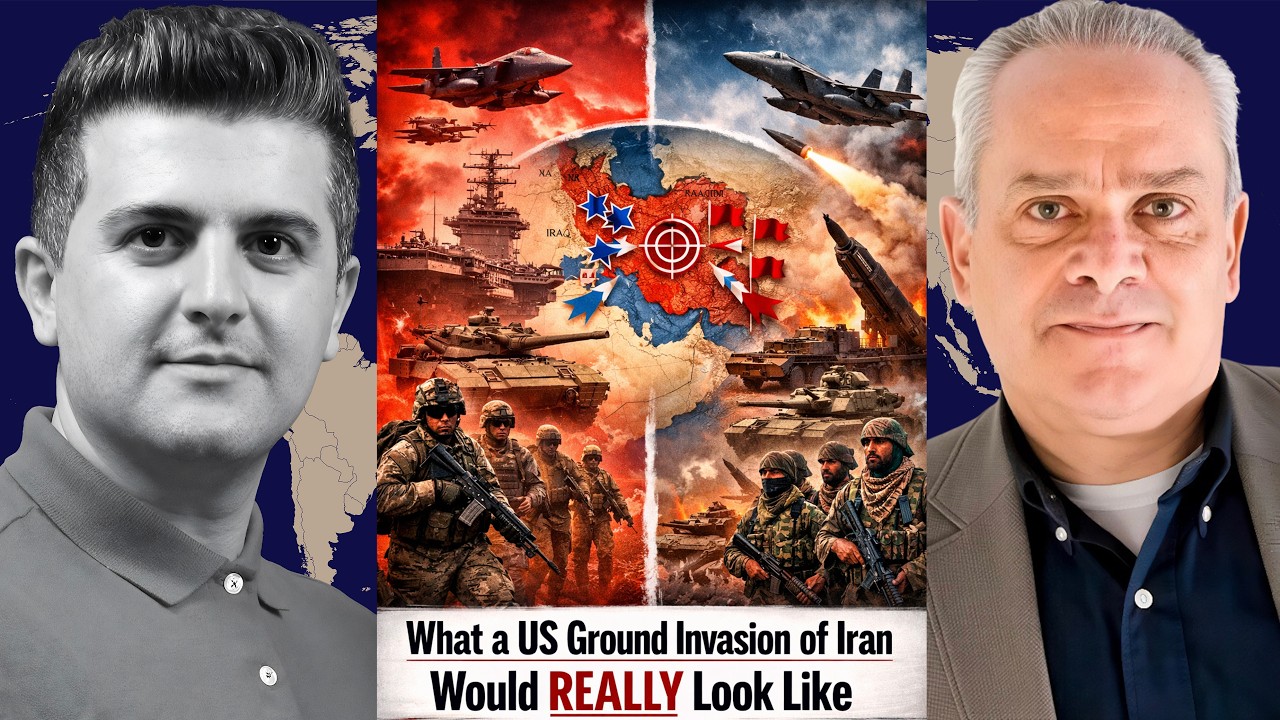
Col. Jacques Baud: What a US Ground Invasion of Iran Would REALLY Look Like
"Colonel Jacques Baud dissects the strategic futility of a US ground invasion of Iran, arguing that current troop levels are insufficient and such an action would backfire, exposing US allies and potentially leading to Iran's nuclearization."

Alex Krainer: US STRIKES Iran – Iran RETALIATES Against Kuwait, Bahrain & Jordan!
"Amidst escalating US-Iran conflict and Iranian retaliation against regional US allies, this episode argues that US foreign policy is deeply controlled by an 'Anglo-Zionist conspiracy' led by the Rothschild banking dynasty, prioritizing Israeli interests over American ones."

Pentagon Prepares For EXTENDED War With Iran
"This episode dissects the geopolitical maneuvers surrounding potential US-Iran conflict, revealing strategic leaks, Netanyahu's diplomatic sabotage playbook, and the true intent behind economic sanctions."