David Frum: The GOP Didn’t Drift Into Trumpism—It Chose It | How to Fix It
YouTube · TbDmtG8cTvI
Quick Read
Summary
Takeaways
- ❖Trumpism deliberately merged populist appeals (like Medicare/Medicaid support) with racism, corruption, and authoritarianism, a path Frum sought to prevent.
- ❖Trump's administration marked an unprecedented shift from traditional political favor-selling to direct personal enrichment, potentially totaling billions.
- ❖US allies are increasingly adopting transactional foreign policies and seeking alternative partnerships (e.g., Canada with China) due to perceived American unreliability.
Insights
1The GOP's Deliberate Embrace of Trumpism
David Frum, a former Bush speechwriter, details his efforts to promote a less ideological Republicanism focused on issues like healthcare and the environment. He notes the bitter irony that Donald Trump and Steve Bannon adopted a similar 'less ideological' stance, but fused it with racism, corruption, and authoritarianism. Frum states he recognized this trajectory and aimed to stop it, not join it.
Frum recounts his post-2003 shift towards a more effective republicanism, focusing on quality-of-life issues and social insurance after the 2008 financial crisis. He then states, 'what was I the bitter irony of all this was while I was arguing for for a less ideological Republicanism, you know who's having the same idea? Donald Trump and Steve Bannon... And what we're going to do is fuse that with racism, corruption, authoritarianism.'
2Unprecedented Personal Corruption Under Trump
The host and Frum assert that Trump fundamentally altered American political corruption by converting traditional favor-selling (which typically funds campaigns) into direct personal wealth. Examples include Trump staying in his own hotels and charging the Secret Service, and Mike Pence being directed to stay in Trump properties. Estimates suggest this personal enrichment could range from millions in his first term to billions in a potential second, often involving foreign entities.
Frum explains, 'Trump really changed things is he took the the the favor selling that has been a traditional part of American politics, but he converted it not into campaign funds, but into personal wealth in his first term.' He cites estimates from The New York Times and The New Yorker of 'more than 1 billion' to 'as much as four billion' in personal wealth.
3Erosion of US Alliances and the Rise of Transactional Foreign Policy
The perceived unreliability of the United States under Trump has forced allies to develop contingency plans and engage in more transactional relationships. Canada's decision to drop tariffs on Chinese EVs in exchange for relief from Chinese agricultural tariffs, despite US requests for solidarity, exemplifies this shift. Allies are no longer confident in US leadership and are prioritizing their own immediate interests.
Frum details Canada's situation: 'My agricultural exports are suffering because of my solidarity with you to protect an uh an EV industry in which we don't fully participate and which you say you want to take away all of from anyway. Why are we making our farmers suffer? So, the deal that Carney struck was uh he dropped the tariffs on Chinese EVs in return for relief from the Chinese tariffs on Canadian agricultural exports.' He concludes, 'Every American ally is saying we have to have contingency plans for an America that twice, not once, twice showed it's not to be trusted.'
4Trump's 'Zones of Influence' Strategy: A Retreat, Not Isolationism
Frum clarifies that Trump's foreign policy is not traditional isolationism but a 'thuggish might make right hemispheric dominance play,' characterized by a 'zones of influence and domination' approach. This means the US would dominate its immediate region (Greenland to northern South America) while conceding other global spheres to rival powers, representing a strategic retreat from the long-standing American principle of not accepting spheres of influence globally.
Frum states, 'That's the big Trump idea is not isolationism, but a kind of zones of influence and domination.' He adds, 'We're going to uh dominate Greenland. We're going to dominate Panama. We're going to subjugate Canada. We're going to subjugate Mexico. And then the rest and Venezuela. So like the northern literal of the um South America to Greenland. That's going to be ours. The rest belongs to somebody else. It's a strategy of retreat.'
Bottom Line
The US's historical position as one of the more corrupt 'pure democracies' (compared to Western European nations) provided a fertile ground for Trump's unique brand of personal enrichment.
This suggests that systemic vulnerabilities in American governance, such as a weaker civil service and a more independent, campaign-finance-driven legislature, made the country susceptible to a leader who would exploit these gaps for personal gain, rather than just campaign funds.
Reforms targeting campaign finance, strengthening civil service protections, and enhancing transparency around presidential family finances could address these deep-seated structural issues, making future administrations less vulnerable to similar abuses.
The 'SAVE act,' proposed by Republicans to require an American passport for voting, is an old-fashioned tactic that misjudges the current political landscape. Passport holders (more affluent, global, educated) are increasingly not Republican voters.
This reveals a disconnect in Republican strategy, where assumptions about voter demographics are outdated. Policies designed to suppress certain voter segments might inadvertently disenfranchise potential allies or fail to target actual opposition effectively.
For Democrats, this highlights an opportunity to mobilize and engage the 'passport-holding' demographic, emphasizing policies that appeal to educated, globally-minded citizens. For Republicans, it suggests a need to re-evaluate voter identification strategies to align with current demographic realities and avoid alienating potential supporters.
Key Concepts
AI as a Mirror, Not a Window
David Frum describes AI as a tool that reflects and sharpens one's own thinking rather than providing external, objective truth. It's useful for intellectual tennis to refine ideas, but not as a substitute for original thought, as it merely mirrors the user's input and prompts.
History Never Repeats Itself, It Only Appears to Do So to Those Who Don't Pay Attention to the Details
This historical principle emphasizes that while situations may seem similar across different eras, the specific details and contexts are always unique. Therefore, one should avoid simplistic parallels and instead focus on the nuanced realities of the present, drawing inspiration from past generations' courage rather than expecting identical solutions.
Lessons
- Future administrations must prioritize accountability for corruption, using tools like the Global Magnitzky Act against foreign entities and pursuing legal action against American participants, rather than seeking to 'normalize' past abuses.
- Implement reforms requiring presidential family members who accept Secret Service protection to disclose their tax returns, ensuring transparency and preventing the use of official benefits for private enrichment.
- Democratic politicians should focus on common-sense issues that resonate with a broad electorate, such as securing borders, ensuring criminals face consequences, and supporting wealth creation, rather than being drawn into 'boutique issues' by extreme factions.
Notable Moments
Frum's personal journey from traditional Republicanism to realizing Trumpism's dangerous fusion of populism with racism and authoritarianism.
This narrative provides a firsthand account of the ideological shift within the GOP, highlighting how a seemingly 'less ideological' approach was weaponized for illiberal ends.
The discussion on how Trump's corruption differs from historical American political corruption, moving from campaign finance to direct personal wealth.
This distinction is critical for understanding the unprecedented nature of recent corruption and the challenges in holding it accountable, as existing legal frameworks may not fully address this new form of abuse.
The historical perspective that 'less is asked of us' today than of past generations who faced civil war, depression, and world wars, urging courage over despair.
This serves as a powerful call to action and a source of hope, reminding listeners that current challenges, while significant, are surmountable if approached with the same resolve as predecessors.
Quotes
"While I was arguing for for a less ideological Republicanism, you know who's having the same idea? Donald Trump and Steve Bannon. Uh they were also saying we need a less ide we need less Paul Ryan, more we need Yeah. We we need to Medicare. We need Medicaid. Right. And what we're going to do is fuse that with racism, corruption, authoritarianism."
"I was saying those things not to help you, but to stop you. I saw you coming. And I and the only way we're going to stop you is if we have a more effective kind of conservatism."
"If you just remember that you're talking to yourself, it can be quite a useful tool... it is a tool for think if I used it as a tool for thinking with I could make my own thinking more sharp. But I certainly wouldn't want to use it as a substitute for my own thinking because um it's it's you know in a funny way it's not really there. It's a mirror. It's not a window."
"The core American idea has always been the United States does not accept spheres of influence... The whole point to Trump is to say, you know what, we don't care. We are retreating within our own little zone. We're going to uh dominate Greenland. We're going to dominate Panama. We're going to subjugate Canada. We're going to subjugate Mexico... The rest belongs to somebody else. It's a strategy of retreat."
"However dark you think the times are today, they have been darker... So so much less is asked of us than was asked of people in the past that it really would be a sin to give into any kind of cowardice or despair."
Q&A
Recent Questions
Related Episodes

Trump Panics As Own Lawyers Turn Against Him Over War
"Donald Trump faces scrutiny from his own Justice Department over alleged insider trading in oil markets tied to Iran war announcements, highlighting broader issues of political corruption and economic destabilization for profit."

Sen. Kaine Forces Vote on Iran War Powers Resolution
"Senator Tim Kaine details his persistent, decade-long fight to compel Congress to vote on acts of war, specifically highlighting his current War Powers Resolution concerning Iran and the historical reluctance of legislators to take a definitive stance on military engagements."

Iran Deal Skepticism. Whoopi Vs Vance. Potomac Park Invasion. Racist Hurls Slurs At Black Boy.
"This episode dissects multiple instances of alleged anti-Black policies and racial injustice, from the Trump administration's legal challenges to reparations and the Iran deal, to police brutality and the erasure of Black history."
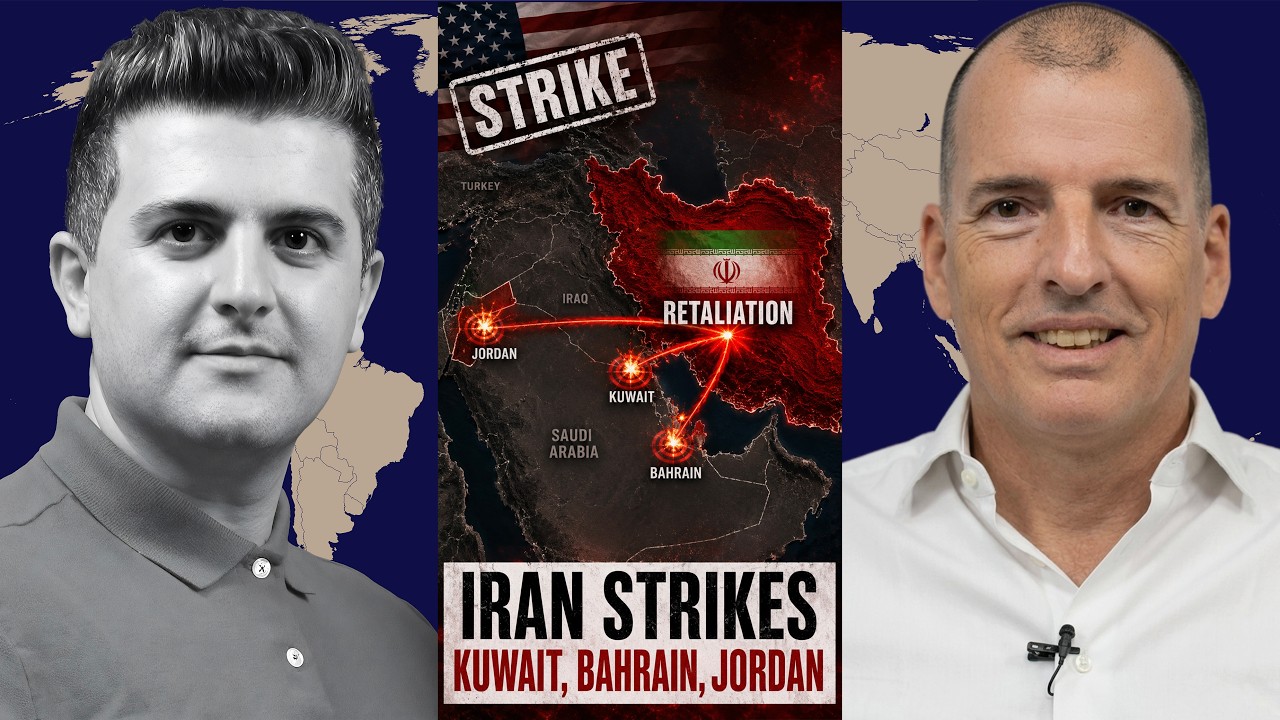
Alex Krainer: US STRIKES Iran – Iran RETALIATES Against Kuwait, Bahrain & Jordan!
"Amidst escalating US-Iran conflict and Iranian retaliation against regional US allies, this episode argues that US foreign policy is deeply controlled by an 'Anglo-Zionist conspiracy' led by the Rothschild banking dynasty, prioritizing Israeli interests over American ones."