Mindscape Ask Me Anything, Sean Carroll | April 2026
YouTube · Tvt7MNyeH84
Quick Read
Summary
Takeaways
- ❖The "structure problem" in Many-Worlds asks how classical objects emerge from the quantum wave function.
- ❖Dan Brown's writing style prioritizes "narrative velocity" over scientific or narrative accuracy.
- ❖Quantum descriptions of macroscopic objects are static and smeared, not "shimmering and swirling."
- ❖Edward Witten's critique of Many-Worlds is an epistemological question about "knowing," not a quantum mechanics flaw.
- ❖Resisting authoritarianism is complex, influenced by individual circumstances and the non-ideal nature of societal change.
- ❖Decoherence explains the emergence of classical "pointer states" in quantum mechanics.
- ❖Jurgen Habermas's "communicative action" and "system-lifeworld distinction" offer frameworks for social and political philosophy.
- ❖The value of college extends beyond financial gain to personal development, though cost remains a significant factor.
- ❖Different space telescopes (JWST, Nancy Grace Roman) serve distinct scientific missions (deep-field vs. wide-field surveys).
- ❖Host maintains low Bayesian priors for alien UAPs due to lack of peer-reviewed evidence and implausible scenarios.
- ❖US foreign policy in Iran is critiqued as tragic, counterproductive, and driven by "idiots" with poor motivations.
- ❖Loop Quantum Gravity is a sensible but likely unsuccessful attempt to quantize general relativity, lacking mechanisms for high-energy regularization.
- ❖Junior researchers should prioritize tenure before extensive public outreach due to academic leverage.
- ❖The Schrödinger equation's initial success was in predicting atomic energy spectra, even before the Born rule.
- ❖First-time authors need a unique "angle" to differentiate their work in crowded topics.
- ❖Boltzmann brain amplitudes are not suppressed by basis selection; solutions lie in cosmic dynamics.
- ❖Light cannot escape black holes because the event horizon itself moves outward at the speed of light.
- ❖Finite entropy regions in de Sitter space would lead to Boltzmann brains unless connected to an infinite external Hilbert space.
- ❖Simple martini recipes are often best; complex additions can disrupt delicate flavors.
- ❖On Earth's surface, we are constantly accelerating at 1g relative to a free-fall trajectory.
- ❖Electron double-slit experiments require extreme isolation to prevent decoherence.
- ❖Life is conjectured to be impossible in conformal field theories due to the absence of a fixed scale for biological entities.
- ❖Photons do not "experience" time; their proper time interval is zero.
- ❖Time crystals are systems whose lowest energy state exhibits periodic motion.
- ❖The Electoral College should be jettisoned for being undemocratic and ineffective in its stated purpose.
- ❖Scientists should advocate their views, with most blame for public distrust falling on bad-faith actors.
- ❖The best theory for the observed universe might imply unobservable realities (like a multiverse).
- ❖The Wheeler-DeWitt equation highlights the "problem of time" in quantum gravity.
- ❖Future generations may view current electoral systems and extreme income inequality as barbaric.
- ❖Moral constructivism does not weaken commitment to ideals; it clarifies their human origin.
- ❖Eternalism means all moments of time are equally real, not that the past "still exists now."
- ❖"Quantum information" refers to the data needed to specify a quantum state, and its conservation is a key principle.
- ❖Macroscopic coarse-graining works due to specific physical properties (like locality) that allow for predictive emergent patterns.
- ❖Mispronunciations of foreign names are generally not a concern for effective communication.
- ❖Entangling a tardigrade's magnetic state is not equivalent to putting it in a spatial superposition for a double-slit experiment.
- ❖The "expansion of space" is not a velocity and cannot be "faster than light."
- ❖Lagrangian and Hamiltonian formalisms are mathematically equivalent.
- ❖Gauge potentials have real, often global, physical consequences beyond their local derivatives.
- ❖Heisenberg's knowledge of GR or matrix calculus is a historical question, but GR was still new when he developed QM.
- ❖Bayesianism defines probability as a degree of belief, while frequentism defines it as long-run frequency.
- ❖Observing non-local effects would be a dramatic violation of quantum field theory.
Insights
1Many-Worlds Interpretation: The Structure Problem
The Many-Worlds Interpretation (MWI) of quantum mechanics faces a significant challenge in explaining how the classical world, with its distinct objects and properties, emerges from the fundamental quantum state, which is described as a vector in an abstract Hilbert space. This is known as the "structure problem." While the "probability problem" (how probabilities arise in a deterministic theory) is largely considered solved, the emergence of classical "structure" remains a fuzzy area of research.
Sean Carroll states, "The other one [problem] which I think is a real question that I think is fascinating and I'm devoting my research energies to trying to study is the problem of structure... That mathematical object by itself doesn't have any way of saying well this part of the universe is a planet and this part is a star and this part is a puppy dog or whatever. It's just a vector pointing in some direction in some giant direct dimensional space."
2The Purpose of Science Communication and Fiction
The host argues that the "accuracy" of science in fiction is often secondary to its narrative purpose. He uses Dan Brown's popular novels as an example, noting how Brown sacrifices logical consistency and scientific accuracy for "narrative velocity"—the compelling speed at which the reader is pulled through the story. This highlights that people consume content for different reasons, and judging fiction solely on scientific precision misses its primary goal of entertainment or storytelling.
Carroll references Anthony Doerr's critique of The Da Vinci Code's logical inconsistencies, then states, "nobody cares. Like maybe you care... But clearly there are plenty of people who don't care because Dan Brown sells billions of books... Dan Brown sacrifices everything for narrative velocity, the speed with which you're pulled through the text."
3Value of Higher Education Beyond Economics
While acknowledging the increasing financial variance in college outcomes, Carroll emphasizes that the primary value of a university education lies not just in economic returns (higher income, better job) but in fostering personal growth and becoming a "better human being." He views college as a "lifeworld" experience focused on ideas, learning, and critical thinking, rather than solely a "system" for acquiring skills.
Carroll states, "my major point... is that it's worth it not because it gets you a higher income but because it makes you a better human being... there's a lot of tools and resources that are there in the four years of undergraduate college experience that are almost irreplaceable elsewhere and that are super duper useful for becoming a better person if that's what you want to do."
4Distinct Missions of Space Telescopes
Different space telescopes are designed for specific scientific objectives, necessitating varied capabilities. The James Webb Space Telescope (JWST) has a narrow field of view, optimized for observing very distant and faint objects like early galaxies and exoplanets. In contrast, the upcoming Nancy Grace Roman Space Telescope will have a wide field of view, making it ideal for large-scale surveys of the relatively nearby universe, studying phenomena like supernovae and the overall cosmic structure (e.g., Hubble tension).
Carroll explains, "JWST has a narrow field of view and Nancy Grace Roman has a wide field of view... If what you're interested in is things that are very far away and very dim, then something like James Web... is what you want... If you have a very wide field of view then what you can do you're not going to see very deep... What you're going to see are many many things in the relatively nearby universe."
5Critique of US Foreign Policy in Iran
Carroll expresses strong disapproval of the US-Israeli actions in Iran, labeling them "tragic" and serving "literally no one's interests." He criticizes US decision-makers as "idiots" driven by "bad motivations" and highlights the counterproductive nature of interventions, such as the unilateral withdrawal from the Iran nuclear treaty. He argues that such actions ironically strengthen the current Iranian regime and destabilize global supply lines.
Carroll states, "The Iran debacle is especially bad because it serves literally no one's interests... the people who are making the decisions are idiots. They do not know what they're doing. They're very very stupid. They have very bad motivations... We already had a treaty in place that was preventing Iran from doing that. And Donald Trump... left the treaty unilaterally."
6The Electoral College as a "Barbarian" Anachronism
Carroll advocates for jettisoning the Electoral College, deeming it a "terrible idea" and a "pointless anachronism." He refutes the common justification that it protects smaller states, arguing that presidential candidates instead focus campaigning efforts on a small number of "swing states," effectively ignoring both small non-swing states and large non-swing states. This system leads to unequal representation where not every vote counts equally, which he considers fundamentally unfair and outdated.
Carroll states, "My thoughts are it needs to be jettisoned. I think the electoral college is a terrible idea... Small states like Wyoming has very few electoral votes. How much time do presidential candidates spend campaigning in Wyoming? Zero... What matters is the small number of swing states... that is wildly unfair to the rest of the country."
Lessons
- For aspiring authors on well-covered topics: Develop a unique "angle" or a substantively different approach to your subject matter to stand out.
- For individuals considering higher education: Evaluate colleges based on their potential for personal growth and intellectual development, not solely on perceived prestige or immediate financial returns, and consider less expensive options.
- For citizens concerned about political systems: Critically examine electoral mechanisms like the Electoral College and advocate for reforms that ensure every vote counts equally and encourage broader representation.
Quotes
"physics can be an escape from the difficulties of the human realm."
"Escape is important. Escape is part of the balance of a well-lived life."
"Dan Brown sacrifices everything for narrative velocity, the speed with which you're pulled through the text."
"The Iran debacle is especially bad because it serves literally no one's interests."
"The electoral college just doesn't do the job that it was described to do."
Q&A
Recent Questions
Related Episodes
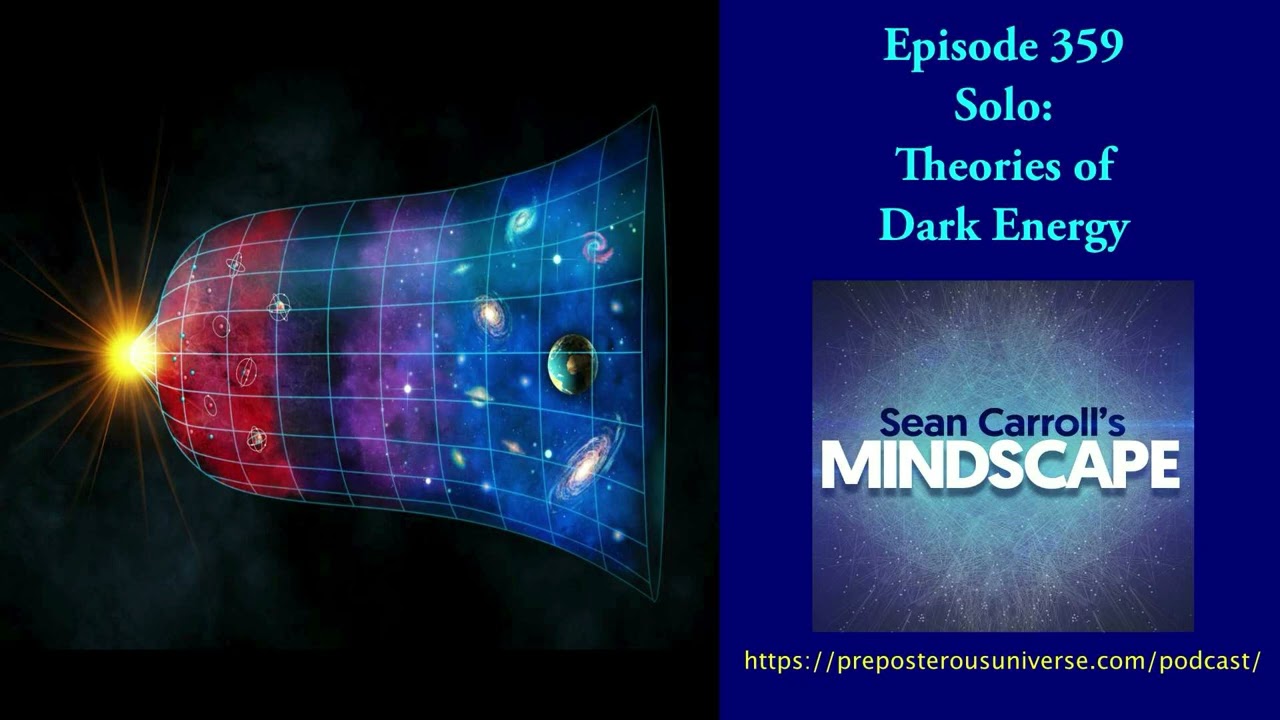
Solo: Theories of Dark Energy | Mindscape 359
"Sean Carroll explores the theoretical landscape of dark energy, dissecting dynamical models like quintessence and phantom energy, and modified gravity, while reflecting on their naturalness, experimental implications, and his personal contributions to the field."

Solo: Vacuum Energy and the Cosmological Constant | Mindscape 358
"Explore the perplexing history and current challenges of the cosmological constant, from Einstein's initial 'blunder' to the modern 10^122 discrepancy and its profound implications for the universe's past and future."

Jeff Coller on mRNA, Vaccines, and Bespoke Therapeutics | Mindscape 357
"mRNA technology, rapidly deployed for COVID-19 vaccines, is poised to revolutionize medicine by enabling rapid, personalized therapies for genetic diseases and cancer, but faces significant delivery and regulatory challenges."
Andrea Wulf on Enlightenment, Nature, Romanticism, and Modernity | Mindscape 356
"Historian Andrea Wulf explores how 18th-century thinkers like Georg Forster, Alexander von Humboldt, and the Jena Circle fundamentally reshaped our understanding of nature, humanity, and the individual, laying the groundwork for modernity and environmentalism."