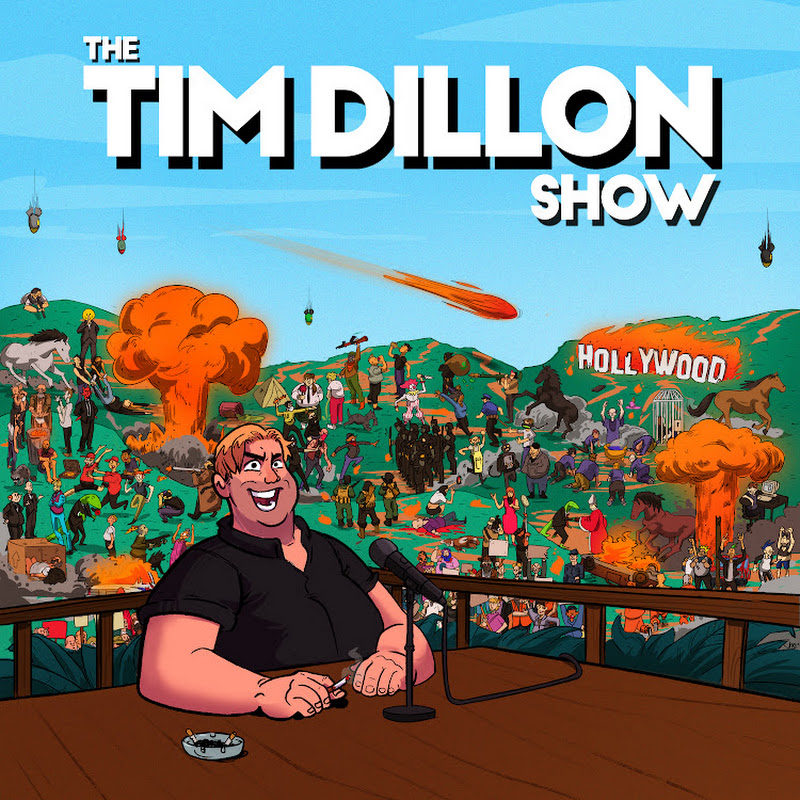
Iran, Looksmaxxing, & The Rapture | The Tim Dillon Show #487
YouTube · VHPtrudNv3Y
Quick Read
Summary
Takeaways
- ❖The US approach to Iran is satirically depicted as a 'victory' despite escalating conflict and casualties, driven by a desire to 'go home' and a new leader who may be more aggressive.
- ❖Dillon criticizes the American public for a 'bloodlust' and apathy towards war, particularly those who cheer for conflict without understanding its implications or personal cost.
- ❖Donald Trump's endorsement of Jake Paul for political office is seen as a sign of societal decline and a 'farewell tour' for a leader who no longer cares about consequences.
- ❖The host contrasts the 'defeated' reaction of Trump rally attendees with the 'joy' of Israelis celebrating in bomb shelters, suggesting the latter are getting the war they wanted.
- ❖Dubai influencers experiencing 'trauma' from missile strikes are portrayed as receiving a taste of the violence their tax-haven lifestyle was built on.
- ❖Dillon argues that identity politics is a 'full breakdown of civil society,' fostering tribalism and sectarian conflict rather than shared values.
- ❖A global war resulting in the death of 4-6 billion people within 24 months is proposed as the 'only way' to reset society, align values, and address intractable problems like housing affordability and child exploitation.
- ❖The 'looksmaxxing' trend is presented as a final indicator of civilization's decay, signaling the cyclical end of society before a violent 'reset'.
Insights
1US Foreign Policy and Public Apathy
Dillon satirically claims the US has 'won' in Iran and should withdraw, despite ongoing military deployments and the killing of an Iranian leader's family. He argues that the American public, fueled by 'bloodlust' and a lack of understanding, cheers on these conflicts, contributing to a 'moral black hole' where violence is celebrated for its own sake, often as a means to 'own the libs.'
Dillon's commentary on the US sending warships to the Middle East while declaring victory, and his description of Americans cheering on war from their backyards without understanding its causes.
2Political Disillusionment and the 'Party's Over'
The host views Donald Trump's endorsement of Jake Paul for political office as a sign of political absurdity and a 'farewell tour' for a leader who no longer cares. He observes that attendees at Trump rallies appear 'defeated' and 'bamboozled,' realizing the 'party' is no longer about them, contrasting this with the perceived 'joy' of Israelis who are 'getting what they want' from the conflict.
Analysis of crowd reactions at a Trump rally during the Jake Paul endorsement, and comparison with footage of Israelis dancing in bomb shelters.
3Dubai Influencers and the Return of Violence
Dillon critiques Dubai influencers who express 'trauma' over missile strikes interrupting their luxurious lives in a tax haven. He frames this as the 'violence that the entire system is built on' finally visiting those who sought to escape accountability and commitment to their home nations, highlighting their shock at insecurity in their 'safe place for international criminals.'
Clips of Dubai influencers reacting to missile strikes, with Dillon's commentary on their 'eggs benedict Middle East' mentality.
4Identity Politics as Societal Decay
Dillon asserts that identity politics represents the 'full breakdown of civil society,' fostering tribalism and sectarian conflict rather than shared values. He views it as a 'path to power' for some, where immutable characteristics are leveraged for influence, leading to a 'domination game' that distracts from genuine human connection and personal stories.
Dillon's extensive monologue on identity politics being his 'least favorite thing' and its role in societal degeneration.
5The 'Global Reset' Through Mass Depopulation
Dillon provocatively argues that the only solution to humanity's current state of moral decay, identity politics, and intractable problems is a global war that eliminates 4-6 billion people within 24 months. He suggests this 'reset' would force survivors to 'get the program,' align their values, and become 'happier, wealthier, smarter, more interesting' in a post-apocalyptic, AI-controlled world.
Dillon's explicit statement that 4-6 billion people need to die in a nuclear war with China to 'get back to what matters here,' and his description of the post-war world.
Bottom Line
The current global conflicts and societal issues are not merely problems to be solved, but rather the initial stages of an intentional 'global death' and 'reset' orchestrated by unseen powers.
This perspective suggests that diplomatic solutions or incremental changes are futile, as the system is already on a predetermined path to catastrophic collapse and rebirth.
For those who believe this, the 'opportunity' would be to prepare for a post-apocalyptic world, potentially by securing resources or aligning with emerging power structures, or simply to observe the 'execution' of this plan.
The 'looksmaxxing' trend, characterized by extreme physical modification and obsession with appearance, is a definitive sign of civilization's ultimate decay, signaling the end of a societal cycle.
This implies that superficiality has reached its peak, indicating a profound lack of genuine purpose or connection, making a violent 'reset' inevitable and even necessary.
From Dillon's satirical viewpoint, this 'opportunity' is merely to recognize the 'end of civilization' and brace for the coming destruction, as attempts to 'fix' such deep-seated vanity are pointless.
Key Concepts
Moral Black Hole
Dillon uses this term to describe parts of American society where morality is absent, leading to indifference towards violence and suffering, particularly in foreign conflicts.
Identity Politics as a Path to Power
Dillon frames identity politics not as genuine advocacy but as a strategic tool used by individuals to build power bases and attain influence through tribal alignment rather than shared universal values.
The Cyclical Collapse of Civilization
Dillon suggests that society repeatedly reaches a point of extreme superficiality, disillusionment, and moral decay (symbolized by 'looksmaxxing' and political absurdity), leading to an inevitable global conflict and depopulation, only to restart the cycle.
Lessons
- Critically examine the narratives surrounding foreign conflicts and question the motivations of those who advocate for war, especially when public understanding is limited.
- Reflect on personal and societal values, considering whether current trends like identity politics or superficial pursuits genuinely contribute to a cohesive and meaningful society.
- Recognize the potential for extreme cynicism and apocalyptic thinking to emerge as responses to perceived societal decay, and consider the underlying frustrations driving such perspectives.
Notable Moments
Dillon's satirical 'bullish' stance on the new Iranian leader, despite US actions against his family, highlighting the absurdity of political narratives.
This sets the tone for the episode's cynical critique of international relations and the disconnect between rhetoric and reality.
The comparison of 'defeated' Trump rally crowds with 'dancing' Israelis in bomb shelters, illustrating a stark contrast in perceived agency and satisfaction with global events.
This moment underscores Dillon's argument about who truly benefits from conflicts and the disillusionment of the average citizen.
The segment on Dubai influencers complaining about missile strikes, framed as the 'violence the system is built on' finally reaching those who thought they were immune.
This serves as a pointed critique of global elites and tax havens, suggesting that no one is truly safe from the consequences of a morally compromised world.
The 'looksmaxxing' video, presented as the ultimate symbol of societal decay and the final stage before an inevitable global 'reset.'
This visual and thematic climax encapsulates Dillon's argument about the superficiality and meaninglessness that precedes civilization's collapse.
Quotes
"The suburban American has a blood lust that is absolutely insatiable. Nothing is enough for these people."
"This is the war that Israel wanted. They wanted Iran gone. And so, so whereas you have the people in Kentucky that are kind of, you know, just standing there... the joy is draining from their face in Kentucky because it's not about them and they know that."
"It is the only shot you have at a good life right now is to hasten the rapture. That is right now the foreign and economic policy of our country currently right now is the rapture."
"The type of violence that the entire system is built on is now somehow coming back and visiting these people. And they're shocked."
"In order to kind of reverse the tide and get people to remember what is important, we have to have a world war where we eliminate 3.5 billion people."
"After everyone gets their shit rocked, people tend not to scream and yell about what they can post on the internet. They really forget about all that stuff."
Q&A
Recent Questions
Related Episodes

🚨 LEFTISTS ARE F*CKING SEETHING 😂😂😂
"The host aggressively celebrates perceived 'wins' for the right-wing, from global conflicts and domestic politics to cultural shifts, framing them as a 'humiliation' for the 'leftist world order' and a testament to Donald Trump's influence."

Iran Update: Israel’s Newest Bombing Campaign, the Oncoming War With China and How to Avoid It
"Colonel Wilerson reveals how the US and Israel are actively bombing China's strategic infrastructure in Iran, escalating a covert economic war that Beijing intends to win without direct military conflict by dismantling the dollar's global dominance."

HOT TOPICS | WARNING: Donald Trump's Iran War Chaos Has Hit the Point of No Return!
"Don Lemon delivers a scathing critique of Donald Trump's recent actions, framing them as desperate, unconstitutional attempts to consolidate power, undermine democracy, and distract from economic and foreign policy failures, all while questioning his mental stability."

Bibi DEMANDS Ground Troops As Marines Rushed to Iran
"Benjamin Netanyahu is pushing for US ground troops in Iran, framing air strikes as insufficient, while the US rushes Marines to the region and struggles to secure the Strait of Hormuz against surprisingly capable Iranian defenses."