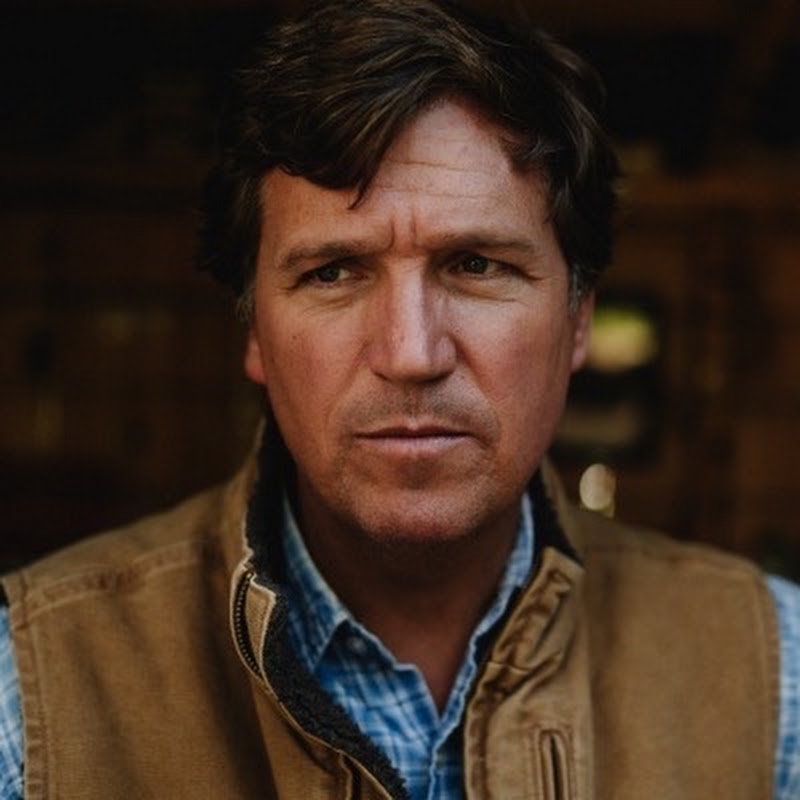
Tucker on the New Religion of Trump’s America and His Mockery of Jesus Christ
YouTube · Vv9Bh6Pu3uc
Quick Read
Summary
Takeaways
- ❖Donald Trump's public actions, including a profane Easter tweet, attacking the Pope, and sharing a meme of himself as Jesus with a demon, are interpreted as mockery of Christianity and an attack on the concept of truth.
- ❖Carlson suggests that the US government's foreign policy has consistently acted in opposition to Christian interests globally, citing examples like the Iraq War and mass migration.
- ❖The host argues that the actual 'civic religion' of the US government, and of Donald Trump, is 'Israelism,' defined by unwavering support for the secular state of Israel.
- ❖Criticism of Israel, particularly the Netanyahu government, is framed as blasphemy within this 'Israelism,' leading to attacks on figures like the Pope, Marjorie Taylor Green, and Thomas Massie.
- ❖The IHRA definition of anti-Semitism is presented as a 'blasphemy law' that criminalizes 'perceptions' and 'rhetorical manifestations' against Jews or non-Jews, with 2/3 of its examples being criticism of Israel.
- ❖Father Josiah Trenum highlights a significant Christian revival in America and Europe, emphasizing the core Christian values of anti-violence and anti-greed, contrasting them with the 'Israelism' described by Carlson.
- ❖Trenum stresses the biblical importance of prophets guiding political leaders, advocating for humility and spiritual counsel in governance, and noting that violence was the singular sin that caused the biblical flood.
Insights
1Trump's Public Mockery of Religious Figures and Truth
Donald Trump, despite being famously irreligious, publicly engaged in specific acts that mocked major religions and the concept of truth. This included tweeting a profane message and war threats on Easter Sunday, attacking the Pope, and sharing a meme depicting himself as Jesus healing a man, which was later modified to include a demon. His inconsistent explanations for these actions further undermined the idea of objective truth.
Trump's Easter tweet threatening Iran and using profanity (), his attack on the Pope (), and the meme of him as Jesus with a demon (). His contradictory statements about sending the meme (, ).
2The US Government's 'Anti-Christian' Foreign Policy
Carlson argues that the US government, distinct from its majority Christian population, has consistently pursued foreign policies that are 'aggressively anti-Christian.' He cites historical examples where US interventions led to the detriment of Christian communities and claims that mass migration policies have demographically weakened Christian Europe.
US foreign policy's effect on Catholics in Vietnam (), Christians in Iraq (), and Lebanon (). US support for mass migration in Europe () and opposition to leaders like Victor Orban who resisted it ().
3'Israelism' as the New Civic Religion
The host asserts that the operative 'civic religion' of the United States government, and of Donald Trump, is 'Israelism'—an unwavering, almost theological, support for the state of Israel. This is evidenced by the political attacks on anyone, regardless of their political alignment, who questions Israel's military aims or lobby.
Carlson states, 'It's Israelism. It's the defense of Israel' (). He points to Trump's attacks on Marjorie Taylor Green, Thomas Massie, and the Pope, noting their commonality is criticism of Israel or its lobby (, , ).
4The IHRA Definition of Anti-Semitism as a 'Blasphemy Law'
Carlson analyzes the International Holocaust Remembrance Alliance (IHRA) definition of anti-Semitism, which has been adopted by many US states and countries. He argues that this definition broadens anti-Semitism to include 'perceptions' and 'rhetorical manifestations,' with two-thirds of its examples being criticism of Israel. He claims it effectively criminalizes dissent and even renders parts of the New Testament 'anti-Semitic.'
The IHRA definition states anti-Semitism is a 'certain perception of Jews which may be expressed as hatred towards Jews' (). Carlson highlights that 2/3 of its examples are criticism of Israel, including comparing Israeli policy to Nazis () and the suggestion that Jews killed Jesus ().
5Christian Revival and Core Gospel Teachings
Father Josiah Trenum provides a counter-narrative to the political and religious decline, observing a significant Christian revival in America and parts of Western Europe. He emphasizes core Christian teachings against violence and greed, contrasting them with the 'Israelism' ideology and the Old Testament's narratives of warfare. He highlights Jesus's radical teachings on non-violence and the importance of spiritual guidance for leaders.
Trenum's observation of a 'fivefold increase' in baptisms and catechumens in his parish () and similar trends in Western Europe (). His explanation that Jesus 'never offers a single order to kill or hurt anybody' () and his sermon on the mount teachings against anger (). His discussion of monastic life as a 'contempt for earthly wealth' ().
6The Role of Prophets and Humility in Leadership
Father Trenum stresses the biblical tradition of prophets advising kings, arguing that political leaders need spiritual counsel to avoid the corrupting influence of power. He contrasts this with modern political arrogance and the 'poison' of constant praise, advocating for humility and adherence to God's word.
Trenum states, 'God would send the prophets to the kings and the king's futures... depended upon whether the king would listen to the prophets or not' (). He mentions righteous kings who submitted their agendas to spiritual fathers () and criticizes American 'pompous' foreign policy ().
Quotes
"So, Donald Trump is not someone who traditionally or ever really has weighed in on questions of faith or theology. He kind of gives it a pass or smiles. Yeah, I'm for it. I'm for it. The Bible. But in the space of one week, Donald Trump, the same famously irreligious Donald Trump, has weighed in in pretty specific ways on matters of faith and theology and religion publicly in ways that are disruptive and sort of hard to understand, but worth trying to understand."
"So, what does that tell you? It tells you what the religion is. The religion is Israelism. It's the support of Israel."
"So, if you look at only Catholics and Muslims have somebody that they look at as their supreme leader, like you know, you got to go to somebody. But even more, it's Catholic. Well, there's only two theocracies in the world. Catholicism and Islam. I'm sorry. the the the uh Islamic Republic of Iran. Yep. And the Vatican. Yeah. Those are the two major theocracies."
"What is blasphemy in modern America? Those are the questions you ask if you are trying to understand what our operative religion is. What's the religion of our leaders? Again, it's not a conventional religion necessarily. It's not Torah Judaism or rabbitic Judaism or Evangelical Christianity or Catholic Christianity. It's the actual religion, the real religion, the set of beliefs that we treat with reverence."
"So, how could a rational person understand that? Well, a rational person could not understand that. Why would a citizen citizen of one country be sent to prison for criticizing the leadership of another country, a country not his own? Why would a citizen of one country be sent to prison for having opinions about historical events that he did not participate in and that were almost a century ago? Does that make any sense? No. Except in religious terms. Those are blasphemy laws. same as the old blasphemy laws."
"But Jesus never offers a single order to kill or hurt anybody. And there's no place in the entire New Testament, the four gospels, the letters that follow mostly from Paul and the vision at the end by St. John called Revelation. There's not one page or sentence in the entire New Testament in which Jesus is recorded saying they're very annoying or they're a threat or they disagree with us or they're of another faith. Kill them. Not once. In fact, it's the opposite of that."
"Not loyalty to the nation. Loyalty to the nation is a Christian virtue in its proper place. But the loyalty that Christ asks is loyalty to the kingdom of God. To seek that first above everything else and to receive our life from him."
"Violence. It's unique amongst evils. So, how could a Christian pastor glorify it?"
"We consider it hated. That doesn't mean we always succeed in hating it. And the people mean well. Most of the time they mean well, but we don't accept it as something nice. We consider it a temptation. It's a temptation. No one is great. Everyone is a sinner. Only Christ is our salvation."
"It can't uh involve civilians. You cannot fail to make a distinction. I find this extremely relevant today. You cannot make a distin You cannot fail to make a distinction between combatants and civilians. Now we know this and the whole decimation of Gaza uh which has completely violated these norms by the way top to bottom completely violated them..."
Q&A
Recent Questions
Related Episodes

Patrick Henningsen: Hezbollah JUST Fired Back at Israel - Iran Vows to “Crush” All Attacks
"Patrick Henningsen argues that the US and Israel initiated an illegal war against Iran, driven by Trump's incompetence and Israeli influence, leading to an inevitable escalation with severe global economic repercussions."

Iran Deal Skepticism. Whoopi Vs Vance. Potomac Park Invasion. Racist Hurls Slurs At Black Boy.
"This episode dissects multiple instances of alleged anti-Black policies and racial injustice, from the Trump administration's legal challenges to reparations and the Iran deal, to police brutality and the erasure of Black history."
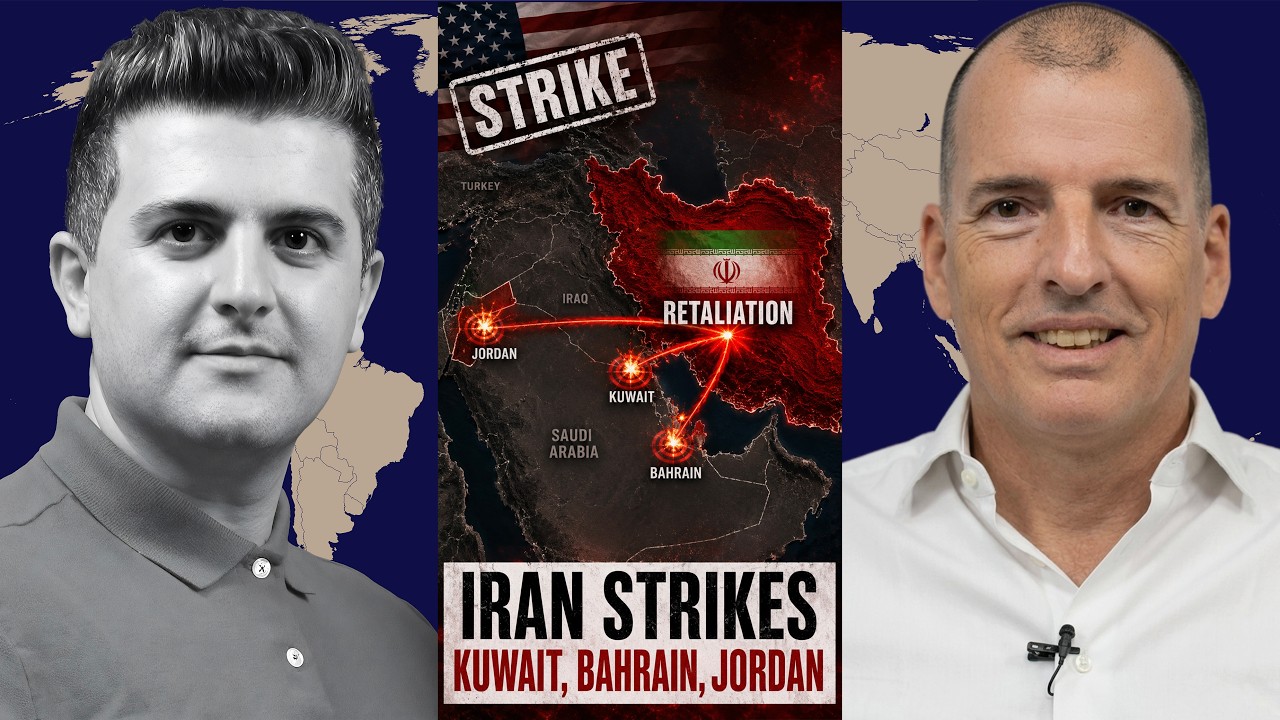
Alex Krainer: US STRIKES Iran – Iran RETALIATES Against Kuwait, Bahrain & Jordan!
"Amidst escalating US-Iran conflict and Iranian retaliation against regional US allies, this episode argues that US foreign policy is deeply controlled by an 'Anglo-Zionist conspiracy' led by the Rothschild banking dynasty, prioritizing Israeli interests over American ones."

LIVE: Trump HIDES FROM PUBLIC as US SOLDIER KILLED!!! 6/2/2026
"The host exposes alleged government cover-ups regarding military casualties, Trump's unexplained public absence, and questionable political appointments, arguing these reflect a 'regime of loser babies' and a failing foreign policy."