SCOTUS Set To DEFEAT Trump FED Takeover
YouTube · ZEW6lrIM45k
Quick Read
Summary
Takeaways
- ❖The Supreme Court's oral arguments indicate a strong likelihood they will block Trump's attempt to fire Fed Governor Lisa Cook, limiting presidential influence over the central bank.
- ❖This potential ruling marks a departure from the Supreme Court's general tendency to support Trump's claims of executive power, particularly when it comes to financial institutions.
- ❖The Federal Reserve is critiqued as an undemocratic body, established to insulate the money supply from public influence and primarily serving the interests of banks and global financial elites.
- ❖Justice Kavanaugh's skepticism about allowing presidential 'for cause' removals suggests a concern for future administrations using similar tactics against their predecessors' appointees.
- ❖The US Treasury Secretary directly intervened to pressure Deutsche Bank to retract an analyst's report that warned of potential European investor sell-offs of US assets, signaling the administration's acute sensitivity to any perceived threat to the dollar's preeminence.
Insights
1SCOTUS Likely to Block Trump's Fed Firing, Signaling a Limit to Executive Power Over Finance
The Supreme Court's oral arguments strongly suggest they will block President Trump from immediately firing Lisa Cook from the Federal Reserve Board. This decision would prevent a president from easily removing Fed governors 'for cause' based on minor infractions, thereby preserving the Fed's intended insulation from direct political influence. This stands out because the Court has often sided with Trump on expanding executive power in other areas.
Nearly all justices asked skeptical questions of the solicitor general regarding the legal bar for removing Cook. Justice Kavanaugh explicitly warned that allowing such removals could lead to a 'what goes around comes around' scenario, where future presidents would fire all prior appointees.
2The Federal Reserve: An Undemocratic Institution Serving Elite Financial Interests
The hosts argue that the Federal Reserve is fundamentally an undemocratic institution, explicitly designed by Congress to remove the American people's power over the money supply and banking system. They contend that the Fed primarily works on behalf of American banks and the global financial system, often at odds with the interests of the general population, particularly through its use of interest rate hikes to 'crush the economy'.
The Fed was 'set up by Congress in the late 1900s explicitly to remove the democratic power of the American people to have influence over our money supply.' Its tools, like raising interest rates, are used to 'deliberately try to crush the economy.'
3US Treasury Pressures Deutsche Bank Over Dollar Stability Report, Revealing Government Sensitivity
The US Treasury Secretary intervened to pressure Deutsche Bank to distance itself from a research note by its chief forex strategist. The report warned that intensifying geopolitical strains could prompt European investors, who hold nearly $8 trillion in US bonds and equities, to reduce dollar exposure. This incident reveals the US administration's extreme sensitivity to any public discourse or market analysis that suggests potential weakness or threats to the dollar's global dominance.
Scott Bessant reported that the Deutsche Bank chief had to distance the bank from a research note on US assets after the US Treasury Secretary 'either called or pressured the bank to move away from the analyst report' which suggested 'Europeans could be selling US assets in response to a trade threat.'
Bottom Line
The US government actively monitors and intervenes in global financial discourse to manage perceptions of dollar stability, even to the point of pressuring private financial institutions to retract analytical reports.
This demonstrates that maintaining the dollar's preeminence is a top-tier national security and economic priority, and the government is willing to exert significant influence to prevent narratives that could undermine it. This suggests a potential vulnerability or an area of high concern for the US.
For investors, this highlights the importance of closely watching geopolitical strains and trade threats as potential triggers for government intervention in financial markets. For analysts, it reveals the political pressure points within global finance that can distort market signals.
Lessons
- Recognize that the Supreme Court, despite its political leanings, may draw a firm line when presidential actions threaten the established independence of key financial institutions like the Federal Reserve.
- Understand that the Federal Reserve's actions, particularly on interest rates, are framed by some as deliberate economic tools that prioritize the stability of banks and global finance over the immediate well-being of the general population.
- Pay close attention to any public or private signals regarding the stability of the US dollar, as government reactions to such signals can reveal underlying economic vulnerabilities and priorities.
Quotes
"What goes around comes around. All the current president's appointees would likely be removed for cause on January 20th, 2029 if there's a Democratic president or January 20th, 2033."
"The Fed is a board set up by Congress in the late 1900s explicitly to remove the democratic power of the American people to have influence over our money supply, of our banking system, and has since morphed into this completely undemocratic institution which is wholly working on behalf of American banks."
"This is the markets, what especially the bond markets are doing, is very very important to them. And you know, so this is showing a little bit of weakness here. To be honest with you, I think it would have been better if they just, you know, pretended like it didn't bother them whatsoever because you're basically broadcasting to the world like this is something that we're worried about."
Q&A
Recent Questions
Related Episodes

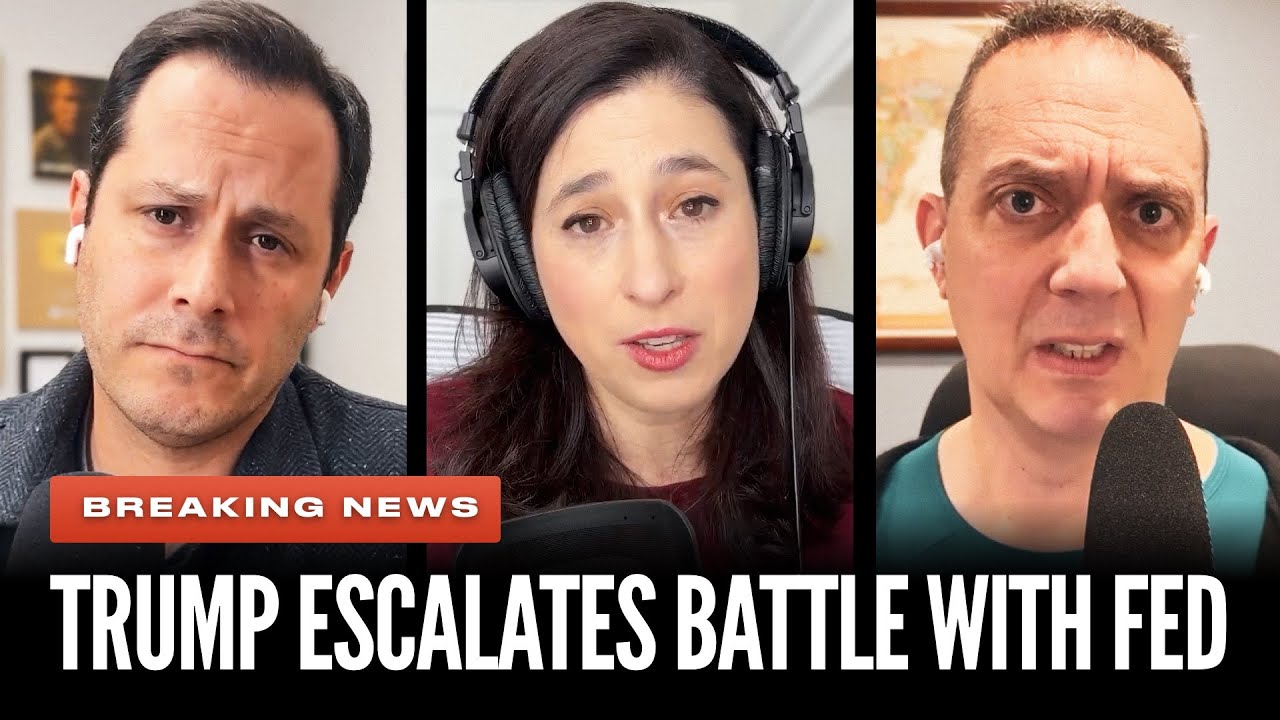
Markets PANIC As Trump Threatens Fed Chair w Prosecution
"Donald Trump's alleged threat to criminally prosecute Fed Chair Jerome Powell over a building renovation project has sent shockwaves through financial markets and ignited a political firestorm over the independence of the Federal Reserve and the Department of Justice."
BREAKING: DOJ Threatens Fed Chair With Criminal Charges
"The Department of Justice's criminal investigation into Fed Chair Jay Powell for alleged false testimony is framed by hosts as a politically motivated attack by Donald Trump, aiming to undermine the Federal Reserve's independence and control interest rate policy."

BREAKING: Iran Threatens To END Talks; U.S. Vows Retaliation; Hezbollah Collapsing? | TBN Israel
"Iran is leveraging Hezbollah and the Strait of Hormuz to manipulate US negotiations, while Israel asserts its right to dismantle Hezbollah's eroding but still dangerous infrastructure in Lebanon, independent of international talks."

🚨 THEY F*CKED AROUND FOR THE LAST TIME 😭😭😭
"This episode unleashes a torrent of highly opinionated commentary on the US-Iran deal, Israel's role, and a scathing critique of 'leftist' policies and immigration, particularly highlighting the UK grooming gang report as evidence of Western societal decay."