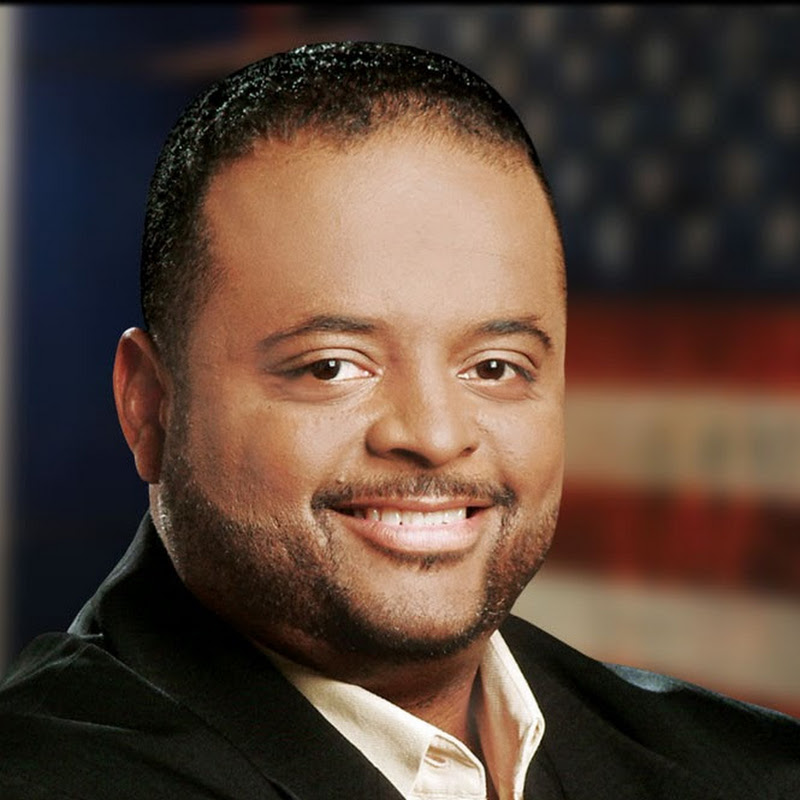
Trump’s America 250 Erases Us. Next250 Builds The Future They Fear
YouTube · _wSW3wHiXZ4
Quick Read
Summary
Takeaways
- ❖Next250 is a three-year initiative culminating in a nationwide 'All of Us 250' day of action on June 27th, offering an alternative to the official 250th anniversary celebration.
- ❖The initiative gathered insights from over 100 organizations in 36 states through listening sessions, resulting in a 'Declaration of Interdependence' outlining shared values.
- ❖A key focus is on collecting participant data (e.g., zip codes from bus travelers) to facilitate targeted, local organizing and sustained engagement beyond the main event.
- ❖Next250 emphasizes building political power through shared values like justice, belonging, dignity, democracy, and independence, rather than just holding performative rallies.
- ❖The strategy involves empowering local leaders through 'train-the-trainer' models and fostering in-person relationships, recognizing the limitations of virtual-only organizing.
- ❖The movement encourages a 'radical imagination' to envision a fundamentally different and interdependent society for the next 250 years, moving beyond reactive problem-solving.
Insights
1Next250's Multi-Year, Data-Driven Organizing Strategy
The Next250 initiative is not a one-off event but a three-year process involving listening sessions with over 100 organizations in 36 states. The core strategy is to collect granular data, such as zip codes from event attendees and bus travelers, to enable targeted local follow-up and sustained organizing. This data allows the movement to connect participants to local issues and groups, ensuring that the energy from large gatherings translates into concrete, long-term political action at the community level.
Carmen Perez Jordan states the work started three years ago, convening over 100 organizations in 36 states for listening sessions that culminated in a Declaration of Interdependence. Tiffany Loft details collecting contact information from bus travelers and using QR codes at the event for sign-ups, emphasizing plugging people into local organizations and campaigns. Roland Martin highlights the importance of knowing where people come from (zip codes) to activate them for local city council or school board meetings.
2Prioritizing In-Person Connection for Authentic Movement Building
Despite the convenience and cost-efficiency of virtual platforms, Next250 emphasizes the critical role of in-person interactions for building authentic relationships, trust, and sustained commitment within a movement. Virtual engagement is seen as a 'lazy' way to explain things and does not foster the intimate connections necessary for deep, long-term solidarity and shared purpose.
Tiffany Loft argues that while virtual is great, it doesn't allow for intimate relationships. She shares a personal anecdote about her long-standing, in-person relationship with Carmen Perez Jordan, highlighting how seeing each other in person builds trust and ensures mutual support. Roland Martin reinforces this, noting that crucial conversations and relationship-building often happen outside formal sessions at in-person events.
3Shifting from Reactive Problem-Solving to Proactive Future-Building
The initiative aims to move beyond merely reacting to current political problems or celebrating a problematic past. Instead, it seeks to foster a 'radical imagination' to envision and actively build a fundamentally different, interdependent society for the next 250 years. This involves defining a bold agenda based on shared values rather than being constrained by existing limitations or external forces.
Tiffany Loft states, 'a declaration of interdependence says we are responsible for the future that we want to hold. Not being reactive to all the problems that are happening, but saying here's what our agenda is going to be.' Carmen Perez Jordan mentions that communities were asked to imagine a 250-year future, a question they are rarely given the resources or time to consider due to being in 'survival mode.'
Bottom Line
The current configuration of the United States may not endure for another 50-250 years, necessitating a fundamental renegotiation of the entire societal project rather than incremental reforms.
This perspective challenges conventional patriotism and calls for a deeper, more radical transformation beyond notions of citizenship, aiming to create a fundamentally different society from the ground up.
This provides an opportunity to build truly intergenerational and intersectional movements that unite diverse communities (indigenous nations, deported individuals, urban youth) around shared values and a collective vision for a new, interdependent social contract.
Major civil rights and advocacy groups are often constrained by corporate funding, which limits their ability to pursue truly transformative or 'radical imagination' agendas, forcing them to answer to external forces rather than community needs.
This highlights a critical barrier to systemic change, suggesting that movements seeking genuine societal transformation must prioritize financial independence from corporate and potentially compromising funding sources.
The opportunity lies in fostering grassroots, community-funded initiatives and independent media platforms that can freely articulate and pursue agendas unconstrained by external financial pressures, thereby enabling more authentic and impactful advocacy.
Key Concepts
Micro-Macro Organizing
The principle that large-scale mobilizations (macro) must be meticulously connected to local, granular data and follow-up actions (micro) to translate broad participation into sustained, actionable political power at the community level. This ensures that the energy of a large event is channeled into concrete local efforts.
Radical Imagination
The concept of envisioning a future society that transcends current limitations and systemic issues, rather than merely making incremental improvements. It involves proactively defining a desired future based on core values like interdependence, dignity, and justice, even if it challenges existing structures or paradigms.
Declaration of Interdependence
An alternative framework to the traditional Declaration of Independence, emphasizing mutual reliance, shared values, and collective responsibility for building a just and equitable society. It shifts the focus from individualistic freedom to collective well-being and interconnectedness.
Lessons
- Engage with organizations like Next250 that prioritize long-term, data-driven organizing and post-event follow-up to ensure your participation contributes to sustained change.
- Seek out and support initiatives that foster in-person community building and relationship development, recognizing their crucial role in strengthening movements beyond virtual interactions.
- Challenge yourself and your community to develop a 'radical imagination' for the future, proactively defining the society you want to build rather than solely reacting to existing problems or political narratives.
Building a Sustainable Social Movement: The Next250 Approach
Conduct extensive listening sessions with diverse communities (over 100 organizations in 36 states) to identify shared values and critical issues, forming the foundation for a collective vision.
Develop a 'Declaration of Interdependence' that articulates these shared values and a bold vision for the future, serving as a guiding document for local and national action.
Organize large-scale, family-friendly events (like 'All of Us 250') that are not ends in themselves, but serve as mobilization points for data collection and connecting participants to ongoing local efforts.
Implement robust data collection mechanisms (e.g., QR codes, bus sign-ups, zip codes) to track participants and enable targeted communication for local organizing post-event.
Prioritize in-person 'train-the-trainer' programs to empower local leaders with the skills and curriculum to organize, power map, build campaigns, and develop leadership within their own communities, fostering multiplication of impact.
Cultivate authentic, in-person relationships among organizers and participants to build trust and ensure sustained commitment, recognizing that virtual interactions alone are insufficient for deep movement building.
Maintain financial independence, ideally through community or foundation support that aligns with the movement's values, to avoid external corporate control that can constrain radical imagination and agenda-setting.
Notable Moments
Roland Martin's frustration with events lacking follow-up
The host articulates a common critique of many large-scale protests and rallies: they often lack a clear post-event strategy for sustained action and data utilization, leading to dissipated energy and minimal long-term impact. This sets the stage for Next250 to explain how their initiative explicitly addresses this failure.
Tiffany Loft's passionate defense of in-person organizing
Loft's energetic explanation of why in-person connection is superior to virtual for building trust and authentic relationships resonates deeply, especially post-pandemic. Her personal anecdote with Carmen highlights the intangible but critical value of shared physical presence in movement building, contrasting it with the 'lazy' nature of relying solely on virtual tools.
Carmen Perez Jordan's personal story of her father's deportation
This personal anecdote grounds the abstract goals of justice and belonging in a concrete, intergenerational experience of systemic injustice. It underscores the deep historical roots of the issues Next250 addresses and provides a powerful emotional motivation for building a protective and inclusive future.
Quotes
"If you don't have that data, what you're doing is you're now trying to replicate what you did and you hope folks show up and then you go there. Well, I hope we have 30 or 40 people. And that to me is just one of the biggest mistakes that I keep seeing when we're asked to cover these events."
"The bigger question, as we all understand, is what are we going to win? Yeah. It's not what are you going to do cuz everybody can do."
"A declaration of interdependence says we are responsible for the future that we want to hold. Not being reactive to all the problems that are happening, but saying here's what our agenda is going to be."
"I do believe that we could create a society where we are I don't want to use the word tolerant cuz that's not the right word, but that we have the ability to come together."
"We're literally laughing ourselves to death because things are happening all around us and we are fixated on comedy shows, award shows, reality shows, the latest fashion thing, the latest gossip and real is happening. And then when it happens, folk go, 'Oh my god, why didn't we know?' Because your ass was paying attention to..."
Q&A
Recent Questions
Related Episodes

LIVE! Love Forward Together Mass People’s Assembly & Moral March Mobilization In Raleigh, NC
"Thousands marched across North Carolina in the 'This Is Our Selma' movement, led by Reverend William Barber, to combat gerrymandering, voter suppression, and advocate for a proactive, love-driven vision of social and economic justice."

Barber Lays Out the Math of Power. 7,000 Votes Control Congress & How We Nationalize State Movements
"Bishop William Barber reveals how a mere 7,000 votes determined the current Congress and outlines a data-driven strategy to nationalize state movements by mobilizing infrequent, low-wage voters."

Woman arrested for death of 2 Black girls. Explosives thrown at Mamdani. Growin' Good In The Hood.
"This episode unpacks critical news affecting the Black community, from a mother's arrest in a tragic child death and threats against a NYC mayor to the enduring legacy of Jesse Jackson Sr. and innovative community-led initiatives in food security and entrepreneurship."
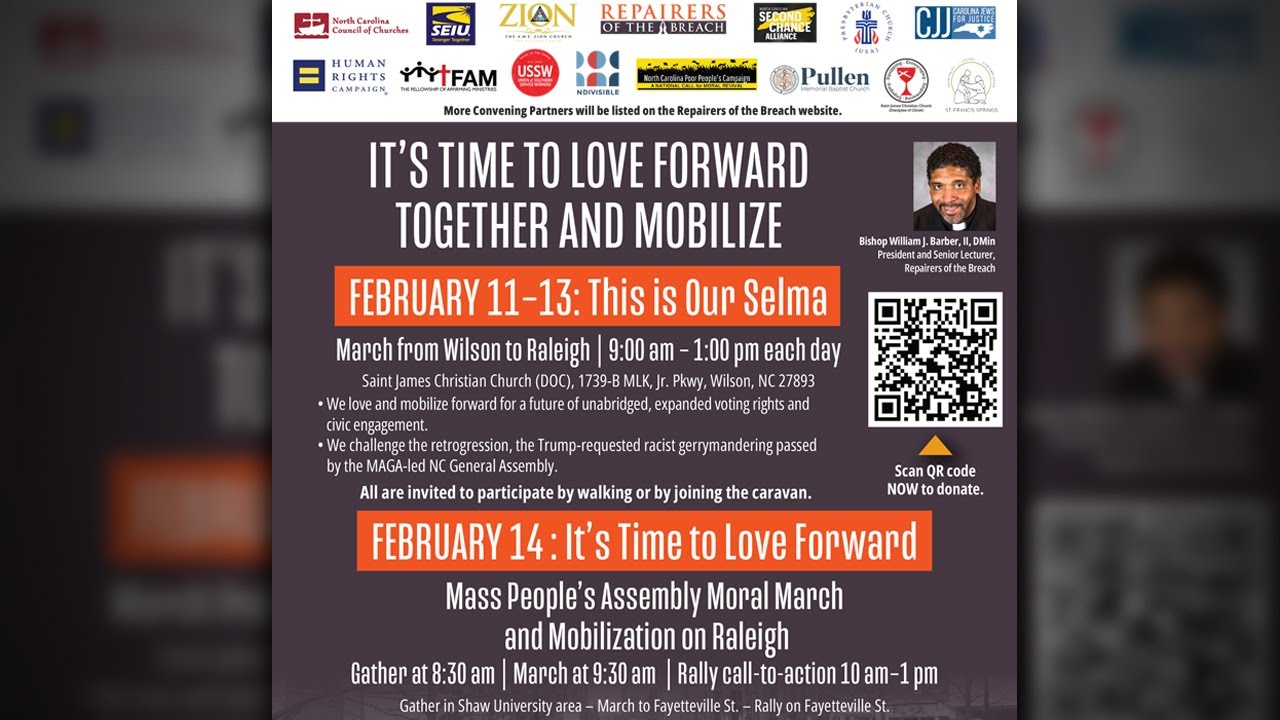
Love Forward Together Mass People’s Assembly & Moral March Mobilization | Day 2
"This episode documents Day 2 of the 'Love Forward Together' march in rural North Carolina, a mobilization against voter disenfranchisement and redistricting, emphasizing community unity and persistent activism."