
BREAKING: Iran FIRES On Emirates; U.S. Opens Hormuz; IDF On High Alert | TBN Israel
YouTube · akQZ8rGOFxo
Quick Read
Summary
Takeaways
- ❖Iran launched 12 cruise missiles and drones at the United Arab Emirates, hitting an oil facility in Fujairah and injuring three Indian citizens.
- ❖The United States initiated 'Project Freedom' to break Iran's naval blockade in the Strait of Hormuz, successfully escorting two commercial ships.
- ❖US Central Command confirmed Iran attacked commercial and military American ships with cruise missiles, drones, and small boats, leading to the destruction of six Iranian boats.
- ❖American intelligence assesses that Iran can still develop a nuclear bomb within one year, despite previous Israeli-American strikes.
- ❖The hosts suggest Iran's Revolutionary Guards' attacks were not coordinated with the Iranian government, potentially indicating internal rifts or a deliberate negotiation tactic.
- ❖Israel is on heightened alert, preparing for potential escalation and coordinating closely with the American military, anticipating an Iranian response if the US strikes.
Insights
1Iran's Direct Escalation in the Gulf
Iran launched 12 cruise missiles and drones towards the United Arab Emirates, striking an oil facility in Fujairah. This marks the first direct attack on a Gulf state since the ceasefire, underscoring a significant escalation beyond maritime incidents in the Strait of Hormuz. The attack on Fujairah, a strategic port city outside Hormuz, sends a message that even alternative maritime routes are not safe from Iranian aggression.
Iran fired 12 cruise missiles towards the United Arab Emirates. An oil facility was hit. () The Emirati Ministry of Defense announced that Iran fired 19 ballistic missiles, three cruise missiles and four drones. () A drone launched from Iran struck the fuel industrial zone in the United Arab Emirates. () Fujairah is not just a port city. It is a strategic asset. It sits outside the straight of Hammuz on the coast of the Gulf of Oman. ()
2US Operation to Break Hormuz Blockade
The United States launched 'Project Freedom' to reopen the Strait of Hormuz, successfully escorting two commercial ships flying the American flag through the strait. This operation directly challenges Iran's attempts to control the international passage. US Central Command confirmed that American forces destroyed six small Iranian boats and intercepted missiles and drones launched by Iran during these escort missions.
The United States has launched an operation to free the straight of Homus. () The American Navy broke through the Iranian blockade on the straight and safely escorted two ships out. () The commander of Sentcom announced that Iran fired cruise missiles towards the American ships and the United States Navy eliminated six small boats. () The United States announced that two commercial ships flying the American flag cross the straight of Hmuz as part of Project Freedom. ()
3Iran's Nuclear Program Remains a Threat
Despite previous Israeli and American strikes, US intelligence estimates that Iran can still achieve nuclear bomb capability within approximately one year. The International Atomic Energy Agency (IAEA) has been unable to verify the location of 440 kg of 60% enriched uranium, enough material for several bombs if further enriched. This unresolved nuclear issue remains the central problem driving the conflict.
Iran can still break through to a nuclear bomb within one year. () American intelligence estimates that despite the recent war, the time Iran would need to build a nuclear bomb has not changed since last summer and that it is still around one year. () The IAEA, the International Atomic Energy Agency, still has not been able to verify the location of about 440 kg of uranium enriched to 60%. ()
4Internal Divisions and Information Warfare in Iran
The hosts suggest that Iran's Revolutionary Guards are conducting attacks without the knowledge or coordination of the Iranian government, leading to internal rifts, with the Iranian President reportedly furious. This internal dynamic is also framed as a deliberate negotiation tactic by Iran to create plausible deniability and project an image of unpredictability, while simultaneously engaging in widespread information denial regarding attacks and blockades.
The Iranian president Mas Pazian was furious yesterday with the revolutionary guards commander Ahmed Vahidi because of the attacks in the Strait of Huz and in the United Arab Emirates and Oman which were carried out without the government's knowledge. () Another way to look at this is this is part of their negotiation tactic and something they've used in the past too where they claim that people are working against the orders of the government. () If a ship passes, Iran denies it. If a boat is hit, Iran denies it. If an attack gets out of control, Iran says that it was not intentional. ()
5Israel's High Alert and 'Game of Chicken'
The IDF is on heightened alert for both offensive and defensive operations, coordinating with the American military. Israel assesses that Iran is trying to keep the conflict limited to the Gulf but acknowledges the risk of broader proxy actions (Hezbollah, Houthis, Iraqi militias). The situation is described as a 'game of chicken,' where Iran risks a wider war if it fights over the Hormuz passage, but loses a key leverage card if it backs down.
The IDF is on heightened alert both for striking and for observing attacks. () Israel is coordinated with the American military and the defense establishment understands that any American strike in Iran, even a limited one, could bring an Iranian response towards Israel. () Inside the Israeli system, the situation is being described as a game of chicken. ()
Lessons
- Recognize the dual nature of Iran's actions: direct military escalation in the Gulf alongside a sophisticated information warfare campaign of denials and misdirection.
- Understand that intelligence assessments, particularly regarding Iran's nuclear timeline, may be influenced by various agendas, requiring critical evaluation of reported timelines and capabilities.
- Be aware of the interconnectedness of regional conflicts; escalation in the Strait of Hormuz can quickly impact other fronts like Lebanon and Gaza, and global markets.
- Consider the economic implications of geopolitical tensions, such as rising oil prices and disrupted shipping/air routes, as direct consequences of regional instability.
Quotes
"Iran will be wiped off the face of the earth."
"If the amiratis make mistakes, it will learn a lesson it will never forget. If it takes an unwise action, all of its interests will become a target for Iran."
"The Iranian regime and the Iranian people aren't sharing the same interest. The Iranian people obviously don't want to go back to war. The Iranian regime actually benefits internally if they go back to war."
"Once they have the information, and they have the information on how to get to a bomb, they ultimately will get to that bomb if you don't continue bombing them and taking away their ability."
"Sometimes what's not said is almost as important as what was said. Iran tried to present a picture in which it still controls the strait. Iran's fast news agency claimed that two missiles hit an American warship near Jusk Island after the ship refused the Iranian warnings."
Q&A
Recent Questions
Related Episodes

Patrick Henningsen: Hezbollah JUST Fired Back at Israel - Iran Vows to “Crush” All Attacks
"Patrick Henningsen argues that the US and Israel initiated an illegal war against Iran, driven by Trump's incompetence and Israeli influence, leading to an inevitable escalation with severe global economic repercussions."

🚨 TOTAL F*CKING CHECKMATE 😂😂😂
"The host argues that Trump's 'ceasefire' with Iran was a calculated '5D chess' move to orchestrate a global energy market reshuffle, while simultaneously lambasting 'woke' domestic policies and the 'freefall' of anti-Trump conservative figures."
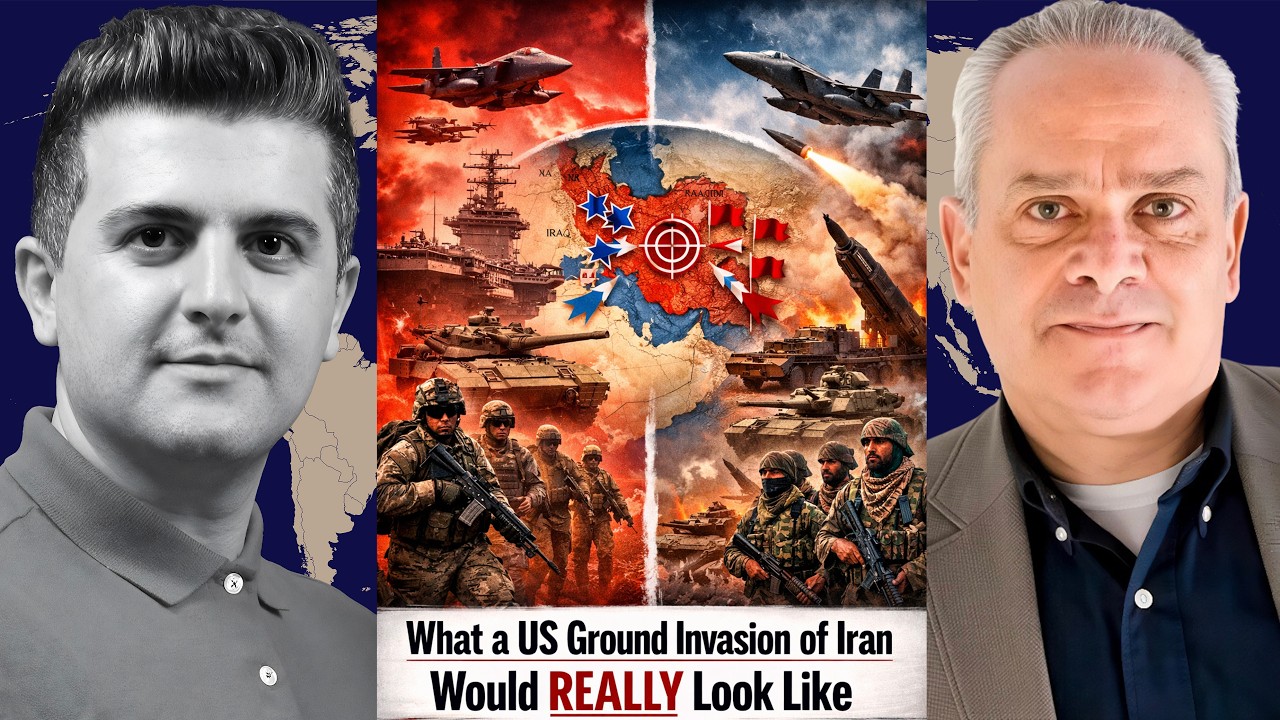
Col. Jacques Baud: What a US Ground Invasion of Iran Would REALLY Look Like
"Colonel Jacques Baud dissects the strategic futility of a US ground invasion of Iran, arguing that current troop levels are insufficient and such an action would backfire, exposing US allies and potentially leading to Iran's nuclearization."

Bibi DEMANDS Ground Troops As Marines Rushed to Iran
"Benjamin Netanyahu is pushing for US ground troops in Iran, framing air strikes as insufficient, while the US rushes Marines to the region and struggles to secure the Strait of Hormuz against surprisingly capable Iranian defenses."