
BREAKING: Judge DENIES Minnesota's Request to REMOVE ICE | LIVE Minneapolis ICE Protests
YouTube · bAFHimLZM-A
Quick Read
Summary
Takeaways
- ❖The 'ICE Out' protest in Minneapolis, organized by Mirac and TCC4J, demands a statewide eviction moratorium and the abolition of ICE.
- ❖ICE operations have caused significant economic hardship, with immigrant residents afraid to work or shop, leading to business closures and inability to pay rent.
- ❖A federal judge denied Minnesota's request to end the ICE 'surge,' citing a lack of metric to define unlawful law enforcement.
- ❖ICE expanded its power to arrest individuals without warrants, formalizing practices already observed by activists.
- ❖Activists draw parallels between current immigration enforcement and historical patterns of 'white supremacist' government actions and U.S. imperialism.
- ❖Community members are organizing mutual aid, rapid response teams, and patrolling schools to protect residents from ICE.
- ❖Allegations of anti-Semitism within Border Patrol leadership, including mocking remarks about a Jewish U.S. attorney, are highlighted.
- ❖A small-town Minnesota police chief reportedly intervened to prevent a federal immigration agent from arresting a resident, marking a potential shift in local law enforcement response.
Insights
1Economic Devastation from ICE Operations Fuels Eviction Crisis
ICE activities in Minneapolis have instilled such fear in immigrant communities that many are afraid to leave their homes for work or essential shopping. This widespread apprehension leads to significant lost wages and forces small businesses, particularly in immigrant-dense areas like the Marcato and Carmel Mall, into severe decline or closure. Consequently, many families cannot afford rent, prompting urgent calls for a statewide eviction moratorium.
Kelly from Mirac details how families have lost primary earners to detention/deportation, and fear prevents others from working (). The host observes closed stalls and declining business at immigrant-owned malls (, , ). Manny from Mirac emphasizes the restaurant industry is 'in shambles' due to fear ().
2Federal Judge Denies Minnesota's Bid to Remove ICE
A federal judge denied Minnesota's request to end the ICE 'surge' and send 3,000 agents home. The state and city argued a violation of the 10th Amendment, which protects state autonomy from federal overreach. However, the judge found no clear 'metric' to determine when lawful law enforcement becomes unlawful, effectively allowing the federal operations to continue.
The host reports breaking news that Judge Kate Mernandez denied Minnesota's request, citing the state's argument lacked a metric to define unlawful law enforcement ().
3ICE Expands Power for Warrantless Arrests, Formalizing Existing Practices
An internal ICE memo, reported by the New York Times, expanded the power of lower-level ICE agents to conduct sweeps and arrest individuals without warrants, based on suspicion of undocumented status. This change formalizes practices that activists observed were already occurring, such as agents arresting people at taco stands or flower vendors without specific warrants, including American citizens.
The host reads breaking news about an ICE memo expanding warrantless arrest powers (). The host notes that these practices were already observed in Los Angeles, with agents arresting individuals without warrants, including American citizens ().
4Historical Context of Immigration Enforcement and White Supremacy
Activists argue that the current structure of DHS and ICE, created post-9/11, is a continuation of historical patterns where U.S. immigration laws have been 'weaponized' against specific groups. They cite examples like Japanese internment, the Chinese Exclusion Act, and historical targeting of Mexicans, framing these actions as part of a 'white supremacist government' pattern evident across both Democratic and Republican administrations.
Kelly from Mirac discusses the shift from INS to DHS/CBP/ICE/USCIS post-9/11 and states that immigration laws have historically been weaponized against groups, citing Japanese internment and the Chinese Exclusion Act (). Manny from Mirac speaks of putting an end to 'white supremacy' ().
5Allegations of Anti-Semitism within Border Patrol Leadership
Concerns are raised about anti-Semitic behavior within Border Patrol, specifically regarding Mr. Bavino, a prominent figure in immigration crackdowns. Incidents include a California Border Patrol Instagram account using an anti-Semitic Michael Jackson song clip over arrest videos and Bavino himself reportedly making derisive remarks about a Jewish U.S. attorney, Daniel N. Rosen, mocking his faith and observance of Shabbat.
The host details a California Border Patrol Instagram post using an anti-Semitic song clip () and describes Mr. Bavino's mocking remarks about the faith of U.S. Attorney Daniel N. Rosen, using terms like 'chosen people' sarcastically ().
Bottom Line
The economic desperation of some U.S. citizens may drive them to take jobs as ICE agents, even if they are not inherently 'evil white supremacists,' creating a complex layer to the enforcement issue.
This perspective suggests that addressing underlying economic inequality could indirectly reduce the pool of individuals willing to participate in controversial enforcement roles, shifting the focus beyond simple moral condemnation.
Advocacy for robust social safety nets and well-paying, ethical job opportunities could be framed as a strategy to weaken the recruitment base for agencies like ICE, aligning economic justice with immigrant rights.
A small-town Minnesota police chief intervened to prevent a federal immigration agent from arresting a local resident, marking a rare instance of local law enforcement actively challenging federal immigration authority.
This incident could signal a potential shift in local police willingness to enforce or cooperate with federal immigration actions, possibly setting a precedent for other municipalities to push back against perceived federal overreach.
Activists can leverage this example to pressure other local police departments to adopt similar non-cooperation policies or 'sanctuary' practices, highlighting successful local resistance against federal agents.
Lessons
- Support and join local immigrant rights organizations like Mirac and Twin Cities Coalition for Justice to participate in rapid response efforts and community defense.
- Advocate for a statewide eviction moratorium in Minnesota to protect immigrant families facing economic hardship due to ICE operations.
- Contribute to mutual aid networks that provide essential support like rent assistance, food, and clothing to affected immigrant communities.
Notable Moments
A federal judge's decision to deny Minnesota's request to remove ICE agents is announced live during the protest, directly impacting the context of the demonstration.
This breaking news underscores the immediate legal challenges faced by local governments attempting to protect their residents from federal immigration enforcement, highlighting the limitations of state power against federal mandates.
Protesters smash a piñata of South Dakota Governor Kristi Noem's face, symbolizing their strong disapproval of her policies and rhetoric.
This act of symbolic protest demonstrates the deep-seated anger and frustration directed at political figures perceived as hostile to immigrant communities, serving as a cathartic and unifying moment for the demonstrators.
A youth poet reads a powerful poem emphasizing unity, love across borders, and the resilience of immigrant communities, stating, 'No one is illegal on strong land.'
The poem serves as an emotional core of the protest, articulating the humanistic values and shared humanity that underpin the movement, and inspiring solidarity among participants.
Many residents in heavily targeted neighborhoods wave, blow kisses, and show support from inside their homes as the march passes, unable to join due to fear of ICE.
This visual highlights the pervasive fear within immigrant communities and the silent support for the movement, underscoring the chilling effect of ICE operations on daily life and community participation.
Quotes
"The immigration laws in this country have been weaponized against certain groups of people... This is really part of a pattern of a white supremacist government in this country."
"If people cannot safely work, move or live, then eviction is violence. Do not sell us out. Declare an eviction moratorium now."
"We will not bow down. These attacks have done nothing, absolutely nothing, but bring us all together as a community."
"I'm not waiting on the mayor or the governor to stop this... We are the ones who can stop this. We need to use our power because there are more of us than them."
"It isn't shocking to learn that ICE is also trained by the Israeli military and uses the same surveillance technologies that we see here."
"If you want to oppose ICE, which we should, let us also oppose the entity that trains them, Israel, which has killed my people, detained my people, taken my people, has left us to die with no one to help."
"Our students have the right to an education. And Trump is denying them this basic right. They should feel safe at their schools. They should feel safe at their bus stops."
"Just because something is a law doesn't make it right. And just because a judge upheld something doesn't make it right."
"We have a duty to fight for our freedom. We have a duty to win. We must love and support one another. We have nothing to lose but our chains."
Q&A
Recent Questions
Related Episodes
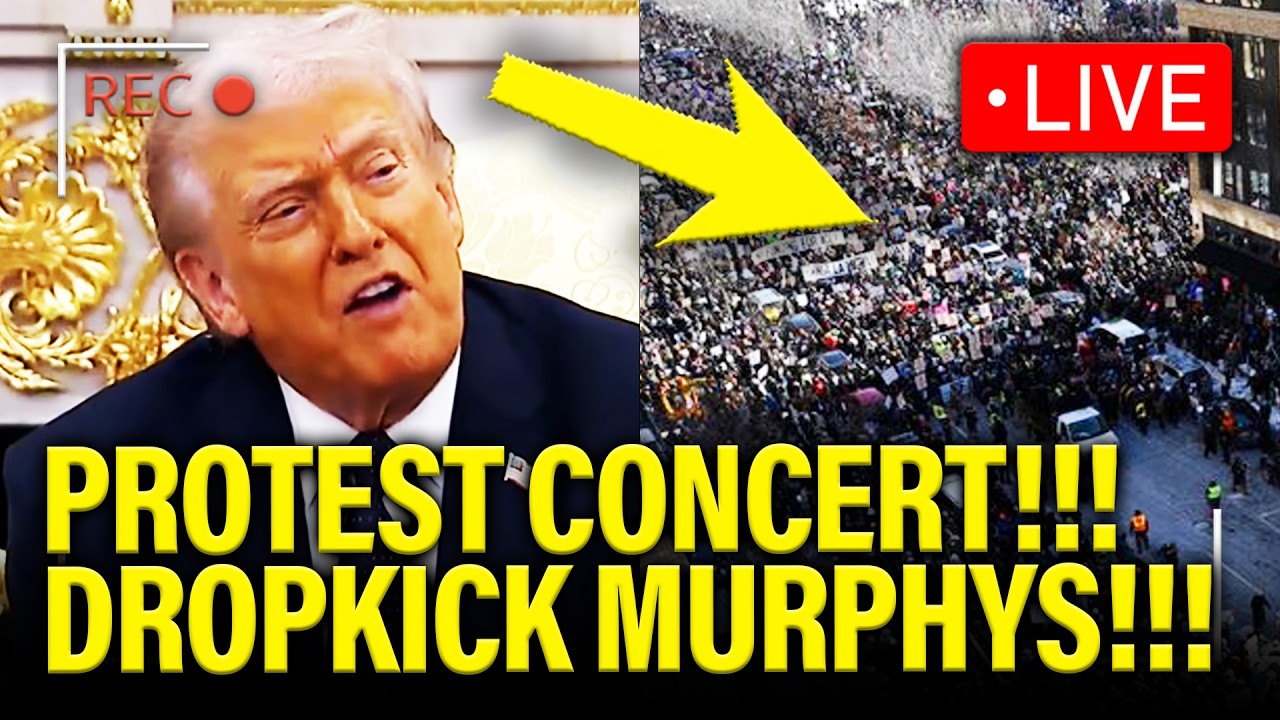
LIVE: MASSIVE PROTEST Concert Against Trump ERUPTS in Minneapolis
"A powerful protest concert in Minneapolis united musicians, comedians, veterans, and community organizers to honor victims of ICE violence, advocate for its abolition, and galvanize local resistance."

LIVE! Love Forward Together Mass People’s Assembly & Moral March Mobilization In Raleigh, NC
"Thousands marched across North Carolina in the 'This Is Our Selma' movement, led by Reverend William Barber, to combat gerrymandering, voter suppression, and advocate for a proactive, love-driven vision of social and economic justice."
Celebrating the Legacy of the Rev. Dr. Bernard Lafayette, Jr.
"This memorial service celebrates the life and enduring legacy of Rev. Dr. Bernard Lafayette, Jr., a pivotal civil rights leader, nonviolence strategist, and educator whose teachings transformed movements globally."
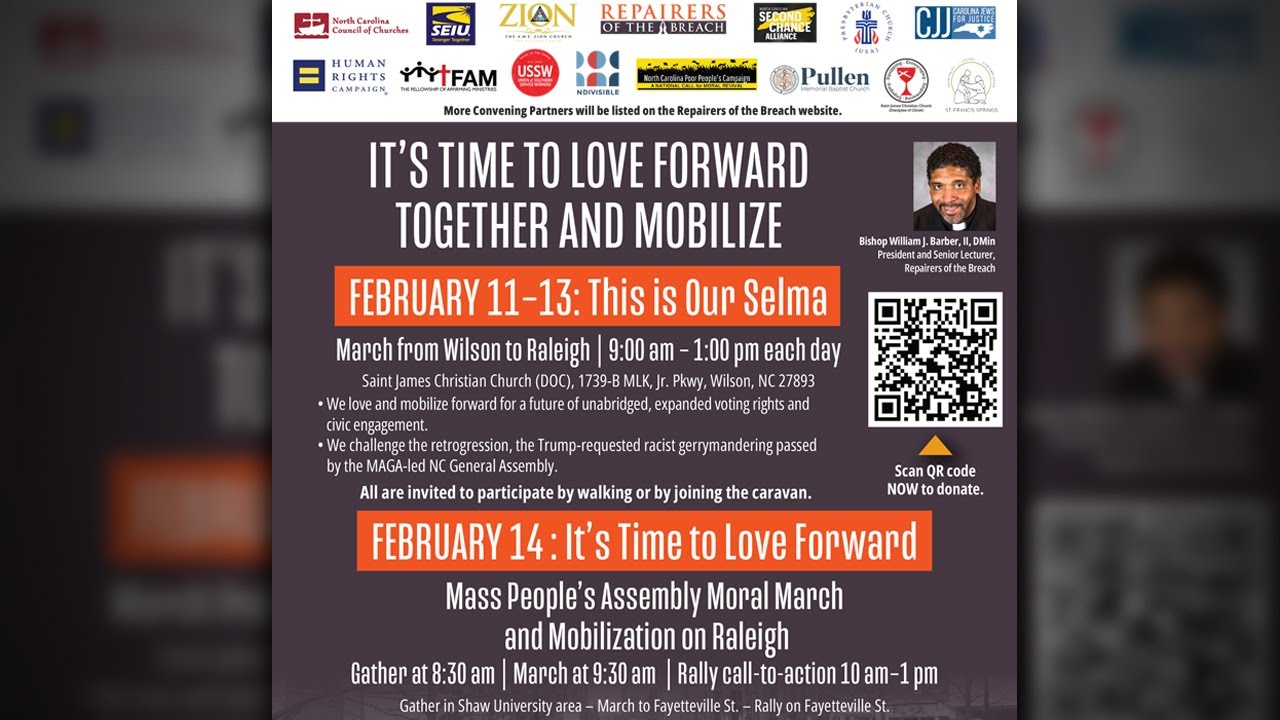
Love Forward Together Mass People’s Assembly & Moral March Mobilization | Day 2
"This episode documents Day 2 of the 'Love Forward Together' march in rural North Carolina, a mobilization against voter disenfranchisement and redistricting, emphasizing community unity and persistent activism."