
Trump And Marco Rubio GO OFF On Liberal Reporters Asking The Same DISRESPECTFUL Question!
YouTube · bzzGljKIQ8g
Quick Read
Summary
Takeaways
- ❖The narrative of a 'MAGA civil war' regarding US strikes on Iran is false; self-identified MAGA Republicans are highly supportive of the president's actions.
- ❖US military action against Iran was a strategic decision to prevent Iran from crossing a 'line of immunity' with advanced weaponry and nuclear ambitions.
- ❖The US and Israel have mutual interests in neutralizing Iran, making joint operations a logical outcome rather than evidence of coercion.
- ❖Attributing US military deaths to a foreign country (Israel) is considered disrespectful and ignores the US's own geopolitical motivations.
- ❖Weakening Iran's leadership and military capabilities serves US interests by disrupting its alliances with Russia and China, impacting energy and military supply chains.
Insights
1MAGA Republicans Strongly Support Iran Strikes, Debunking 'Civil War' Narrative
Contrary to mainstream media narratives suggesting a 'MAGA civil war' over US military operations in Iran, polling data indicates strong approval among Republicans. Self-identified MAGA Republicans are significantly more hawkish on Iran than their non-MAGA counterparts, showing higher approval for military action, greater belief in its threat reduction, and more trust in Trump's decisions regarding force.
A CNN poll found 77% of Republicans approve of US action, with MAGA Republicans being 30 points more likely to strongly approve and nearly 50 points more likely to trust Trump's judgment.
2US Strikes on Iran: A Joint Operation Driven by Mutual Interests, Not Israeli Coercion
The host argues that the US military strikes on Iran were not a result of Israel forcing the US's hand, but rather a joint operation based on mutual strategic interests. Marco Rubio explained that the US acted preemptively because an Israeli attack on Iran was anticipated, and Iran would retaliate against the US, leading to higher American casualties if the US waited. Trump also stated he 'might have forced Israel's hand,' implying a coordinated effort.
Marco Rubio stated, 'We knew that if Iran was attacked... they would immediately come after us. And we were not going to sit there and absorb a blow.' Donald Trump said, 'If anything, I might have forced Israel's hand, but Israel was ready and we were ready.'
3Iran Poses an Imminent Threat Requiring Preemptive Action
Both Trump and Rubio emphasized that Iran was on the verge of developing an untouchable missile and drone program, potentially leading to nuclear weapons capability. This 'line of immunity' necessitated preemptive strikes to dismantle their terroristic capabilities and prevent them from holding the world hostage.
Rubio stated Iran 'in about a year or a year and a half would cross the line of immunity.' Trump asserted, 'There was no way in the world that this terroristic regime was going to get nuclear weapons. Not under Donald Trump's watch.'
4Weakening Iran Serves Broader US Geopolitical Interests Against Russia and China
Beyond immediate threats, the host explains that regime change in Iran significantly weakens US adversaries Russia and China. Iran is a key ally in the 'anti-western block,' supplying drones to Russia and oil to China. Disrupting Iran's leadership and military capabilities directly impacts the military and energy security of these rival powers.
The host states, 'Iran is an ally of China and Russia... taking out their leadership... significantly weakens Russia when it comes to getting drones... and it significantly weakens China when it comes to energy and oil.'
Bottom Line
The US decision to strike Iran was partly a calculated move to preempt an anticipated Israeli strike, thereby mitigating the risk of Iran's retaliatory attacks on US forces and preventing higher American casualties.
This reveals a complex, interdependent strategic calculus where US actions are not just reactive but also preemptive in anticipation of allied actions and enemy responses, aiming to control the escalation and minimize US risk.
Analysts should consider the 'preemption of preemption' as a distinct strategic framework in alliance dynamics, particularly in volatile regions, to understand how major powers manage proxy conflicts and protect their assets.
The host posits that the US's interest in regime change in Iran is directly tied to weakening the 'anti-western block' of Russia and China, specifically by disrupting Russia's drone supply and China's energy sources.
This frames the Iran conflict not just as a regional issue or an Israeli concern, but as a critical front in a broader global power competition, where actions in one theater have direct implications for others.
Businesses and policymakers should analyze the interconnectedness of global conflicts, recognizing that regional instability can be leveraged to achieve strategic objectives against major geopolitical rivals, impacting supply chains and resource access.
Lessons
- Challenge simplistic narratives about foreign policy; seek out diverse data and perspectives beyond initial media headlines.
- Understand that US foreign policy decisions, especially military actions, are often driven by complex, multi-layered national security and geopolitical interests, not just single-factor influences.
- Recognize that 'America First' can encompass maintaining global military dominance and asserting power to protect geopolitical interests, rather than strict isolationism.
Quotes
"Self-identified MAGA Republicans are actually far more hawkish on Iran than their non-MAGA counterparts. Well, because actual MAGA Republicans understand that, you know, in order to make America great again, that means that we still have to be dominant on the world stage."
"If anything, I might have forced Israel's hand, but Israel was ready and we were ready and we've we've had a a very very powerful impact."
"This was a question of timing of why this had to happen as a joint operation, not the question of the intent. Once the president made a decision that negotiations were not going to work... the decision was made to strike them."
"I don't think that I would ever suggest that our leaders are being controlled by a foreign country and that they don't have any autonomy to make their own decisions. And one of the reasons why I say this is because I personally just haven't seen the evidence."
"At the very least, again, Iran is an ally of China and Russia, right? They are the uh the big three, right? in terms of you know the anti-western block and Iran taking out their leadership having regime change uh significantly weakens Russia... and it significantly weakens China."
Q&A
Recent Questions
Related Episodes
Robby Soave GOES OFF On ANNOYING Liberal Black Woman Making Emotional Trump Deranged Arguments!
"The host dissects a heated foreign policy debate, arguing that 'left-wing' emotionalism and 'Trump derangement' prevent a rational understanding of US sanction strategies against Cuba and Iran."

Will Venezuela Be Trump's Vietnam?
"An expert breaks down three perilous pathways for Venezuela under potential US intervention, from a 'Panamanian model' to a 'Libyan-style civil war,' and the broader geopolitical fallout for Latin America."

Iran Deal Skepticism. Whoopi Vs Vance. Potomac Park Invasion. Racist Hurls Slurs At Black Boy.
"This episode dissects multiple instances of alleged anti-Black policies and racial injustice, from the Trump administration's legal challenges to reparations and the Iran deal, to police brutality and the erasure of Black history."
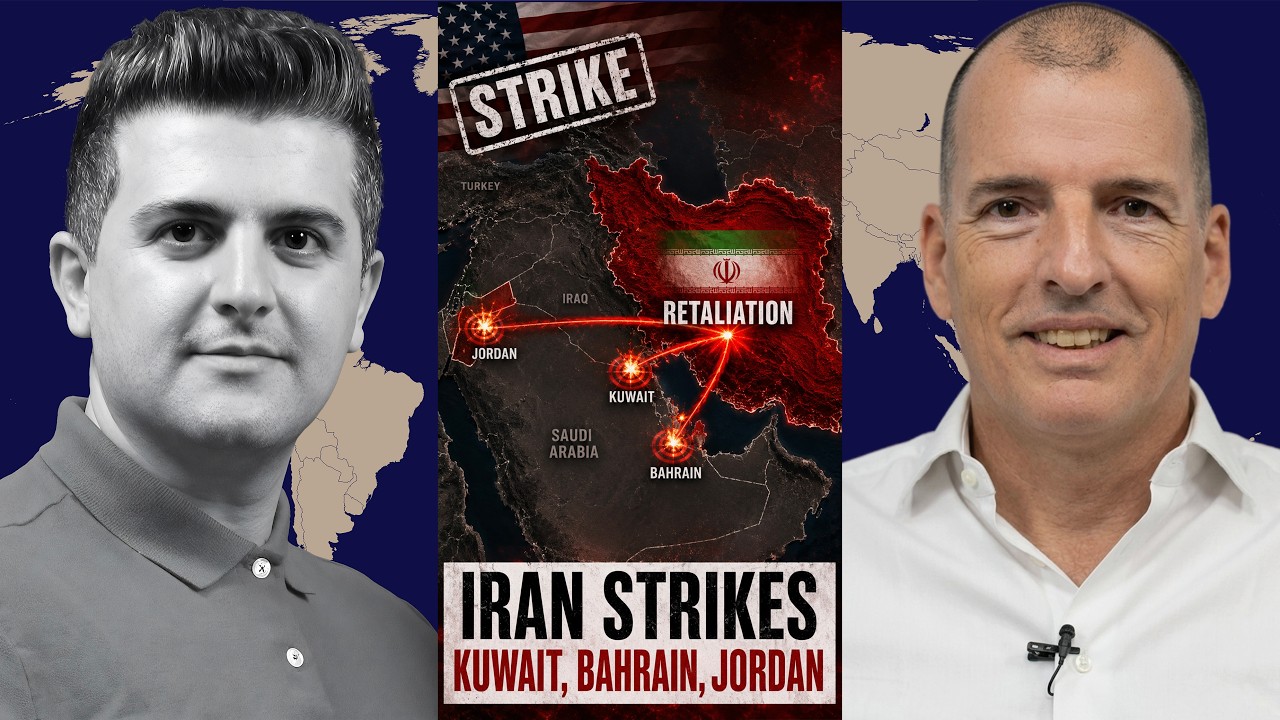
Alex Krainer: US STRIKES Iran – Iran RETALIATES Against Kuwait, Bahrain & Jordan!
"Amidst escalating US-Iran conflict and Iranian retaliation against regional US allies, this episode argues that US foreign policy is deeply controlled by an 'Anglo-Zionist conspiracy' led by the Rothschild banking dynasty, prioritizing Israeli interests over American ones."