
"Heading For A Global DEPRESSION!" Professor Jiang Debates Iran War, Trump And China Ties
YouTube · dbVdnL6HWOg
Quick Read
Summary
Takeaways
- ❖The Strait of Hormuz closure is causing a monumental shock to global production systems, impacting oil, helium, fertilizer, and sulfuric acid supplies.
- ❖Economists predict a financial crisis stemming from damage to the physical production system, a reversal of typical financial-to-manufacturing shocks.
- ❖Trump's Iran policy is viewed as a 'massive gamble' that alienated allies, making international cooperation difficult.
- ❖China engaged in 'backdoor diplomacy' for the Iran ceasefire and is building manufacturing resilience and self-sufficiency, positioning itself as a potential long-term economic leader.
- ❖There are starkly opposing views on the future: a multi-decade global depression versus an unprecedented AI/robotics-driven productivity revolution.
- ❖Bitcoin is critiqued as a 'naive' alternative to money, primarily a speculative store of value with high energy consumption, destined to fall to its 'illegal transaction' floor.
Insights
1Iran Conflict's Monumental Economic Shock
The closure of the Strait of Hormuz is not merely an energy crisis but a severe disruption to the planet's physical infrastructure. It has destroyed a large part of the planet's infrastructure for dragging oil out of the ground, impacting 30% of the world's helium supply, 30-50% of fertilizer, and half of the sulfuric acid used industrially. This will cause a monumental shock to the global production system.
Steve Keen states, 'every measure I've seen said it's larger than 1973 with the Omipa war, larger than the price rise in the 1979 when prices increased by a factor of four.' He details the destruction of helium, fertilizer, and sulfuric acid supplies.
2Financial Markets Underreacting to Physical Production Damage
Current financial markets are remarkably resilient despite the severe stress on the global economy. This underreaction is expected to be followed by an overreaction, leading to a financial crisis caused by damage to the physical production system, a reversal of the usual dynamic where financial issues impact manufacturing.
Steve Keen references George Soros's market approach: 'the markets actually do is they underreact in the first place and then overreact later.' He notes financial experts ignore 'physical manufacturing processes behind what's happening in the straight.'
3Trump's Iran Policy as a 'Massive Gamble'
President Trump's approach to Iran, including the incursion and withdrawal from the nuclear deal, was a significant gamble with substantial economic and political downsides. His public criticism of allies further complicated international cooperation needed to address the crisis.
Piers Morgan states, 'it struck me that this was always a massive gamble by President Trump and that the potential downside was was big and it's turned out to be very big so far.' Steven Moore acknowledges 'short-term pain for long-term gain' but questions its duration. Piers also points out Trump 'keeps trashing them all publicly' making allies unwilling to help.
4China's Strategic Resilience and Potential Isolationism
China is not 'sitting out' the Iran crisis, having engaged in 'backdoor diplomacy' for a ceasefire. It has shown greater economic resilience and adaptability than other Southeast Asian countries and has been strategically preparing for such eventualities. However, its export-dependent economy and resource consumption make long-term global conflict unfavorable, potentially leading to increased isolationism.
Professor Jiang states, 'China did a lot of backdoor diplomacy in order to pressure the Iranians to attempt a ceasefire.' He adds, 'China has been much more resilient and much more able to adapt to the new economic circumstance.' He predicts China 'may see that China begins to become much more isolationist over the years.'
5The Threat of a Global Depression vs. AI-Driven Boom
The world faces two extreme, opposing futures: a multi-decade global depression due to energy and resource shocks, or an unprecedented productivity revolution driven by AI and robotics. The outcome depends on navigating current geopolitical and environmental challenges.
Professor Jiang states, 'we are heading towards a global depression and this is a process that could take decades.' Steven Moore counters, 'we are entering the greatest period of productivity revolution in the history of civilization.' Steve Keen frames it as a 'sliding doors moment' between 'catastrophe from global warming' and a 'future of plenty.'
6Bitcoin's Inherent Flaws and Limited Future
Bitcoin is fundamentally flawed as an alternative to money because it's treated primarily as a store of value, discouraging its use as a means of payment. Its value is speculative, and its high energy consumption makes it vulnerable in an energy-constrained world. Its long-term 'floor' value is likely limited to facilitating illegal transactions.
Steve Keen states, 'Bitcoin can only be used as either a store of value or a means of payment... it's still not used by any scale as a means of payment.' He adds, 'when it stops rising, then the only way to go is down' and predicts its floor at 'illegal drug sales... and weapon sales.' He also notes its 'enormous amounts of energy' consumption.
Bottom Line
The current economic crisis is unique because it's driven by physical production system damage, not financial system failure, suggesting traditional economic models may be insufficient for forecasting or intervention.
Policymakers and investors relying solely on financial indicators might misinterpret the severity and nature of the downturn, leading to ineffective responses. A focus on supply chain resilience and resource security is paramount.
Investment in technologies and infrastructure that enhance local production, resource efficiency, and alternative supply chains could become critical, especially for nations seeking to reduce reliance on vulnerable global chokepoints.
China's long-term strategic planning and investment in self-sufficiency (including alternative energy like thorium reactors) positions it uniquely to potentially 'win' in a fragmented, resource-constrained global environment, contrasting with Western focus on military intervention.
Western nations, particularly the US, may be strategically disadvantaged by prioritizing military solutions and neglecting domestic infrastructure and energy independence, potentially ceding technological and economic leadership.
Governments and businesses should re-evaluate national security beyond military terms to include economic self-sufficiency, critical resource development, and advanced energy technologies, potentially mirroring China's long-term strategic investments.
Key Concepts
Soros's Market Reflexivity
George Soros's approach to markets, where markets first underreact to events and then overreact later, creating opportunities for those who anticipate these shifts. This is applied to the current underreaction of financial markets to the physical destruction of global infrastructure.
Lessons
- Re-evaluate investment portfolios for resilience against supply chain disruptions and energy price volatility, considering the 'underreaction then overreaction' market dynamic.
- Monitor geopolitical developments in critical energy chokepoints like the Strait of Hormuz closely, as they have direct and profound impacts on global resource availability and prices.
- Consider the long-term implications of national energy policies, recognizing that 'drill baby drill' strategies, while increasing domestic supply, do not fully insulate an economy from global market prices or geopolitical instability.
Notable Moments
The heated exchange where Steve Keen calls America the 'evil empire' and Steven Moore retorts that such a view indicates a 'personality disorder,' highlighting the deep ideological divide on US foreign policy.
This moment encapsulates the intense disagreement on America's role in global conflicts and the moral justification for its actions, which underpins much of the economic and geopolitical debate.
The stark contrast between Professor Jiang's and Steve Keen's prediction of a multi-decade global depression and Steven Moore's vision of an 'incredible future' driven by AI and robotics.
This illustrates the extreme divergence in expert opinion regarding the fundamental trajectory of human civilization, forcing listeners to consider radically different future scenarios.
Quotes
"I think that we are heading towards a global depression."
"What actually the markets actually do is they underreact in the first place and then overreact later."
"When you destroy helium production, when you destroy fertilizer throughput, when you lock all those resources up, the production system has to fall over. So, this is going to be a financial crisis caused by a damage to the production system."
"Energy is the master resource. Everything that we have is derivative of energy."
"If you want to get people to help you, probably don't call them a bunch of morons all the time would be my starting point."
"China is the one country that seems to be pushing itself heavily in towards alternative energy, both renewables and nuclear... America's wasted its time invading other countries, blowing up the rest of the planet, trying to control the oil system rather than building its own infrastructure. China is the winner."
Q&A
Recent Questions
Related Episodes

Iran Update: Israel’s Newest Bombing Campaign, the Oncoming War With China and How to Avoid It
"Colonel Wilerson reveals how the US and Israel are actively bombing China's strategic infrastructure in Iran, escalating a covert economic war that Beijing intends to win without direct military conflict by dismantling the dollar's global dominance."
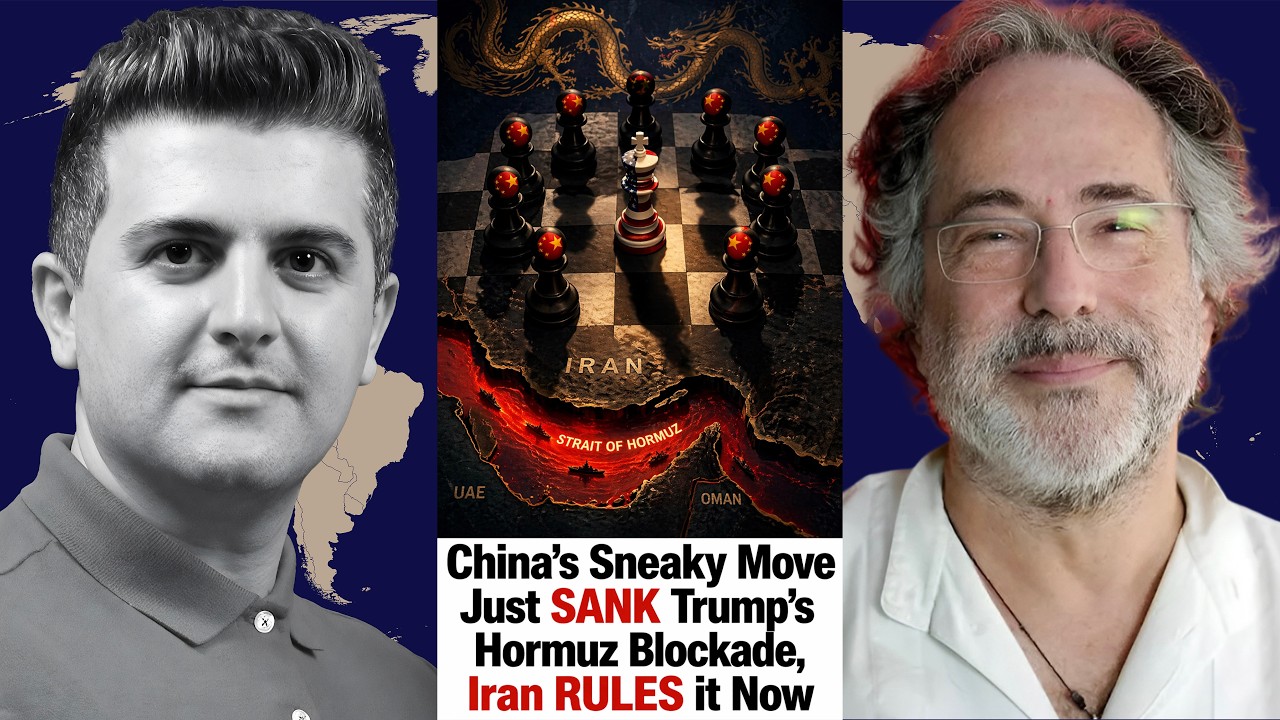
Pepe Escobar: “Total Failure”: Trump’s Blockade Just Backfired Disastrously
"Pepe Escobar argues that the US blockade against Iran, spearheaded by Donald Trump, has utterly failed and backfired, accelerating global economic chaos and challenging US geopolitical dominance."

🚨 LEFTISTS ARE F*CKING SEETHING 😂😂😂
"The host aggressively celebrates perceived 'wins' for the right-wing, from global conflicts and domestic politics to cultural shifts, framing them as a 'humiliation' for the 'leftist world order' and a testament to Donald Trump's influence."

Bibi DEMANDS Ground Troops As Marines Rushed to Iran
"Benjamin Netanyahu is pushing for US ground troops in Iran, framing air strikes as insufficient, while the US rushes Marines to the region and struggles to secure the Strait of Hormuz against surprisingly capable Iranian defenses."