
PBS News Hour full episode, April 27, 2026
YouTube · e2BhkC9b6qU
Quick Read
Summary
Takeaways
- ❖Cole Tomas Allen, 31, was charged with attempted assassination of President Trump after breaching security at the White House Correspondents' Dinner, armed with two firearms and knives.
- ❖A Secret Service agent was shot during the incident but was protected by a bulletproof vest, with officials praising law enforcement's response.
- ❖Former Secret Service agent Bill Gage described the incident as a 'massive security success story' due to overlapping security perimeters, but recommended immediate changes like pushing out magnetometers and hardening checkpoints.
- ❖Iran proposed reopening the Strait of Hormuz if the U.S. lifts its blockade, unfreezes assets, and pauses nuclear program negotiations, an offer the U.S. deemed 'not good enough'.
- ❖The Supreme Court heard arguments on whether federal pesticide laws shield Bayer (Roundup's maker) from lawsuits alleging its glyphosate ingredient causes cancer.
- ❖Health Secretary Robert F. Kennedy Jr.'s characterization of autistic people as unable to achieve independence sparked a contentious debate about dividing the autism spectrum, with advocates fearing stigmatization and parents of high-needs individuals seeking greater recognition.
- ❖The Trump administration's support for Bayer in the Roundup case has created significant tension with the 'Make America Healthy Again' (MAHA) movement, which advocates for stricter pesticide regulation.
Insights
1Secret Service Protocols Proved Effective, Yet Require Refinement
Despite an armed assailant breaching an outer security layer at the White House Correspondents' Dinner, the Secret Service's concentric security rings successfully prevented the attacker from reaching the President. Former agent Bill Gage emphasized this as a 'massive security success story.' However, the incident highlighted areas for improvement, particularly regarding the placement and staffing of magnetometer checkpoints and evacuation plans for other high-ranking officials.
Bill Gage, a former Secret Service special agent, stated, 'Secret Service operates having sort of overlapping and concentric rings of security... if one of them sort of fails or is stretched, the overlapping one will sort of be able to stop an attacker. And that's what happened here.' He also noted, 'I think you're going to see those magnetometer checkpoints pushed out some and those checkpoints being staffed by additional agents, probably tactical teams.'
2Iran-U.S. Negotiations at an Impasse Over Strait of Hormuz and Nuclear Program
Iran presented a proposal to reopen the Strait of Hormuz in exchange for the U.S. lifting its blockade, unfreezing Iranian assets, and pausing nuclear program negotiations. The U.S. rejected this offer, insisting on the permanent dismantling of Iran's nuclear program. This fundamental disagreement has led to a diplomatic deadlock, with an Iranian official describing the moment as 'totally an impasse.'
An Iranian official told PBS NewsHour that Iran made a proposal to reopen the Strait of Hormuz if the U.S. lifts its blockade, unfreezes blocked Iranian assets, and pauses any negotiation of Iran's nuclear program. The official added that the U.S. already described this offer as 'not good enough.' Secretary of State Marco Rubio stated, 'We have to ensure that any deal that is made... definitively prevents them from sprinting towards a nuclear weapon at any point.'
3Roundup Cancer Lawsuits Expose Deep Political Rifts and Regulatory Challenges
The Supreme Court heard arguments in a case concerning whether federal law shields Bayer from lawsuits alleging Roundup's glyphosate causes cancer. This legal battle has created significant tension within the Trump administration, as President Trump's executive order boosted glyphosate production and his administration is arguing on behalf of Bayer, directly conflicting with the 'Make America Healthy Again' (MAHA) movement and Health Secretary Robert F. Kennedy Jr.'s stance.
Helena Bottemiller Evich explained, 'At the heart of this is whether or not EPA has the final say on pesticides.' She noted, 'Bayer has been supported by the Trump administration at every turn through an executive order. The Trump administration is actually before the Supreme Court arguing on behalf of Bayer as well. And so MAHA is furious about this.'
4Debate Over Autism Spectrum Definition Highlights Support Needs Discrepancies
Comments by Health Secretary Robert F. Kennedy Jr. characterizing autistic individuals as unable to achieve independence reignited a contentious debate about whether the autism spectrum is too broad. Parents of severely autistic individuals, like Alicia Mesa, feel such distinctions would help secure necessary resources, while advocates like Jordyn Zimmerman, a non-speaking autistic woman, fear that labels like 'profound autism' could lead to stigmatization and limit opportunities.
Robert F. Kennedy Jr. stated, 'These are kids who will never pay taxes, they will never hold a job... Many of them will never use a toilet unassisted.' Alicia Mesa, mother of a severely autistic son, said, 'I felt relief. Finally, someone in high office was acknowledging the reality that my son lives through every single day.' Jordyn Zimmerman, a non-speaking autistic woman, expressed, 'My worry with that for myself and everyone in the community is that the narrative doctors told my family... is wildly different than who I am.'
Bottom Line
The White House Correspondents' Dinner incident, despite being a security 'success' in containing the threat, will likely lead to a significant re-evaluation of security protocols for all large public events involving high-ranking officials, potentially making them more restrictive and less accessible.
This could impact not only political events but also public gatherings where officials are present, leading to increased costs, logistical challenges, and a potential reduction in the informal interactions that often characterize such events.
Security firms specializing in high-level event protection and advanced threat detection technologies will likely see increased demand and opportunities for innovation in hardening public venues against determined attackers.
The internal conflict within the Trump administration regarding Roundup and pesticide regulation, pitting economic interests against public health concerns (as championed by RFK Jr. and the MAHA movement), reveals a deeper ideological struggle that could fracture conservative coalitions and influence future environmental and health policy.
This division could lead to unpredictable policy shifts, create opportunities for bipartisan alliances on specific issues, and force companies like Bayer to navigate a more complex and politically charged regulatory landscape, regardless of Supreme Court rulings.
Advocacy groups focused on public health and environmental safety could leverage these internal tensions to push for stronger regulations, while businesses developing alternative, safer agricultural solutions may find increased market receptivity and political support.
Lessons
- For event organizers hosting high-profile government officials, proactively engage with Secret Service and DHS to review and harden security perimeters, considering measures beyond standard magnetometer checkpoints.
- Businesses in the agricultural sector should closely monitor the Supreme Court's decision on the Roundup case and its implications for product liability and warning label requirements, preparing for potential shifts in regulatory compliance and consumer perception.
- Advocates and policymakers in the autism community should focus on developing nuanced support frameworks that address the diverse needs across the spectrum without creating stigmatizing divisions, emphasizing communication access and individualized care plans.
Notable Moments
Liz Landers' and Lisa Desjardins' firsthand accounts of the White House Correspondents' Dinner attack, including Landers scootering to the White House for a briefing and Desjardins observing Rep. Steve Scalise (a past shooting survivor) being escorted out.
These personal narratives provide a visceral understanding of the chaos and immediate journalistic response during a major security incident, highlighting the bravery of reporters and the lingering trauma of political violence on public figures.
Quotes
"It's always shocking when something like this happens. Happened to me a little bit, and that never changes."
"The Americans clearly have no strategy. And the problem with conflicts like this is always that you don't just have to go in. You also have to get out."
"It has ripped open major tensions within this MAHA and MAGA coalition."
"Parents like myself are exhausted. I can't go and advocate for him, just take a trip to Washington. So he has the potential to disappear completely from the conversation."
"It was painful to think about all I had missed and all the ways I had been so misjudged, but also incredible to think about how I could now have a say in my life."
Q&A
Recent Questions
Related Episodes

BREAKING: U.S. SINKS Iranian Boats; Iran Talks Stall; Israel Hits Beirut | TBN Israel
"The U.S. and Israel escalate military actions against Iran and its proxies, while diplomatic talks stall over Iran's nuclear program, Strait of Hormuz fees, and the future of Hezbollah."

PBS News Hour full episode, May 8, 2026
"This episode unpacks escalating US-Iran military actions in the Strait of Hormuz, a resilient yet divergent US jobs market, the ongoing political battle over congressional redistricting, and the controversial new US counterterrorism strategy."

🚨 TOTAL F*CKING CHECKMATE 😂😂😂
"The host argues that Trump's 'ceasefire' with Iran was a calculated '5D chess' move to orchestrate a global energy market reshuffle, while simultaneously lambasting 'woke' domestic policies and the 'freefall' of anti-Trump conservative figures."
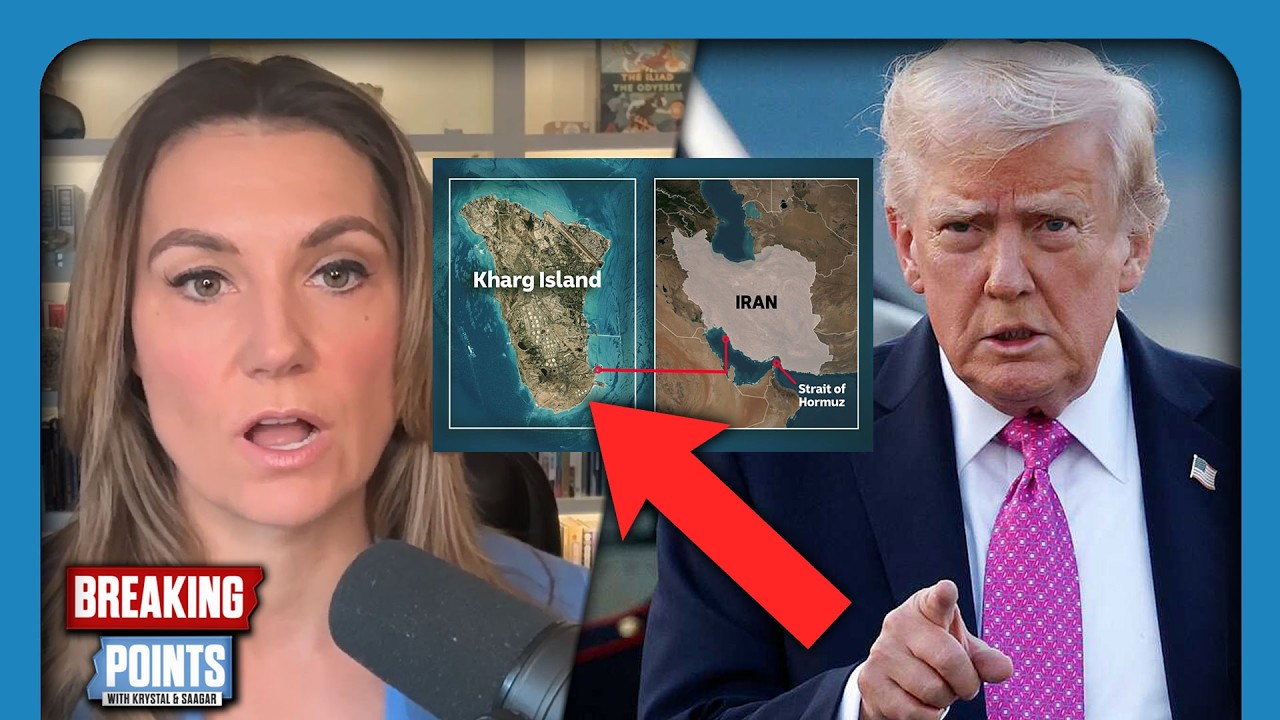
BREAKING: TRUMP ATTACKS OIL ISLAND, MARINES CALLED IN, 5 US PLANES HIT
"The US-Iran conflict escalates with a Trump-ordered strike on Iran's Karg Island, triggering Iranian retaliation against UAE oil facilities and US military assets, while the US deploys Marines and Israel plans a ground invasion of Lebanon."