
Will US/Israel Consider Nukes On Iran
YouTube · gREeZ66QH4I
Quick Read
Summary
Takeaways
- ❖The US is depleting its critical missile defense stockpiles, evidenced by the redeployment of THAAD and Patriot systems from South Korea to the Middle East.
- ❖Iran is effectively using cheap drones to exhaust expensive US interceptors, while maintaining combat effectiveness through decentralized command and control.
- ❖The conflict risks spreading to the Horn of Africa, with potential Ethiopian mobilization against Eritrea to facilitate US/Israeli missile launches against Houthis.
- ❖Concerns are high that Israel, facing a dire situation, might employ tactical nuclear weapons, and the US could also consider nuclear escalation or atmospheric tests.
Insights
1US Missile Stockpile Depletion and Indo-Pacific Weakening
The US is moving THAAD and Patriot anti-missile systems from South Korea and the Indo-Pacific to the Middle East. This indicates that US Central Command (CENTCOM) has exhausted its critical stockpiles for a high-tempo war, estimated to be only 8 days' worth. This action weakens the US's standing in the Indo-Pacific, leading to allies like South Korea feeling 'betrayed'.
Reports of THAAD/Patriot redeployment; CENTCOM's 8-day stockpile estimate; South Korean leader's 'betrayed' comment.
2Iran's Effective Asymmetric Strategy
Iran's strategy involves using inexpensive drones to force the US to expend its limited, multi-million dollar interceptor missiles. Simultaneously, Iran attacks high-end radar systems to create channels for its more advanced missiles, which have not yet been fully deployed. Iran has also decentralized its command and control, making its forces resilient to strikes.
Iranian use of $100,000 drones against multi-million dollar interceptors; attacks on high-end radar systems; decentralization of command and control; estimated 88,000-100,000 drones.
3US Strategic Failure Driven by Political Commitments
Despite warnings from top military officials, including Vice Admiral Cotcher and General Kaine, President Trump is deeply committed to the war with Iran, aiming for regime change. This commitment is linked to his relationship with Netanyahu and Israeli business ties. The US strategy is criticized for not aligning with realities on the ground and for pursuing multiple, conflicting objectives (regime change, denuclearization, missile degradation) without adequate resources.
Relief of Vice Admiral Cotcher for leaking contentious meetings; Trump's commitment to the conflict; alleged deal with Miriam Adelson; Trump family's Israeli business ties.
4Potential for Nuclear Escalation by Israel and US
Brandon Wikard expresses serious concern that Israel, facing a dire and underreported situation, might resort to using tactical nuclear weapons (the 'Samson option') against Iran. He also believes that given President Trump's rhetoric of 'going so big' and the current escalation path, the US deploying nuclear weapons or conducting an atmospheric test is not impossible, especially if conventional means fail to 'break' Iran.
Dire situation in Israel; 'Samson option' doctrine; Trump's 'go so big' rhetoric; historical precedent of India-Pakistan nuclear tensions.
5Concealment of US Casualties
Official reports of US military casualties (7 killed, 8 seriously wounded) are likely understated. The host and guest believe the actual numbers are significantly higher, citing the extensive damage to facilities like the Fifth Fleet headquarters in Bahrain, which is described as a 'moonscape'. They suggest casualties are being released slowly to avoid shocking the public.
Wall Street Journal reporting 7 killed, 8 wounded; Secretary Hegath declining to give total numbers; description of Bahrain's Fifth Fleet headquarters as a 'moonscape'.
Bottom Line
The war could expand into the Horn of Africa, with Ethiopia potentially mobilizing to hit Eritrea's coastline. This would allow the US and possibly Israel to mount land-based missile launchers there to better attack the Houthis.
This regional expansion would further complicate the conflict, draw in more actors, and increase the humanitarian and geopolitical stakes in an already volatile area.
Analysts should monitor Ethiopian-Eritrean relations and US/Israeli military movements in the Red Sea and Horn of Africa for early indicators of this expansion.
Iran's missile production capabilities are largely underground and unknown to the US, making claims of 'taking out' their production capabilities largely speculative and ineffective.
This means US airstrikes are likely having a limited long-term impact on Iran's ability to wage asymmetric warfare, prolonging the conflict and making a decisive military victory through airpower unlikely.
Intelligence agencies and defense planners need to reassess the true extent of Iran's hardened and dispersed military infrastructure to avoid overestimating strike effectiveness.
Key Concepts
Interceptor Math / Asymmetric Warfare
The concept that defending against cheap, numerous attacks (e.g., $100,000 drones) with expensive, limited resources (e.g., multi-million dollar interceptor missiles) is an unsustainable strategy that quickly depletes a defender's capabilities. Iran is leveraging this asymmetry.
Decentralized Command and Control
A military strategy where operational authority and resources are distributed among field commanders, allowing forces to remain combat-effective even if central command is disrupted. This makes an adversary more resilient to targeted strikes against leadership or infrastructure.
Lessons
- Monitor US military redeployments from the Indo-Pacific, as they signal critical resource strain and potential shifts in global power projection.
- Analyze Iran's asymmetric warfare tactics (cheap drones vs. expensive interceptors, decentralized command) to understand how non-state or less technologically advanced actors can challenge superior military powers.
- Pay close attention to rhetoric and actions regarding nuclear options from both Israel and the US, as the risk of escalation is considered significantly higher than previously thought.
Notable Moments
Discussion of Vice Admiral Cotcher's relief from post for leaking details of a contentious meeting between General Kaine and President Trump, where generals warned against the war.
This highlights the significant internal military opposition to the conflict and suggests that political motivations are overriding expert strategic advice, potentially leading to disastrous outcomes.
Quotes
"To be an enemy of America is dangerous, but to be a friend of America is fatal."
"You're basically trying to hit a $100,000 at best drone with a missile that's a couple million dollars and we as I noted we don't have a lot of those anyway."
"The president is deeply committed to this war and I think this probably has something to do with his relationship with Netanyahu."
"The Iranian strategy is very simple. Survive. That's all the regime has to do. And it has done that."
"I believe the Israelis are getting ready to pop off a nuke. I really do. And I think this is a very dire moment in the history of our country because we are highly tethered to this insane policy. It's not our own policy. We're not writing it. This is the Israelis writing it for us."
Q&A
Recent Questions
Related Episodes
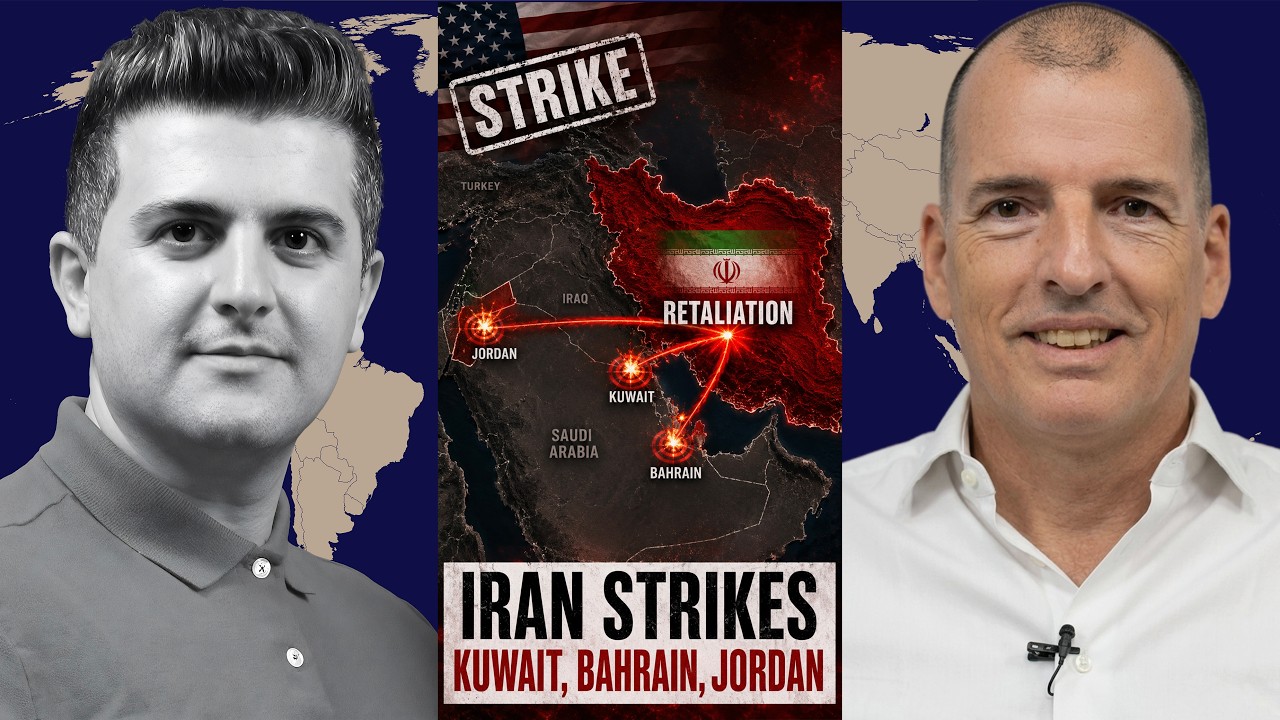
Alex Krainer: US STRIKES Iran – Iran RETALIATES Against Kuwait, Bahrain & Jordan!
"Amidst escalating US-Iran conflict and Iranian retaliation against regional US allies, this episode argues that US foreign policy is deeply controlled by an 'Anglo-Zionist conspiracy' led by the Rothschild banking dynasty, prioritizing Israeli interests over American ones."

Iran Update: Israel’s Newest Bombing Campaign, the Oncoming War With China and How to Avoid It
"Colonel Wilerson reveals how the US and Israel are actively bombing China's strategic infrastructure in Iran, escalating a covert economic war that Beijing intends to win without direct military conflict by dismantling the dollar's global dominance."

Bibi DEMANDS Ground Troops As Marines Rushed to Iran
"Benjamin Netanyahu is pushing for US ground troops in Iran, framing air strikes as insufficient, while the US rushes Marines to the region and struggles to secure the Strait of Hormuz against surprisingly capable Iranian defenses."

BREAKING: Iran Threatens To END Talks; U.S. Vows Retaliation; Hezbollah Collapsing? | TBN Israel
"Iran is leveraging Hezbollah and the Strait of Hormuz to manipulate US negotiations, while Israel asserts its right to dismantle Hezbollah's eroding but still dangerous infrastructure in Lebanon, independent of international talks."