
Seyed M. Marandi: Rockets from Lebanon Strike Deep in Israel – Decisive Iran-US Clash Imminent
YouTube · gfUh61RczdQ
Quick Read
Summary
Takeaways
- ❖Iran's threat of a massive missile strike on northern Palestine directly deterred an Israeli attack on Beirut's Dahiyeh district.
- ❖The 'Axis of Resistance' uses economic pressure, including the potential closure of the Strait of Hormuz and Bab el-Mandeb, as a strategic tool to force US intervention against Israeli aggression.
- ❖Iran's patience is aimed at making the US prioritize its own interests over Israeli interests, not at collapsing the global economy.
- ❖Western media, NGOs, and certain Arab regimes are seen as complicit in Israeli actions and attempts to isolate the resistance.
- ❖Iran demands a comprehensive regional ceasefire, including Gaza, and will not accept deals that permit Israeli violations or occupation.
- ❖The Lebanese government is criticized for blocking Iranian aid to refugees and attempting to push for a ceasefire that allows Israeli presence.
Insights
1Iran's Direct Deterrence of Israeli Aggression
Israel announced plans to 'flatten' Dahiyeh, a large residential area in Beirut. Iran viewed this as a red line and prepared a significant missile strike. This direct threat, communicated to the US, reportedly resulted in the US forcing Israel to back down.
Iran was about to fire a huge volley of missiles at northern Palestine... Trump has made that statement basically forcing this race to stop.
2Strategic Use of Economic Choke Points
Iran and its allies strategically leverage control over critical maritime choke points like the Strait of Hormuz and Bab el-Mandeb as a means of economic pressure and a guarantee for future agreements. While full economic disruption is avoided to prevent global collapse, these options remain powerful 'last resort' measures to build pressure on the US to act against Israel and ensure compliance with any future deals.
The next war will probably lead to the shutting of the Red Sea because it is expected here that the escalation will be very swift and very rapid. ... The Strait of Hormuz is Iranian and Omani territorial water and we will get our reparations through our territorial water that is being used. If you don't like it, you shouldn't have started the war. ... Bab el-Mandeb is still there. And we can just close Bab el-Mandeb as well. These are two important choke points in the hand of the axis of resistance.
3Critique of Western and Regional Complicity
The speaker asserts that Western nations, their NGOs, and certain Arab regimes (Qatar, UAE, Saudi Arabia) actively collude with Israel to isolate and destroy the 'Axis of Resistance' and its civilian supporters in Lebanon and Gaza. This includes encouraging sectarian divisions in Lebanon, preventing refugees from finding shelter, and supporting Israel's genocidal actions, while Western media suppresses information about civilian casualties.
The United States and the Europeans and their NGOs in Lebanon and the Saudis and the Qataris... have been encouraging their people and the Emirates in Lebanon not to allow the refugees into their neighborhoods. ... Aliyev in and in in Azerbaijan, a Shia country, an ally of the Israeli regime is transporting oil to help Netanyahu through Turkey.
Bottom Line
The 'Axis of Resistance' deliberately avoids full global economic collapse, despite having the capability to cause it, to maintain a moral high ground and prevent widespread human suffering.
This suggests a calculated restraint in their strategy, aiming for specific political outcomes rather than indiscriminate destruction, which contrasts with common Western narratives of them being purely destructive.
Western policymakers could explore this stated restraint as a potential avenue for de-escalation or negotiation, understanding that the 'Axis of Resistance' has specific, articulated limits to its economic warfare.
The Lebanese government is actively working against its own people by blocking aid from Iran and Iraq to resistance supporters and refugees, aligning with US and Arab dictatorship agendas.
This reveals deep internal divisions and corruption within Lebanon, where elements of the government prioritize external alignment over the welfare of its citizens, complicating humanitarian efforts and internal stability.
International aid organizations and diplomatic efforts need to recognize and navigate the Lebanese government's alleged obstructionism, potentially seeking alternative channels for aid delivery or pressuring the government to allow humanitarian access.
Key Concepts
Escalation Ladder
The concept of controlled, tiered responses to provocations, where each 'red line' has a corresponding, higher-level response, with full economic disruption (e.g., closing Red Sea) as a last resort.
Deterrence Theory
The use of credible threats of retaliation (e.g., missile strikes, choke point closures) to prevent an adversary from taking undesirable actions.
Lessons
- Recognize the 'Axis of Resistance's' strategic use of economic leverage (Strait of Hormuz, Bab el-Mandeb) as a primary tool for deterrence and negotiation, not merely as a threat of global economic collapse.
- Understand that Iran's stated red lines regarding civilian protection in Lebanon and Gaza are backed by credible military threats, which have demonstrably influenced US and Israeli actions.
- Critically evaluate Western media narratives on West Asian conflicts, as they are presented as often biased and complicit in obscuring civilian suffering and the motivations of the 'Axis of Resistance'.
Notable Moments
Israel's announced intention to flatten Dahiyeh in Beirut, a densely populated area.
This threat was a critical escalation point that triggered Iran's direct military response threat, demonstrating a clear red line for the 'Axis of Resistance'.
Iran's decision to halt negotiations with the US as an added pressure tactic after Israel's threat to Beirut.
This illustrates Iran's willingness to use diplomatic pauses as a form of leverage, linking negotiation progress directly to de-escalation on the ground.
Quotes
"What the Iranians want is the pressure to build up in the United States to a point where the United States, where the regime, where the elites, including the Zionists in the United States... conclude that their interests are a priority over the Israeli interests."
"Iran does not want the global economy to crash. Whoever thinks that is wrong... the crashing of the global economy will create... starvation, will create global misery. Iran does not want that."
"The Strait of Hormuz is Iranian and Omani territorial water and we will get our reparations through our territorial water that is being used. If you don't like it, you shouldn't have started the war."
Q&A
Recent Questions
Related Episodes

Patrick Henningsen: Hezbollah JUST Fired Back at Israel - Iran Vows to “Crush” All Attacks
"Patrick Henningsen argues that the US and Israel initiated an illegal war against Iran, driven by Trump's incompetence and Israeli influence, leading to an inevitable escalation with severe global economic repercussions."
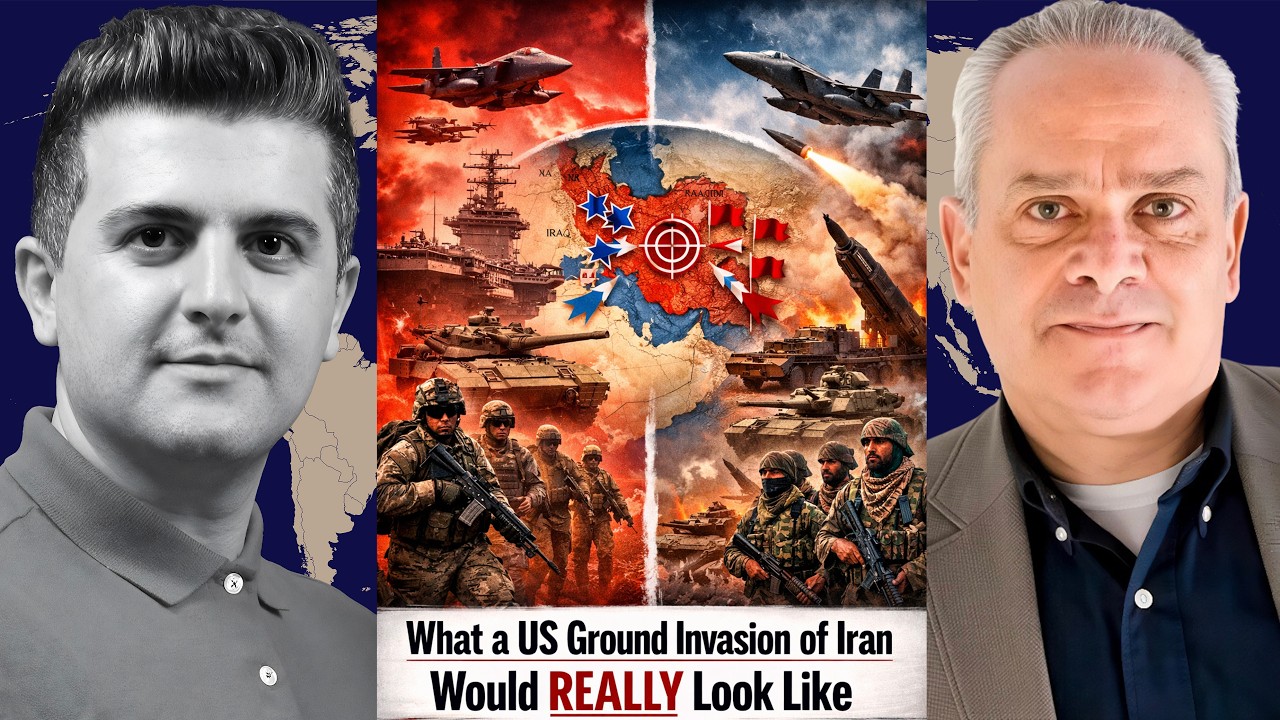
Col. Jacques Baud: What a US Ground Invasion of Iran Would REALLY Look Like
"Colonel Jacques Baud dissects the strategic futility of a US ground invasion of Iran, arguing that current troop levels are insufficient and such an action would backfire, exposing US allies and potentially leading to Iran's nuclearization."

BREAKING: Iran Threatens To END Talks; U.S. Vows Retaliation; Hezbollah Collapsing? | TBN Israel
"Iran is leveraging Hezbollah and the Strait of Hormuz to manipulate US negotiations, while Israel asserts its right to dismantle Hezbollah's eroding but still dangerous infrastructure in Lebanon, independent of international talks."

Iran Update: Israel’s Newest Bombing Campaign, the Oncoming War With China and How to Avoid It
"Colonel Wilerson reveals how the US and Israel are actively bombing China's strategic infrastructure in Iran, escalating a covert economic war that Beijing intends to win without direct military conflict by dismantling the dollar's global dominance."