
Zoning Laws Are Killing the Middle Class (w/ Mechele Dickerson) | How to Fix It
YouTube · hydDPEhUOxY
Quick Read
Summary
Takeaways
- ❖The middle class was created by government policy (e.g., New Deal, GI Bill) and can be restored through new policy.
- ❖Federal housing policy should shift from mortgage interest deductions (favoring the wealthy) to a broader housing credit that benefits renters and lower-income homeowners.
- ❖Local zoning laws, such as minimum square footage and large lot requirements, are exclusionary and must be reformed to allow for diverse, affordable housing options.
- ❖Non-safety-related building regulations should be reduced to lower construction costs and encourage developers to build smaller, more affordable homes.
- ❖Accessory Dwelling Units (ADUs) should be encouraged by local governments to increase housing supply and affordability.
- ❖Public K-12 schools need to adapt their calendars and utilize buildings more effectively to support working parents and prevent 'summer slide' for lower-income children.
- ❖Higher education financial aid has skewed towards merit-based scholarships for rich students; it must return to need-based support for middle and lower-income students.
- ❖States must increase funding for public colleges and community colleges to reduce tuition burdens.
- ❖Employers should reconsider bachelor's degree requirements for jobs that don't need them, and vocational training should be adequately funded and promoted.
- ❖Tax codes should incentivize companies to retrain workers displaced by automation and AI, rather than just subsidizing efficiency gains that lead to layoffs.
- ❖The decline of pensions has left many without retirement savings; companies and policymakers must address this to ensure middle-class retirement security.
- ❖Government has the capacity to mobilize large workforces for public service by offering competitive wages, benefits, and debt relief, as demonstrated by the creation of ICE.
Insights
1Federal Tax Code Favors Wealthy Homeowners, Not the Middle Class
The federal mortgage interest deduction primarily benefits upper-income homeowners who itemize deductions, doing nothing for renters or lower-income homeowners. This policy actively disadvantages the middle class in an increasingly renter-dominated society.
Most people using the mortgage interest deduction are upper income. A housing deduction or credit for renters and lower-income families would be more equitable.
2Exclusionary Zoning Laws Price Out Middle and Lower-Income Families
Local zoning laws mandating minimum house sizes, large lots, and specific setbacks create exclusionary communities, making it impossible for young people, seniors, and middle-income families to find affordable housing. These regulations reflect outdated assumptions about community needs.
Examples include subdivisions requiring 3500 sq ft minimum homes on half-acre lots. This prevents smaller, more affordable homes needed by different demographics.
3Public Schools Are Underutilized and Mismatched to Modern Work Schedules
The traditional public school calendar and daily schedule, designed for an agrarian economy, are incompatible with the 8-to-5 working hours of most middle and lower-income parents. School buildings are also underutilized, missing opportunities to serve as broader community centers or provide extended educational support.
Parents struggle with summer childcare and after-school arrangements. The 'summer slide' disproportionately affects lower-income children. Schools demonstrated their potential as food and testing centers during COVID.
4Higher Education Financial Aid Skews Towards the Rich, Not the Needy
Colleges and universities have shifted financial aid from need-based to 'merit-based' scholarships, often to attract wealthy students who can pay a significant portion of tuition. This practice diverts funds from poor and middle-income students who genuinely need assistance, making college unaffordable.
Colleges use 'enrollment management programs' to offer partial scholarships to rich students, improving their bottom line more than fully funding poor students.
5Employer Degree Requirements Create an 'Overeducated' Workforce
Many employers unnecessarily require bachelor's degrees for jobs that do not functionally need them. This forces high school graduates into expensive four-year programs, even when vocational training would be more appropriate and affordable, contributing to student debt and underemployment.
Algorithms filter out applicants without bachelor's degrees, even if they possess critical skills. Many recent graduates are in jobs not requiring a degree.
6The Decline of Pensions Threatens Middle-Class Retirement Security
The shift from defined-benefit pensions to defined-contribution retirement plans (like 401ks) since the 1980s has left many middle-class workers without adequate retirement savings. This 'freedom of choice' often results in people not saving enough, leading to poverty in old age.
Many people in their 50s and 60s have nothing saved for retirement, forcing them to continue working or face poverty.
Bottom Line
The hollowing out of the middle class economy directly correlates with the hollowing out of the middle of politics, leading to increased division and polarization.
Economic inequality isn't just an economic problem; it's a fundamental threat to political stability and social cohesion, making economic restoration a political imperative.
Policymakers addressing middle-class economic issues can simultaneously build broader political coalitions and reduce societal anger.
The government's ability to rapidly mobilize a large workforce, as seen with the creation of ICE, demonstrates that a public service workforce for essential, undervalued jobs (like childcare or elder care) is feasible if political will and incentives (signing bonuses, debt relief, decent wages) are present.
Claims that a large public service workforce cannot be created are often about political will, not logistical impossibility. This model could address both unemployment and the undervaluation of critical care sectors.
Policymakers could explore a 'public service corps' model to fill essential roles, provide meaningful employment, and revalue 'care' work, especially in an era of AI-driven job displacement.
Key Concepts
Agrarian Economy School Calendar
The current public school calendar, with long summer breaks and specific daily hours, is a relic of an agrarian economy and is incompatible with the needs of modern working families, particularly those in the middle and lower-income brackets.
NIMBY vs. YIMBY
The conflict between 'Not In My Backyard' (NIMBY) attitudes, which resist housing density and diversity, and 'Yes In My Backyard' (YIMBY) movements, which advocate for more inclusive and affordable housing development, is central to local housing policy debates.
Lessons
- Advocate for federal tax reform that replaces the mortgage interest deduction with a universal housing credit or deduction, benefiting both renters and homeowners across income brackets.
- Engage with local government and planning commissions to push for the elimination of exclusionary zoning laws (e.g., minimum lot sizes, single-family only) and reduction of non-safety-related building regulations to foster affordable housing development and ADUs.
- Support initiatives to extend public school hours, implement year-round schooling, and utilize school buildings as community hubs to better align with working parents' schedules and provide continuous educational enrichment.
- Demand that colleges and universities re-prioritize need-based financial aid over merit-based scholarships for wealthy students, and advocate for increased state funding for public higher education and community colleges.
- Challenge employers to remove unnecessary bachelor's degree requirements for jobs and promote vocational training and apprenticeship programs as viable and respected career paths.
- Push for policies that incentivize companies to invest in worker retraining programs for those displaced by automation and AI, rather than solely subsidizing efficiency gains that lead to job losses.
- Advocate for the re-establishment of retirement security mechanisms, such as pensions or universal retirement savings programs, to ensure that middle-class workers can afford to retire without falling into poverty.
Local Housing Affordability Playbook
Review and identify all exclusionary zoning laws (e.g., minimum square footage, large lot requirements, single-family only zones) within your jurisdiction.
Initiate public discussions and gather community input on the need for diverse housing types (e.g., smaller homes, duplexes, ADUs) to accommodate young people, seniors, and middle-income families.
Propose and implement zoning reforms that allow for greater housing density, smaller lot sizes, and the construction of Accessory Dwelling Units (ADUs) without excessive restrictions.
Conduct an audit of local building regulations, identifying and eliminating those that are not safety-critical but significantly increase construction costs for affordable housing developers.
Explore incentive programs for developers willing to build affordable, smaller-scale housing units, ensuring a diverse housing stock that meets community needs.
Notable Moments
The host and guest discuss how the middle class was a deliberate creation of government policies like the New Deal and GI Bill, implying it can be recreated.
This reframes the middle class as a policy choice rather than an organic economic outcome, empowering policymakers to act.
Mechele Dickerson highlights the irony of trusting childcare workers with infants but not wanting them as neighbors due to exclusionary zoning.
This analogy powerfully exposes the hypocrisy and social cost of exclusionary housing policies, humanizing the 'those people' argument.
The discussion points out that public school calendars are still structured for an agrarian society, creating immense challenges for modern working parents.
This highlights an outdated systemic issue that directly impacts middle-class families' ability to work and children's educational outcomes.
Dickerson uses the mobilization of ICE as an example of the government's capacity to create a large workforce with incentives, suggesting this model could be applied to public service jobs.
This provides a concrete, albeit 'heretical,' example that counters arguments about the impossibility of large-scale government intervention to create jobs and revalue labor.
Quotes
"When you hollow out the middle of our economy, you hollow out the middle of our politics. That's not a coincidence."
"If you trust your baby to be with Miss Becky in the butterfly room, why do you not want to live in the same neighborhood with Miss Becky in the butterfly room?"
"It simply makes no sense for us to act like we're still an agrarian economy."
"There may not be the political will to do it, but we could do it if we wanted to."
Q&A
Recent Questions
Related Episodes

LIVE MAY DAY Protests in NYC
"May Day protests in NYC united thousands against economic inequality, corporate power, and immigrant injustices, demanding systemic change and union strength."

BREAKING: Trump is TERRIFIED That You’ll WATCH THIS INSANE Video!
"The host exposes the stark contrast between public figures' self-portrayals and their actual conduct, from Trump's 'Great American State Fair' flop to Ken Paxton's hypocritical vacation, and Tucker Carlson's alarming embrace of Russian propaganda."
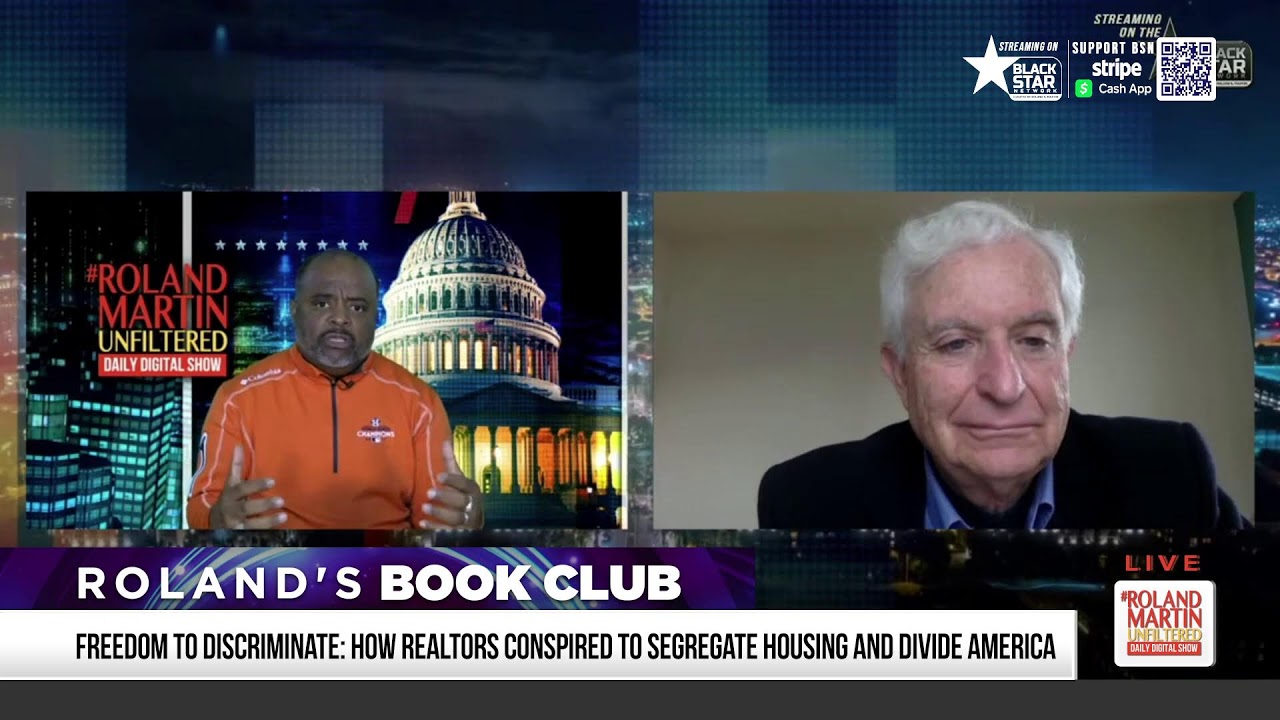
Freedom to Discriminate: Realtors Conspired to Segregate Housing & Divide America |#RolandsBookClub
"This episode exposes how American realtors deliberately invented and institutionalized housing segregation, shaping federal policy and ultimately redefining the concept of 'freedom' to fuel a political ideology that continues to divide the nation."

This is becoming impossible to defend
"Donald Trump's recent actions, from sabotaging a bipartisan housing bill to exhibiting concerning cognitive and behavioral patterns, reveal a leader increasingly detached from reality and detrimental to his own party's success."