
LIVE: Final Iran Talks CHAOS - IRGC Reject Trump Demands - U.S. Troops On High Alert
YouTube · iGnlTg2y0fY
Quick Read
Summary
Takeaways
- ❖US-Iran talks are deadlocked over nuclear issues and the Strait of Hormuz, with the IRGC rejecting US demands.
- ❖President Trump's 2-3 day deadline for the IRGC is seen as a tactic to buy time for US military redeployment.
- ❖US Marines are on high alert, with deployments to the Middle East completed, indicating readiness for military action.
- ❖Internal divisions are escalating within Iran, with clerics publicly challenging the IRGC's authority.
- ❖A pattern of 'fake news' about imminent deals preceding US strikes on Iran has been identified, potentially for market manipulation.
- ❖Previous air strikes failed to bring down the Iranian regime due to its dispersed leadership hiding in non-military locations.
Insights
1Deadlock over Core Issues
US-Iran talks failed due to IRGC's rejection of US demands concerning the reopening of the Strait of Hormuz and the nuclear program. The IRGC initially showed willingness to discuss nuclear issues but later refused, demanding US troop withdrawal and an end to Israeli defense actions in Lebanon before any nuclear discussions.
The IRGC... once again rejected the US demands. It's basically Groundhog Day going back and forth... The deadlock is because of nuclear and the Strait of Hormuz which is the main points, obviously. Iran's Foreign Minister spokesperson stated claims about discussing nuclear are 'media speculations'.
2Strategic Delay for Military Readiness
The host posits that President Trump used the ceasefire and diplomatic talks as a deliberate tactic to buy time for the US military to redeploy troops and equipment to the Middle East, and to coordinate new strategies with Israel and Arab allies. This was to create legitimacy for potential future strikes.
President Trump has been doing this for the past few weeks since the ceasefire started, only to buy time to redeploy the troops to the Middle East... He had to buy time for the US military to remobilize. Right now, the deployment is basically completed, it's done.
3Internal Power Struggle in Iran
Significant internal divisions are escalating within Iran, characterized by open criticism of the Supreme Leader's authority and the IRGC's dominance. Clerics, feeling sidelined after an alleged IRGC 'coup,' are publicly challenging the military leadership.
The internal divisions in Iran continues to escalate... Hamid Rassai, who's a cleric, openly shouting at the the other side of the regime... and also questioning the authority of the supreme leader. The IRGC did a coup and with Ahmad Vahidi, the IRGC military in charge of the country and the clerics still had a bit of power or positional power which was parliament.
4Pattern of Pre-Conflict Disinformation
The host identifies a recurring pattern where, days before US strikes on Iran, 'fake news' reports surface claiming a deal is imminent or that Trump and Netanyahu are at odds over pursuing diplomacy versus military action. This pattern was observed before previous conflicts in June 2025 and February 2026.
The trend is that days before, every time there was a the conflict returns, Netanyahu and Trump have a fight. They fall out... Straight after that, we had the strikes. 7 hours ago, today, we had new Iran peace proposal triggers tense Trump-Netanyahu call. So this has been... the same thing. Every single time it's the same thing.
Bottom Line
Market Manipulation via Disinformation: 'Fake news' about an imminent US-Iran deal was intentionally 'planted' just before market close, leading to the S&P 500 closing in the green, only for the reports to be debunked minutes later.
Geopolitical events are being actively manipulated to create short-term market reactions, indicating a new layer of risk for investors who rely on immediate news.
Develop sophisticated real-time news verification systems that can identify and flag potentially planted disinformation campaigns related to high-stakes geopolitical events, offering a competitive edge in financial analysis.
IRGC's Strategic Weakness in Negotiations: Despite rejecting US demands, the IRGC was 'cornered' into participating in talks they couldn't walk away from, as immediate strikes would follow. They are limited to defensive actions, unable to initiate preemptive attacks.
The IRGC's negotiating posture is not one of strength but of strategic constraint, forced to engage in talks to avoid immediate military repercussions.
For intelligence agencies and policymakers, understanding this constraint allows for more effective pressure tactics, potentially by creating scenarios where walking away from talks becomes even more costly than conceding.
Ineffectiveness of Air Strikes Against Dispersed Leadership: Previous 'shock strategy' air strikes, even those targeting the supreme leader, failed to bring down the Iranian regime because its leaders operate from bunkers, hospitals, and schools, not conventional military bases or government offices.
Traditional air campaigns are insufficient against a non-conventional, dispersed leadership structure, necessitating a fundamental rethinking of military strategy for regime change.
Invest in advanced intelligence gathering and precision targeting technologies capable of locating and neutralizing highly mobile and dispersed leadership elements, or develop non-kinetic strategies that exploit internal divisions and economic vulnerabilities more effectively.
Lessons
- Verify geopolitical news from multiple credible sources, especially around market closing times, to avoid being swayed by potentially 'planted' disinformation campaigns.
- Recognize that diplomatic talks in high-stakes conflicts may serve as strategic delay tactics for military repositioning rather than genuine peace efforts.
- Monitor internal political divisions within adversarial regimes, as these can be indicators of instability and potential shifts in power dynamics.
Notable Moments
Reports of a US-Iran deal being 'almost ready' were released just before market close, causing the S&P 500 to close in the green, only to be debunked minutes later.
This highlights a potential instance of deliberate market manipulation through geopolitical disinformation, impacting investor decisions based on false hope of de-escalation.
A cleric in Iran, Hamid Rassai, openly questioned the Supreme Leader's authority and criticized the IRGC's actions during negotiations, a 'very naughty thing to do' in the Islamic Republic.
This public defiance signals escalating internal power struggles and divisions within the Iranian regime, potentially weakening its unified front during external conflicts.
The US Central Command posted a seemingly random image of US Marines refueling an M142 HIMARS on social media.
The host interprets this as a deliberate message of military readiness and activity, aimed at signaling strength and preparedness to adversaries.
Quotes
"The IRGC... once again rejected the US demands. It's basically Groundhog Day going back and forth."
"President Trump has been doing this for the past few weeks since the ceasefire started, only to buy time to redeploy the troops to the Middle East..."
"We get the highly enriched. We will get it and we don't need it. We don't want it. We'll probably destroy it after we get it, but we're not going to let them have it."
"Wars are not scheduled by holidays. I don't understand why people think wars are like some sort of like soap opera or like drama on TV. Like that's not really how reality works."
Q&A
Recent Questions
Related Episodes

Patrick Henningsen: Hezbollah JUST Fired Back at Israel - Iran Vows to “Crush” All Attacks
"Patrick Henningsen argues that the US and Israel initiated an illegal war against Iran, driven by Trump's incompetence and Israeli influence, leading to an inevitable escalation with severe global economic repercussions."
BREAKING: Protests ERUPT In Iran Over IRGC Surrendering To Trump - Infighting Clashes In Tehran
"Iran is experiencing severe internal infighting and protests as hardline IRGC elements clash with government figures over a perceived 'surrender' to the US, while mainstream Western media misrepresents the situation."
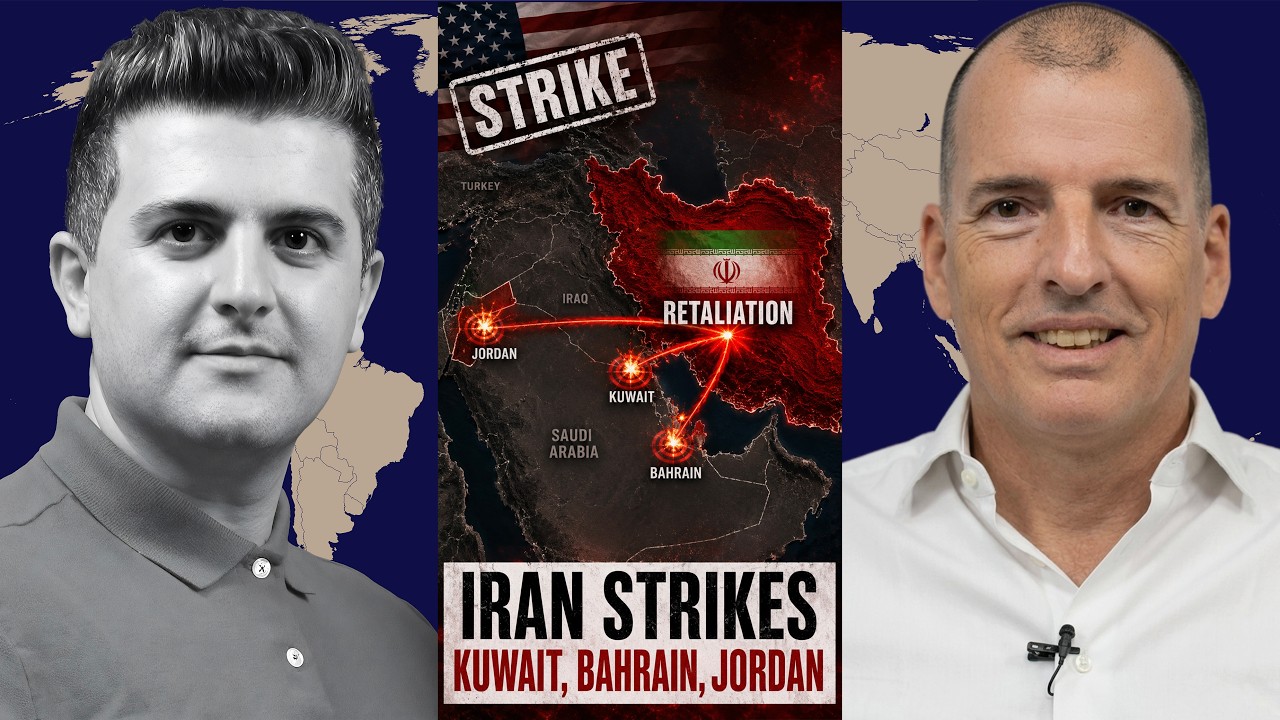
Alex Krainer: US STRIKES Iran – Iran RETALIATES Against Kuwait, Bahrain & Jordan!
"Amidst escalating US-Iran conflict and Iranian retaliation against regional US allies, this episode argues that US foreign policy is deeply controlled by an 'Anglo-Zionist conspiracy' led by the Rothschild banking dynasty, prioritizing Israeli interests over American ones."
Col. Jacques Baud: What a US Ground Invasion of Iran Would REALLY Look Like
"Colonel Jacques Baud dissects the strategic futility of a US ground invasion of Iran, arguing that current troop levels are insufficient and such an action would backfire, exposing US allies and potentially leading to Iran's nuclearization."