
BREAKING: Clashes ERUPT In Lebanon - IRGC Suspend 'Iran Deal' Talks - Israel Says NO CEASEFIRE
YouTube · iV3CtaA_Iiw
Quick Read
Summary
Takeaways
- ❖Hezbollah violated a ceasefire, leading to IDF retaliation and ongoing clashes in southern Lebanon.
- ❖The US announced a ceasefire between Hezbollah and Israel, but the IDF immediately stated they would continue to defend themselves.
- ❖Iran deal talks were suspended, with the IRGC reportedly having a "meltdown" over the situation.
- ❖Mark Zell suggests President Trump's apparent shift on the Iran deal is a strategic move to secure Republican victories in midterm elections by focusing on domestic economic issues.
- ❖Israel's non-inclusion in the Iran memorandum of understanding (MOU) is seen as granting it a "free hand" to act against threats from Hezbollah and potentially Iran.
- ❖The IRGC is attempting to bait Israel and the US into escalating the conflict, possibly to gain a clearer negotiating position or to blame Israel for escalation.
- ❖Internal disunity and conflicting leadership within the Iranian regime (IRGC, parliament, foreign minister) contribute to their unpredictable stance.
- ❖Hezbollah leaders publicly declare their intent to expel Israel from Lebanese soil, rejecting any notion of surrender.
Insights
1Ongoing Clashes Despite Ceasefire Claims
Hezbollah initiated attacks, killing four IDF soldiers, prompting significant Israeli Air Force strikes (over 20, eliminating at least 18 Hezbollah members). The US announced a ceasefire, but Israel explicitly rejected it, continuing operations and hitting over 150 Hezbollah targets since midnight.
Last night, Hezbollah once again violated the ceasefire. The Israelis defended themselves. Today, we also had the Hezbollah side managed to unfortunately kill four IDF soldiers. Today, we still had IDF hitting multiple positions in Lebanon." [], "the United States announced that we now have a ceasefire again between Hezbollah and Israel... The IDF said, 'No. If we get attacked, we're going to continue to defend ourselves.'" [], "Israel launched a new overnight ground advance into southern Lebanon... over 20 strikes were conducted by the Israeli Air Force. At least 18 Hezbollah members were eliminated." [], "the IDF continues to hit Hezbollah... the Israeli Air Force have been hitting southern Lebanon. Multiple targets have been hit despite the ceasefire announcement." [], "the IDF saying that they have now hit more than 150 Hezbollah targets in Lebanon since midnight."
2Trump's Strategic De-escalation for Domestic Gain
Mark Zell posits that President Trump's seemingly contradictory stance on the Iran deal (extending an economic lifeline) is a calculated political maneuver. The goal is to put the Iran conflict "on the back burner" until the midterm elections, allowing Trump to focus on domestic economic issues (gas prices, food prices, stock market) to secure a Republican victory and prevent Democratic attempts to impeach him.
The President is been elected to protect and further American interests... a victory by the Democratic Party in the November midterm elections would result in a catastrophe... he's doing is trying to put the Iran conflict on back on the back burner until the elections. He's got a 60-day ceasefire, he will definitely extend it by another 60 days...
3Israel's "Free Hand" Due to Non-Inclusion in MOU
Israel was deliberately not made a party to the memorandum of understanding (MOU) with Iran. This exclusion, initially seen as a negative, is interpreted as a strategic advantage, giving Israel a free hand to strike back with intensity against Hezbollah, Syria, and potentially Iran, without being constrained by the agreement.
Israel is never a party to this memorandum of understanding. That was deliberate... this gives Israel a free hand. If if the if if things in Lebanon deteriorate like they're doing right now, Israel will strike back and they've said it." [], "By not being part of the deal, Israel can do whatever they want. Obviously, President Trump will have to show outrage and but at the same time, President Trump said again last night, 'If Israel has to attack Iran... of course the United States will send the troops and will help them.'"
4IRGC's Baiting Strategy and Internal Disunity
The IRGC is actively using Hezbollah to "poke the bear" (Israel) to test boundaries and force the Americans' hand, aiming for an escalation that would allow them to blame Israel and potentially trigger US airstrikes, which they might paradoxically desire to unify their fragmented leadership. However, their own "nuclear is our right" rhetoric traps them from making logical concessions in negotiations.
It seems like the IRGC know this and they keep getting Hezbollah to poke the bear, right?" [], "the IRGC could tell Hezbollah to keep poking the bear, to test the waters, to push boundaries, and to force the Americans' hands because they know that the Americans are taking a long break until the next round of the conflict." [], "The IRGC want air strikes to return... they don't have unity. Nobody knows who's actually running the show." [], "they basically trapped themselves by creating this rhetoric of 'Nuclear is our right, blah blah blah.'"
5"Ceasefire" Redefined in the Middle East
Israeli officials and President Trump himself define a "ceasefire" in the Middle East not as a cessation of hostilities, but as a commitment to not escalate attacks or to hit the other side in a "more moderate manner," while still reserving the right to defend oneself.
One of them said, 'A ceasefire being in effect does not prevent us from continuing our operations.' Another one said, 'A ceasefire does not mean ceasing fire. It means not escalating attacks.'... President Trump was asked by a reporter, 'What what what How do you classify a ceasefire in the Middle East?' Then he said, 'Well, it's the Middle East. In that part of the world, ceasefire simply means you'll be hitting the other side in a more moderate manner.'
Bottom Line
The US administration's strategic de-escalation of foreign conflicts for domestic political gain creates a vacuum that regional actors like Israel can exploit to pursue their own security interests more aggressively.
This implies that US foreign policy, particularly in sensitive regions like the Middle East, can be significantly influenced by internal election cycles, leading to unpredictable and potentially more volatile regional dynamics.
For regional powers, understanding US domestic political calendars and priorities can inform their own strategic calculations, allowing them to anticipate periods of reduced US intervention or increased operational freedom.
The IRGC's internal disunity and ideological traps (e.g., "nuclear is our right") hinder their ability to make rational strategic decisions in negotiations, potentially pushing them towards conflict as a default.
This suggests that external pressure or negotiation tactics might be less effective if the internal structure of the adversary is fragmented and driven by entrenched, non-negotiable rhetoric.
Exploiting or understanding these internal divisions could be a key leverage point for adversaries, or a significant challenge for those seeking diplomatic resolutions.
Lessons
- Monitor US domestic political cycles closely for their potential impact on international foreign policy and regional conflicts.
- Recognize that "ceasefire" declarations in volatile regions like the Middle East may not signify an end to hostilities but rather a shift in intensity or a temporary pause.
- Analyze the internal political and ideological constraints of adversarial regimes, as these can significantly influence their negotiation strategies and propensity for conflict.
Quotes
"The President is been elected to protect and further American interests... he's doing is trying to put the Iran conflict on back on the back burner until the elections."
"Israel is never a party to this memorandum of understanding. That was deliberate... this gives Israel a free hand."
"A ceasefire does not mean ceasing fire. It means not escalating attacks."
"Israel will not tolerate attacks on our soldiers or our territory, and will exact a very heavy price from Hezbollah."
"Victory in every sense means the expulsion of Israel from our land, which will definitely be achieved. We are not the people of surrender."
Q&A
Recent Questions
Related Episodes

Patrick Henningsen: Hezbollah JUST Fired Back at Israel - Iran Vows to “Crush” All Attacks
"Patrick Henningsen argues that the US and Israel initiated an illegal war against Iran, driven by Trump's incompetence and Israeli influence, leading to an inevitable escalation with severe global economic repercussions."
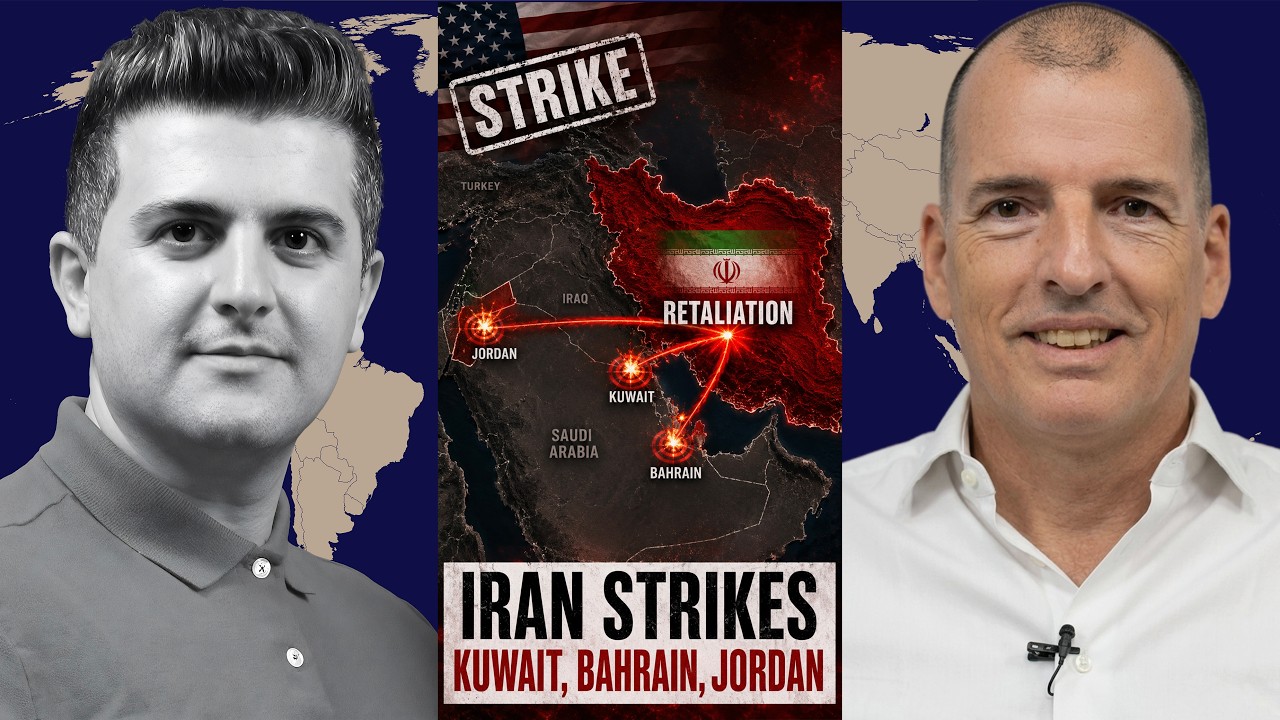
Alex Krainer: US STRIKES Iran – Iran RETALIATES Against Kuwait, Bahrain & Jordan!
"Amidst escalating US-Iran conflict and Iranian retaliation against regional US allies, this episode argues that US foreign policy is deeply controlled by an 'Anglo-Zionist conspiracy' led by the Rothschild banking dynasty, prioritizing Israeli interests over American ones."
Col. Jacques Baud: What a US Ground Invasion of Iran Would REALLY Look Like
"Colonel Jacques Baud dissects the strategic futility of a US ground invasion of Iran, arguing that current troop levels are insufficient and such an action would backfire, exposing US allies and potentially leading to Iran's nuclearization."
BREAKING: Israel BOMBS Major Iran Gas Site; Top Mullah ELIMINATED; Iran Vows VENGEACE | TBN Israel
"Israel and the United States have escalated their 'Roaring Lion War' against Iran, striking its largest gas facilities, eliminating key intelligence and military figures, and disrupting missile production, while Iran threatens a broader energy war in the Gulf."