
Col. Jacques Baud: Trump’s Final Card Just ENDED Israel – Full Breakdown
YouTube · iZ5xSBYxxyQ
Quick Read
Summary
Takeaways
- ❖Iran's Foreign Minister's tour to Pakistan, Oman, and Russia was a calculated diplomatic effort to coordinate with neighbors and define negotiation red lines, particularly concerning the Strait of Hormuz.
- ❖The West, including the US and EU, practices 'diplomacy by pressure,' imposing views rather than seeking mutual solutions, a stark contrast to Iran's measured approach.
- ❖US military deployments, including three aircraft carriers in the region, reflect a World War I-era understanding of war focused solely on overwhelming force, ignoring diplomatic and strategic dimensions.
- ❖Killing enemy leadership ('decapitation strikes') is a strategic mistake that removes potential negotiation partners and creates unpredictable outcomes, as seen in US policy towards Iran and Israeli actions against Hezbollah and Hamas.
- ❖Israel's actions in southern Lebanon, including the destruction of villages and Christian heritage, are perceived as an expansionist 'Rafa doctrine' aimed at creating a buffer zone up to the Litani River.
- ❖GCC countries, despite hosting US military bases, are increasingly vulnerable 'human shields' in the US-Iran conflict, facing devastation of critical infrastructure like desalination plants and oil exports.
- ❖The US's actions have severely harmed its credibility in the Middle East, potentially leading to major shifts in regional alliances and a preference for non-Western technological and military partnerships.
Insights
1Iran's Strategic Use of the Strait of Hormuz
Iran views the Strait of Hormuz as a critical leverage point against the international and US economies. Their proposed 'filtration system' for the Strait, allowing passage for some countries while excluding military vessels, demonstrates a calculated strategy to exert pressure without a full blockade, making it a central point of negotiation.
Iran's Foreign Minister Araghchi's discussions in Oman focused on managing the Strait of Hormuz crisis and its potential use in negotiations with the US, evolving from a non-issue before the war to a foundational negotiation point.
2Western Strategic Blindness in Warfare
Western powers, particularly the US, fundamentally misunderstand modern warfare, viewing it solely through a World War I lens of 'balance of force' (more tanks, more guns equals victory). This tactical focus neglects the crucial diplomatic and strategic dimensions of conflict, leading to an inability to achieve meaningful victory even with overwhelming military power.
The speaker states, 'The West doesn't understand war otherwise that the balance of force... Westerners have a very hard time to understand war differently as what they did during World War I.' He adds that the US 'will not be able to win because they don't know even what they are fighting for.'
3Decapitation Strikes as Strategic Mistakes
The strategy of 'decapitation strikes'—killing enemy leadership—is a profound strategic error. While seemingly weakening the enemy, it eliminates the very individuals with whom future negotiations for peace or resolution could occur, creating greater uncertainty and making it harder to understand and outmaneuver the opponent.
Donald Trump's comment, 'I don't know to whom we should talk in Iran,' after US/Israeli actions against Iranian leadership, exemplifies this. The speaker references Cold War nuclear strategies that aimed to preserve enemy leadership to facilitate peace talks.
4Israel's 'Rafa Doctrine' and Historical Erasure in Lebanon
Israel is applying a 'Rafa doctrine' in southern Lebanon, systematically destroying villages and converting them into rubble to create a buffer zone up to the Litani River. This destructive approach extends to cultural and religious heritage, including Christian churches and statues, reflecting a broader pattern of erasure rather than construction.
The speaker describes Israeli forces using bulldozers to 'erase everything' in Lebanese villages, similar to Rafa in Gaza, and mentions unshown Western media images of Israeli soldiers 'decapitating the Mary, the mother of Jesus, and also destroying statues of Jesus Christ on the cross.'
5GCC Countries as US 'Human Shields'
Gulf Cooperation Council (GCC) countries, hosting US military bases, are effectively being used as 'human shields' in the US-Iran conflict. Their critical infrastructure (desalination plants, oil exports) is highly vulnerable to Iranian retaliation, making them the primary victims of any escalation despite Iran's stated aim to target only military installations.
The speaker notes that GCC countries are 'under extreme pressure' and that the US is 'using those countries as human shields.' He highlights their 90-92% reliance on desalination and the vulnerability of oil pipelines.
Bottom Line
The West's designation of groups like Hezbollah as 'terrorist organizations' is a deliberate tactic to bypass international humanitarian law and justify actions like torture and civilian massacres, effectively granting 'free hands' to aggressors.
This legalistic maneuver undermines the rule of law and allows for disproportionate responses, escalating conflicts and making peaceful resolutions more difficult by dehumanizing the opponent.
International legal bodies and human rights organizations could critically examine the political motivations behind 'terrorist' designations and their impact on adherence to international law during conflicts.
The destruction of ancient Christian communities and heritage in the Middle East, actively or passively supported by Western governments (US, France), represents a tragic loss of cultural and religious roots, including Aramaic-speaking communities linked to Jesus Christ.
This indicates a profound disconnect between stated Western values and actions, contributing to regional instability and alienating local populations who see their heritage destroyed.
Advocacy groups and cultural preservation organizations could highlight this destruction to pressure Western governments to re-evaluate their alliances and policies in the region, focusing on protecting indigenous communities and heritage.
Key Concepts
Left Brain vs. Right Brain Approach to Conflict
This model distinguishes between two fundamental approaches to warfare and diplomacy. The 'left brain' approach, attributed to Iran, Russia, Palestinians, and Hezbollah, is characterized by rational analysis, clear strategies, stated objectives, and predictable behavior. The 'right brain' approach, attributed to Western leadership (US, EU), is intuitive, emotion-driven, lacks scientific analysis of opponents, and results in constantly shifting objectives and tactical, rather than strategic, engagement.
Diplomacy by Pressure
A diplomatic strategy where one party attempts to impose its conditions through threats and overwhelming force, rather than through negotiation and compromise. This approach, exemplified by Donald Trump and the EU, is contrasted with traditional diplomacy that seeks to 'smooth the angles' and ease solutions between partners.
Lessons
- Challenge the prevailing narrative of conflict by seeking out diverse analytical perspectives that delve into the strategic thinking of all parties, not just the tactical outcomes.
- Analyze diplomatic statements and military deployments for underlying strategic objectives (or lack thereof), rather than accepting them at face value, particularly regarding 'diplomacy by pressure'.
- Consider the long-term consequences of 'decapitation strikes' and the destruction of civilian infrastructure, recognizing how such actions can prolong conflicts and complicate future peace efforts.
Notable Moments
The host notes the sensational title of the episode, 'Trump’s Final Card Just ENDED Israel,' and the speaker's subsequent nuanced analysis that critiques Israeli and US strategy.
This highlights the discrepancy between media framing and expert analysis, underscoring the need for critical engagement with information, especially in complex geopolitical contexts.
The speaker's comparison of Western leadership to a 'right brain' (intuitive, emotional) and adversaries to a 'left brain' (rational, strategic) approach to conflict.
This provides a unique mental model for understanding the divergent outcomes and persistent misunderstandings in international conflicts, suggesting a fundamental cognitive gap.
Quotes
"The West doesn't understand war otherwise that the balance of force. It's always a matter of the number of tank you have and the number of this and number of that."
"If you don't accept my condition, I will kill you. But that that's exactly you know it's a variation of this World War I complex that we have in the in the West."
"The Iranians understand the Americans much better than the Americans understand them. And that's that's the advantage."
"Killing the head or the so-called decapitation strikes are strategic mistakes."
"Sun Tzu said 25 hundred years ago, he said strategy without tactics or tactics without strategy is just noise before defeat."
"My view is that Bible is not is not a real estate document."
"When the Israeli comes, we are back to desert. They destroy everything."
"The US is in fact using those countries as human shields."
Q&A
Recent Questions
Related Episodes

Patrick Henningsen: Hezbollah JUST Fired Back at Israel - Iran Vows to “Crush” All Attacks
"Patrick Henningsen argues that the US and Israel initiated an illegal war against Iran, driven by Trump's incompetence and Israeli influence, leading to an inevitable escalation with severe global economic repercussions."

BREAKING: Iran Threatens To END Talks; U.S. Vows Retaliation; Hezbollah Collapsing? | TBN Israel
"Iran is leveraging Hezbollah and the Strait of Hormuz to manipulate US negotiations, while Israel asserts its right to dismantle Hezbollah's eroding but still dangerous infrastructure in Lebanon, independent of international talks."
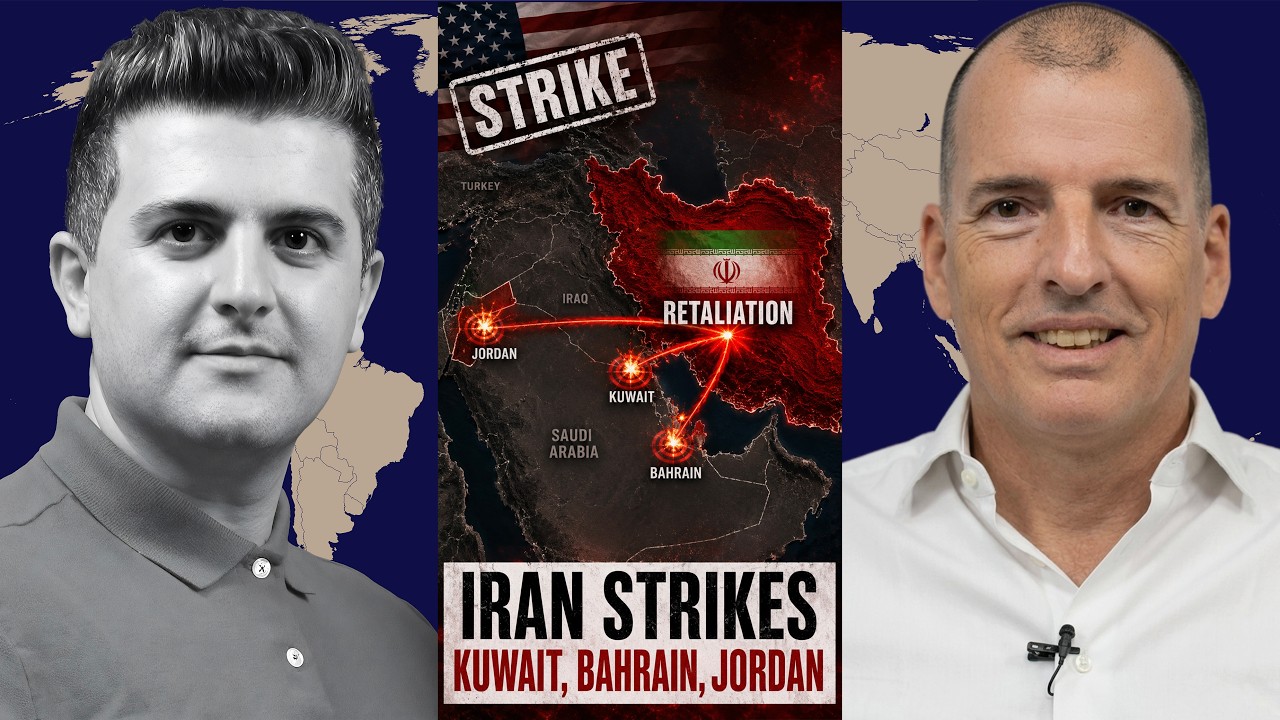
Alex Krainer: US STRIKES Iran – Iran RETALIATES Against Kuwait, Bahrain & Jordan!
"Amidst escalating US-Iran conflict and Iranian retaliation against regional US allies, this episode argues that US foreign policy is deeply controlled by an 'Anglo-Zionist conspiracy' led by the Rothschild banking dynasty, prioritizing Israeli interests over American ones."

🚨 TOTAL F*CKING CHECKMATE 😂😂😂
"The host argues that Trump's 'ceasefire' with Iran was a calculated '5D chess' move to orchestrate a global energy market reshuffle, while simultaneously lambasting 'woke' domestic policies and the 'freefall' of anti-Trump conservative figures."