
Larry Johnson & Col. Wilkerson: Iran Just FULLY Opened the Strait of Hormuz – It’s OVER for Trump
YouTube · ionE4H44LUA
Quick Read
Summary
Takeaways
- ❖Iran's foreign minister announced the Strait of Hormuz is fully open for commercial vessels, tied to a Lebanon ceasefire, but Iran still requires prior permission and tolls.
- ❖Donald Trump's public statements on the Middle East are framed as a confusing propaganda campaign, detached from Israeli realities and intended to make him appear in control.
- ❖The White House simultaneously announced a ceasefire in Lebanon and doubled down on sanctions against Iran and China, creating contradictory policy signals.
- ❖The global economy is now experiencing a definite 20% oil shortage due to the Strait of Hormuz closure, with spot prices reaching $210/barrel, far above futures market rates.
- ❖China is reportedly supplying Iran with advanced satellite technology, potentially making Iran's second tier of targets even more devastating.
- ❖US drone technology is considered two generations behind Russia, Iran, and China, focusing on expensive, easily destroyed assets rather than innovative small drones.
- ❖US sanctions since 2000 have caused 38 million deaths, primarily women and children, leading two-thirds of the world to resent US policy and seek alternatives.
- ❖China is actively positioning itself to replace the American financial system, emphasizing development over punishment, and attracting allies like the Philippines with oil offers.
- ❖Trump's personality has reportedly changed since last fall, exhibiting yelling, screaming, and a lack of empathy, raising concerns about his intellectual intactness and erratic decision-making.
- ❖The US military-industrial complex prioritizes lobbyists and congressional interests over strategic innovation, leading to outdated and expensive defense procurement.
- ❖The US is preparing for a "very intense strike" against Iran, despite the current ceasefire and the economic chaos caused by existing sanctions.
Insights
1Contradictory US Policy on Iran and China
The US administration is pursuing conflicting strategies, announcing a ceasefire in Lebanon while simultaneously imposing new, severe sanctions on Iran and China. This creates policy incoherence and undermines US credibility.
Larry Johnson notes that while the White House announced Israel's agreement to a Lebanon ceasefire (a key Iranian demand), it simultaneously doubled down on sanctions against Iran and China, targeting banks and threatening China. This directly contradicts Iran's demand for sanctions relief as a precondition for negotiation. "The White House is announcing that they've that they are been forcing, you know, forcing Israel to agree to stop, you know, shooting to try to to have this ceasefire in Lebanon. The White House is then doubling down on sanctions and making it clear that this is not only to go after Iran, this is going after China."
2Imminent Global Oil Shortage and Price Discrepancy
The world is now facing the full economic impact of the Strait of Hormuz closure, with a significant oil shortage and a massive disconnect between futures market prices and actual spot prices.
Larry Johnson explains that the initial closure of the Strait didn't immediately impact global supply because tankers already at sea continued their journeys. However, as of April 17, 2026, the full 20% cut-off of world oil supply is now being felt, with spot prices in places like Singapore reaching $210/barrel, significantly higher than the reported Brent futures price of $95. This indicates a severe, unacknowledged economic crisis. "The world is now as of today dealing with a definite 20% shortage of oil... the price per barrel of oil was not the $95 that they're showing for Brent on the futures market. No, no, $210 a barrel."
3US Military-Industrial Complex's Outdated Procurement
The US defense procurement system is slow, bulky, and driven by lobbyists, leading to the development of extremely expensive, yet easily neutralized, military assets like the $250 million Triton drone, while falling two generations behind rivals in critical areas like drone technology.
Colonel Wilkerson questions why the US builds "super expensive things like Predator and Reaper and this one [Triton] when we know that if we ever get in a real conflict, they'll be the first thing shot out of the air." Larry Johnson adds that the US is "two generations behind Russia and Iran and China when it comes to drones" and that the system "does not readily accept innovation." "Why do we build these super expensive things like Predator and Reaper and this one when we know that if we ever get in a real conflict, they'll be the first thing shot out of the air." and "The United States is two generations behind Russia and Iran and China when it comes to drones."
4Humanitarian and Geopolitical Impact of US Sanctions
US sanctions policy has resulted in 38 million deaths since 2000, predominantly women and children, alienating a significant portion of the global population and driving nations towards alternative financial systems led by China.
Colonel Wilkerson cites a study indicating the immense human cost of US sanctions, which has fostered deep resentment globally. This punitive approach contrasts sharply with China's emphasis on development, making China's offer of an alternative financial system appealing to nations under US sanctions. "Since 2000, we have killed 38 million people with our sanctions. ... 500,000 in Iraq alone... We have over two billion people under these sanctions. Is there any wonder that Xi Jinping has finally done what he's done and said we are going to replace the American financial system with the Chinese one and you all are welcome to join because we will be emphasizing development not punishment."
Bottom Line
China's strategic investment in advanced port infrastructure, like the one in Peru, and its offer of a development-focused financial system, creates a compelling alternative for nations disaffected by US punitive sanctions, accelerating a global economic reorientation.
This shift represents a direct challenge to US economic hegemony and could lead to a rapid decline in dollar dominance and US geopolitical influence, particularly in regions like South America and the Middle East.
Businesses and investors should monitor the growth of China-led financial and infrastructure initiatives, as these will define new trade routes, economic hubs, and investment opportunities outside the traditional Western-centric system.
The reported advanced Chinese drone technology, capable of stealth and targeting F-35s, signifies a revolutionary leap in air defense that could fundamentally alter future aerial combat and render current Western air superiority doctrines obsolete.
This technological gap means that the US and its allies are vulnerable to significant losses in any conflict involving these advanced systems, making high-cost, conventional air assets increasingly ineffective.
Defense contractors and strategists must urgently pivot to counter-drone technologies and asymmetric warfare tactics, or risk being outmatched by adversaries leveraging cost-effective, advanced drone swarms and stealth capabilities.
Key Concepts
The Wizard of Oz Moment
The idea that the US's perceived power and invincibility are being exposed as a "fraud" when the curtain is pulled back, revealing a less capable reality.
Chaos as Strategy
The US approach to confronting the shift of power from West to East is characterized by creating chaos rather than accommodating the change, leading to self-destructive outcomes.
Lessons
- Monitor the disconnect between futures and spot oil prices, as the $210/barrel reality indicates a severe, unacknowledged global economic crisis that will impact supply chains and operating costs.
- Re-evaluate geopolitical risk assessments, recognizing the US's contradictory foreign policy and the accelerating shift towards a multipolar world with China and Iran as significant economic and military players.
- Diversify supply chain dependencies away from single-source nations, especially for critical components like rare earth minerals and magnets, given China's dominance and US-China tensions.
Notable Moments
Trump's erratic behavior and lack of empathy
Larry Johnson and Colonel Wilkerson discuss reports of Trump's significant personality change, including yelling at Marjorie Taylor Green and expressing a lack of empathy for threats against her child, raising concerns about his mental state and decision-making.
The "Skunk Works" comparison for Chinese drone tech
Larry Johnson's friend in intelligence describes Chinese drone technology as "skunk works sh*t," indicating a level of advanced, cutting-edge innovation previously associated with top-secret US projects like the SR-71 Blackbird and F-117 stealth fighter.
Quotes
"Donald Trump has gone off the goddamn rails. I mean, this man is now completely detached from reality."
"The world is now as of today dealing with a definite 20% shortage of oil and the disconnect between the futures market and what people are actually paying... $210 a barrel."
"Since 2000, we have killed 38 million people with our sanctions. ... Is there any wonder that Xi Jinping has finally done what he's done and said we are going to replace the American financial system with the Chinese one and you all are welcome to join because we will be emphasizing development not punishment."
"We have awakened a sleeping giant and filled it with a fearful resolve."
"This war right now against Iran is saddled on the US side with so many false assumptions and lies about the nature of Iran and we have now picked a fight that we can't win."
"It's the Wizard of Oz moment. You know that moment at the end of the movie Wizard of Oz where Toto the dog pulls back the curtain and instead of the great and powerful Oz, there's this little old guy who's an itinerate preacher running the machine behind the curtains and you realize he's a fraud."
Q&A
Recent Questions
Related Episodes
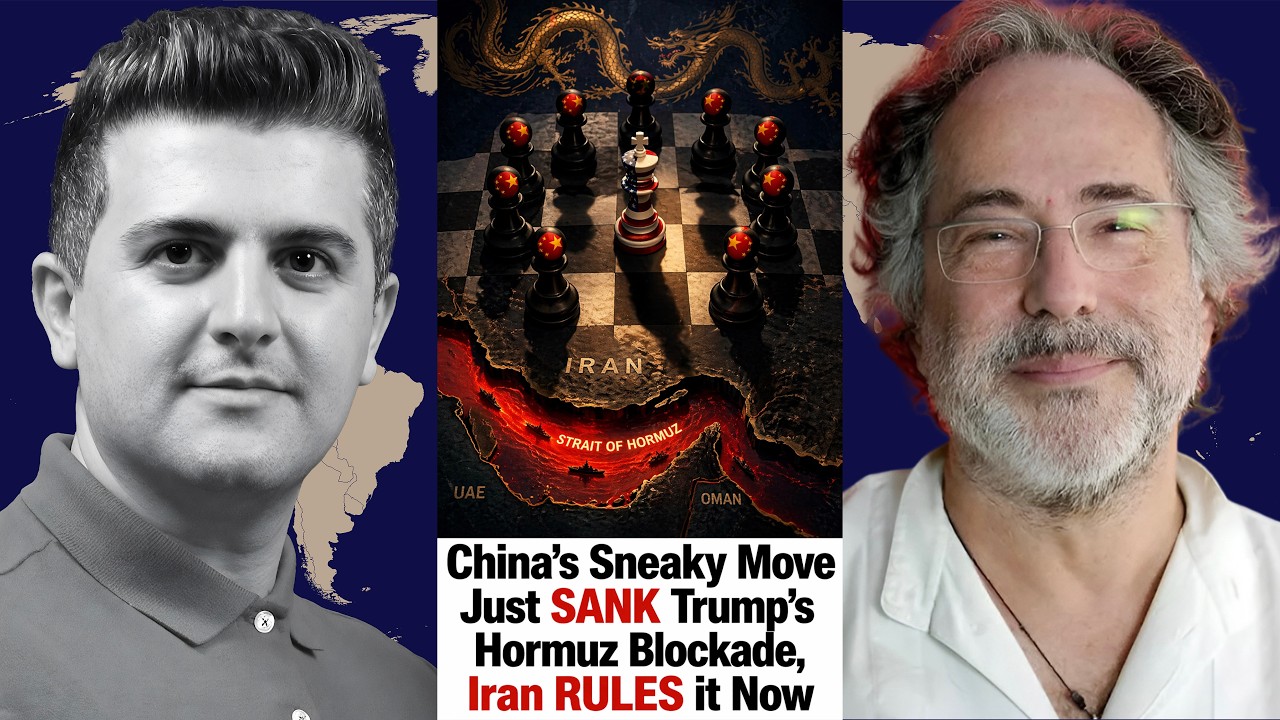
Pepe Escobar: “Total Failure”: Trump’s Blockade Just Backfired Disastrously
"Pepe Escobar argues that the US blockade against Iran, spearheaded by Donald Trump, has utterly failed and backfired, accelerating global economic chaos and challenging US geopolitical dominance."

Patrick Henningsen: Hezbollah JUST Fired Back at Israel - Iran Vows to “Crush” All Attacks
"Patrick Henningsen argues that the US and Israel initiated an illegal war against Iran, driven by Trump's incompetence and Israeli influence, leading to an inevitable escalation with severe global economic repercussions."

Col. Jacques Baud: What a US Ground Invasion of Iran Would REALLY Look Like
"Colonel Jacques Baud dissects the strategic futility of a US ground invasion of Iran, arguing that current troop levels are insufficient and such an action would backfire, exposing US allies and potentially leading to Iran's nuclearization."

Alex Krainer: US STRIKES Iran – Iran RETALIATES Against Kuwait, Bahrain & Jordan!
"Amidst escalating US-Iran conflict and Iranian retaliation against regional US allies, this episode argues that US foreign policy is deeply controlled by an 'Anglo-Zionist conspiracy' led by the Rothschild banking dynasty, prioritizing Israeli interests over American ones."