Moral Monday — Moral Witness in the Public Square
YouTube · ixlzWZhELgg
Quick Read
Summary
Takeaways
- ❖The 'public pulpit' serves as a direct challenge to governmental power, grounded in biblical calls for justice and righteousness.
- ❖Speakers denounce policies that prioritize military spending over social welfare, labeling them as 'theft from the poor' and 'economic violence'.
- ❖The concept of 'policy violence' extends to cuts in food assistance, Medicaid, denial of living wages, and discriminatory voting practices.
- ❖Religious nationalism is criticized for using faith to justify oppression, war, and the starvation of the poor.
- ❖True knowledge of God is linked to breaking systemic inequality and defending the vulnerable, not theological phrases or military strength.
- ❖The movement is framed as a moral, not partisan, issue, calling for a 'moral revival' and 'holy imagination'.
- ❖The Iran nuclear agreement's unilateral tearing up by the Trump administration is cited as an act of 'political arrogance' leading to 'apocalyptic madness'.
- ❖Universal healthcare for all is presented as a moral imperative, contrasting the US healthcare system with other developed nations.
- ❖The 'moral fabric' of society is described as being intentionally torn by policies that connect war, poverty, voting rights, and social neglect.
- ❖A global call is issued to build 'public pulpits' and lead delegations to mend the moral fabric through consistent, non-violent witness.
Insights
1The Mandate for a Public Pulpit
The rally establishes the concept of a 'public pulpit' as a necessary response to a state that has 'distorted the moral narrative.' Drawing from Jeremiah 22, speakers argue that the word of God must be proclaimed directly to those in power, not confined to religious institutions. This means taking faith 'out of the buildings of the church' and confronting issues like religious nationalism and systemic neglect in the open.
A speaker states, 'This is our call to build a public pull pit. Grounded in Jeremiah 22... the word came directly to the gates of the king's palace.' Another adds, 'The pull pit cannot be locked behind stained glass windows in this season.'
2Condemnation of Policy Violence and Economic Injustice
Speakers explicitly label government actions that harm vulnerable populations as 'policy violence' and 'policy murder.' This includes cuts to food assistance and Medicaid, denial of living wages, starvation of public education, and the gutting of the social safety net. They connect these domestic issues to military spending, arguing that money for war is 'theft from the poor' and diverts funds from universal healthcare, child poverty eradication, and infrastructure repair.
John Cavana from the Institute for Policy Studies details how 3.5 million people lost food assistance due to a bill that 'slashed food assistance and Medicaid... as it poured funds trillions into the war machine.' He calls this 'policy violence' and the war in Iran 'policy murder.'
3Critique of Religious Nationalism and Hypocrisy
The rally denounces 'religious nationalism' as a 'toxic falsehood' that 'hijacks the cross' and uses the language of faith to justify white supremacy, war, and the starvation of the poor. Speakers criticize politicians who 'legislate poverty by day and pretend to pray by night,' highlighting a perceived hypocrisy where religious piety is divorced from actions of justice and compassion.
A speaker states, 'We denounce the politicians who legislate poverty by day and and rep and pretend to pray by night.' Another adds, 'This unholy movement attempts to hijack the cross... and twist the gospel into a weapon of control.'
4The Moral Imperative for Universal Healthcare
Universal healthcare is presented as a fundamental moral issue, aligning with Jesus' teachings to care for the hungry and sick. Speakers highlight the US as the only rich country without universal health coverage, leading to shorter lives, depression, and skipped treatments due to cost. They advocate for 'Medicare for all' as a reflection of love for one's neighbor.
Dr. Jimmy Hawkins states, 'We're calling for universal health care today for each and every person who lives in this country... America is also the only rich country without universal health coverage.' He supports Senator Bernie Sanders' call for 'Medicare for all'.
5Global Witness Against Geopolitical Predation
The movement extends its 'witness' globally, with a speaker noting an invitation to Germany to engage with the World Council of Churches. They express concern that America is increasingly viewed as a 'geopolitical predator,' pushing policies akin to those of Russia and China, and deliberately walking into injustice rather than merely stumbling. This calls for an international moral stand against such actions.
A speaker mentions an upcoming trip to Germany for the World Council of Churches, noting, 'we never thought that America would be a geopolitical predator, pushing the kind of things that Russia and China are pushing.'
Bottom Line
The explicit redefinition of policy decisions as 'policy violence' or 'policy murder' directly attributes moral culpability to legislative and executive actions that result in human suffering, moving beyond traditional political critique to a theological condemnation.
This framing elevates the moral stakes of political engagement, potentially radicalizing the discourse and galvanizing faith communities to view policy advocacy as a spiritual imperative rather than a secular political activity. It challenges the neutrality of policy and demands a moral accounting for its human impact.
This perspective creates an opportunity for advocacy groups to unite diverse faith traditions under a common moral banner, transcending denominational differences to collectively oppose policies deemed violent or murderous. It could lead to broader interfaith coalitions focused on systemic change rather than single-issue advocacy.
The assertion that America is becoming a 'geopolitical predator' and that its actions are 'deliberately walking into injustice' rather than 'stumbling' represents a profound shift in self-perception and international critique, particularly from within a faith-based American context.
This challenges the traditional narrative of American exceptionalism and moral leadership, suggesting a need for internal repentance and a re-evaluation of its global role. It implies a deeper, intentional moral failing rather than accidental missteps.
This insight opens avenues for international solidarity movements, where American faith leaders collaborate with global counterparts to address US foreign policy and its impact. It could foster a more critical and self-aware approach to international relations within American civil society, pushing for foreign policy rooted in justice and compassion rather than power projection.
Key Concepts
The Public Pulpit
This model posits that religious faith and moral authority must extend beyond traditional church buildings and into the public square. It's a call for clergy and people of faith to actively engage in political discourse and protest, directly confronting government policies and leaders at 'palace gates' rather than remaining confined to sanctuaries. It emphasizes that faith is not a 'choreographed holiness' but a mandate for justice and righteousness in society.
The Torn Moral Fabric
This model describes society's interconnected social issues (war, poverty, voting rights, healthcare, gender inequality) as threads within a single moral fabric. The argument is that these issues are not isolated but are deliberately torn apart by unjust policies and those in power for profit and control. Mending this fabric requires understanding the interconnectedness of these injustices and engaging in holistic, sustained action to stitch it back together with justice, love, and mercy, rather than addressing issues in isolation.
Policy Violence / Policy Murder
This framework redefines the impact of governmental decisions. Instead of viewing policy outcomes as mere economic or political consequences, it labels policies that lead to suffering, death, or dispossession (e.g., cuts to food assistance, lack of healthcare, aggressive foreign policy) as forms of 'violence' or 'murder.' This model aims to elevate the moral stakes of political decisions, demanding accountability for the human cost of legislative choices.
Lessons
- Build a 'public pulpit' in your local community, state, or town to provide a consistent moral witness against unjust policies and advocate for systemic change.
- Join or support campaigns like 'People Over Pentagon' to oppose increased military budgets and redirect funds towards social programs like healthcare and education.
- Engage in voter mobilization efforts, focusing on a moral vision for policy rather than partisan politics, to ensure fair and just access to ballots for all citizens.
- Actively challenge religious nationalism and any attempts to use faith to justify oppression, war, or systemic neglect, instead promoting a theology of justice and love.
- Advocate for universal healthcare, living wages, fully funded public education, and robust social safety nets, viewing these as moral imperatives for a just society.
Building a Public Pulpit for Moral Witness
Identify a public space (e.g., outside a government building) to establish a 'public pulpit' for consistent moral witness, drawing inspiration from Jeremiah's direct confrontation with the king.
Gather diverse faith leaders, community organizers, and impacted individuals to collectively articulate a unified moral message against interconnected injustices (war, poverty, voting rights, healthcare).
Utilize theological and ethical frameworks to condemn specific policies as 'policy violence' or 'policy murder,' providing concrete evidence of their human cost (e.g., cuts to food assistance, military spending).
Issue clear calls to action, such as advocating for universal healthcare, protecting voting rights, opposing excessive military budgets, and challenging religious nationalism.
Maintain a consistent presence and message, organizing regular 'Moral Monday' type events and encouraging others to replicate this model in their own communities globally, fostering a 'structural socioeconomic revolution'.
Notable Moments
The collective, rhythmic chanting of 'Witness!' throughout the rally, especially during and after each speaker's address.
This repetitive call serves as a powerful unifying element, reinforcing the central theme of moral accountability and the collective responsibility to speak truth to power. It creates a sense of shared purpose and spiritual urgency among participants and listeners.
The spontaneous singing of 'Witness' at the conclusion of the rally, led by a speaker and joined by the crowd.
This moment transforms the protest into a spiritual experience, drawing on a tradition of resistance music. It provides emotional resonance, solidifies community bonds, and underscores the deep-seated faith driving the movement, making the call to action feel both sacred and deeply personal.
The final speaker's powerful analogy of the 'torn moral fabric' and the call to 'mend one fabric' rather than focus on 'six speeches'.
This analogy provides a concise and profound summary of the rally's core message: that all social injustices are interconnected and must be addressed holistically. It reframes individual issues as symptoms of a larger, systemic moral breakdown, emphasizing the need for unified and sustained effort to restore justice and love.
Quotes
"We do this because the state has distorted the moral narrative, using religious nationalism to sanitize their crulest of empires and justify their systemic neglect of our people."
"God turns his back on a faith that sings beautifully on Sunday, but then votes to crush the vulnerable on Monday."
"A nation that continues year after year to spend more money on military defense than on programs of social uplift is approaching spiritual doom."
"Every dollar spent on a missile is a dollar stolen from the poor."
"It means structural socioeconomic revolution that makes the people happy."
"We never thought that America would be a geopolitical predator, pushing the kind of things that Russia and China are pushing."
"Pull the thread of war and you find the money that was supposed to feed the poor. Pull the thread of poverty and you find the people that did not want you to vote. Pull the thread of the vote and you find that women told to sit down and be quiet... It is one fabric and it is being torn."
Q&A
Recent Questions
Related Episodes
Roland speaks at Columbus Educ. Assoc. MLK Dinner
"Roland Martin challenges the audience at an MLK dinner to move beyond passive celebration and engage in active, sustained political and economic struggle, emphasizing that 'rest time is over' for those seeking real societal change."
George Floyd 6 Years Later. Redistricting War in The South. Talarico Senate Campaign
"This episode exposes the ongoing legislative battles and strategic resistance against efforts to diminish Black political power, from federal policing reform to state-level gerrymandering and calls for economic boycotts by Black athletes."

All Roads Lead To the South: Nat’l Day Of Action For Voting Rights | Mass Rally | Montgomery, AL
"A mass rally in Montgomery, Alabama, ignites 'Freedom Summer 2026' to combat the Supreme Court's decimation of Black political power and demand unprecedented voter mobilization across the South."
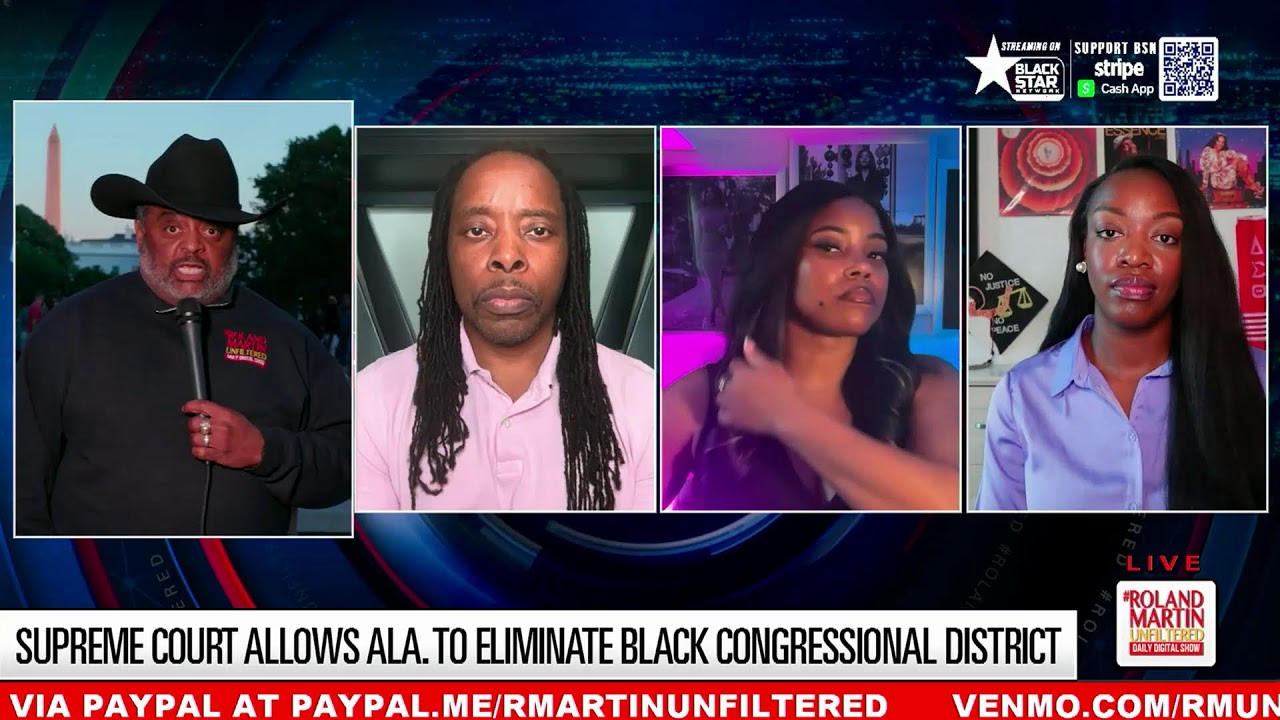
Moral Monday at BLM Plaza. Cleo Fields Sounds Alarm on Louisiana & Gary Chambers Pushes Turnout
"Activists and faith leaders gathered at Moral Monday to denounce 'policy violence' in various forms, from war and budget cuts to voter suppression and healthcare denial, urging sustained mobilization against a 'hijacked' democracy."