Bill O'Reilly & Colby Hall Debate President Trump's Actions
YouTube · jf5yyxe7xF0
Quick Read
Summary
Takeaways
- ❖Colby Hall criticizes Trump's 'scale, speed, and brazenness' in exploiting executive precedents, arguing it reinforces 'might makes right' and undermines democracy.
- ❖Bill O'Reilly defends Trump's actions, stating they are necessary because an entrenched opposition in Congress would obstruct any presidential initiative, especially on national security.
- ❖Hall cites the Maduro extraction, Greenland proposal, and aggressive ICE tactics as examples of overreach; O'Reilly argues national security concerns justify bypassing Congress.
- ❖O'Reilly points to court rulings against Trump's National Guard deployment as evidence that the President is, in fact, constrained.
- ❖Hall acknowledges some Trump administration successes (Iran/Israel, border cleanup) but condemns tactics like masked ICE agents shooting protesters or invading homes without warrants.
Insights
1The 'Might Makes Right' Critique of Executive Action
Colby Hall argues that the Trump administration's executive actions, characterized by their 'scale, speed, and brazenness,' operate with 'impunity' and 'zero checks and balances.' He frames this as a dangerous philosophical construct that reinforces 'might makes right,' moving the nation away from democratic principles.
Hall's column 'Enough is Enough' criticizes Trump's 'overreach' (). He states the executive branch 'literally acts without impunity or with impunity with zero checks and balances' () and that this 'reinforces might makes right' ().
2Justification for Bypassing Congress: The 'Entrenched Opposition' Argument
Bill O'Reilly presents President Trump's perspective that his opposition is so entrenched they prioritize obstruction over national good. Therefore, the President must act decisively, bypassing Congress on critical issues like removing foreign leaders or military operations, because legislative debate would cause unacceptable delays or outright rejection.
O'Reilly explains Trump's mindset: 'his opposition is so entrenched that they don't care about what's good for the country and so he has to cut through that' (). He adds, 'He can't go to Congress and say I want to remove Maduro... because no Democrat will ever vote for anything that Trump wants' ().
3Constitutional Constraints vs. Situational Interpretation
The debate highlights a core tension: Hall insists that the Constitution's checks and balances cannot be selectively applied based on political convenience. O'Reilly counters that post-9/11 national security concerns provide precedent for executive action, and that courts do ultimately constrain the President, citing the withdrawal of the National Guard from LA.
Hall states, 'You don't get to pick and choose what the Constitution says' () and 'You can't simply say I'm going to avoid checks and balances if I know that a congressional check and balance is not going to give me what I want' (). O'Reilly argues, 'You can if there's precedent about national security after 9/11. All of that changed' (). He also notes, 'the courts ruled that the president could not send National Guard to LA... So he took him out' ().
Notable Moments
Colby Hall's column 'Enough is Enough' is introduced, criticizing Trump's overreach and the 'scale, speed, and brazenness' of his actions compared to past administrations like Obama's.
This sets the stage for the debate, establishing Hall's core argument against Trump's executive power usage and providing specific examples like the Maduro extraction and federal law enforcement tactics.
O'Reilly defends Trump's mindset, arguing the President believes he must bypass Congress due to entrenched opposition that would never support his initiatives, even on national security matters like removing Maduro.
This reveals the strategic rationale behind Trump's executive actions as perceived by his supporters, framing them as a necessary response to political gridlock rather than an abuse of power.
Hall acknowledges Trump's successes in handling Iran vis-à-vis Israel and 'cleaning up the abject horror that is the border,' but immediately pivots to condemning tactics like masked ICE agents shooting protesters or invading homes without warrants.
This moment shows Hall's attempt at a nuanced critique, acknowledging positive outcomes while still condemning methods, highlighting the ethical and procedural concerns even when agreeing with a policy's goal.
O'Reilly argues that states refusing to obey federal law are in 'open rebellion,' while Hall dismisses 'rebellion' as an overstep and points out the right's situational abandonment of 'states' rights' principles.
This illustrates the partisan framing of state-federal conflicts and the selective application of constitutional principles depending on political alignment, exposing hypocrisy on both sides.
Quotes
"What distinguishes the current moment is not the impulse to push boundaries, but the scale, speed, and brazenness with which these accumulated precedents are being exploited."
"His opposition is so entrenched that they don't care about what's good for the country and so he has to cut through that."
"An executive branch that literally acts without impunity or with impunity with zero checks and balances is acting in a way that really sort of reinforces might makes right, which is a philosophical construct that we long moved past and it's not really democratic."
"You don't get to pick and choose what the Constitution says."
"My job, I was elected to protect the American people, and I'm going to do it. And I am not going to submit to some theoretical process when I believe I have the authority to take out people like Maduro, the Muellers, people who are threats to this country."
Q&A
Recent Questions
Related Episodes
LIVE: DEM SENATORS ADDRESS UNLAWFUL WAR!!
"Democratic Senators, joined by VoteVets, forcefully condemn the administration's 'unlawful war' in Iran, citing constitutional overreach, devastating human and economic costs, and a deliberate lack of transparency and congressional oversight."

Trump DOJ REACHES NEW LOW Trying to SAVE Trump
"Professor Aziz Huck dissects the foundational principles of the rule of law, revealing how modern political partisanship and the Justice Department's 'weaponization fund' challenge core constitutional mechanisms and legal predictability."
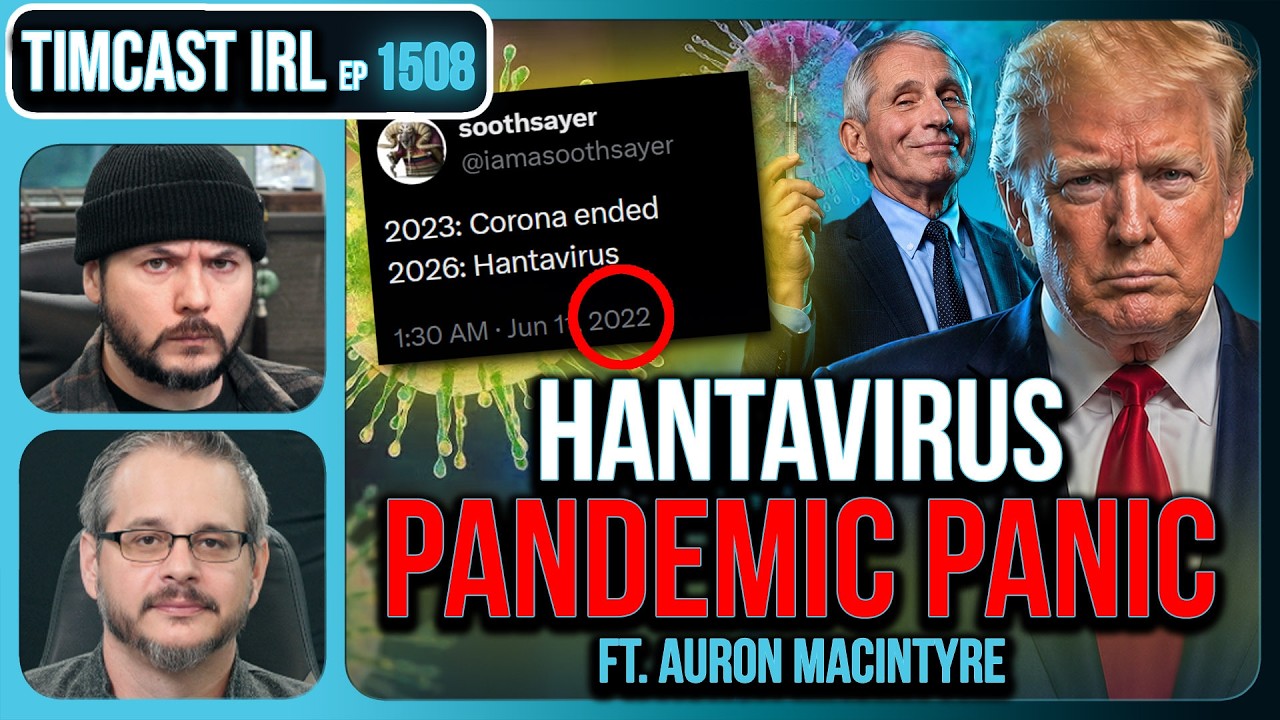
HANTAVIRUS PANDEMIC PANIC, Human To Human Spread Feared | Timcast IRL
"Tim Pool and his guests dismiss the Hantavirus panic as media desperation, pivot to discussing escalating political polarization, the rise of technocracy, and the weaponization of social issues."

MAGA Stooge Freezes After My Question on CNN
"Adam Mockler dissects the Trump administration's claims of 'total victory' in foreign conflicts and its alleged attempts to politicize the Department of Justice, arguing these actions undermine democratic institutions and moral leadership."