
Saudis, UAE Break Into Regional HOT WAR
YouTube · lmJuIx4KSGQ
Quick Read
Summary
Takeaways
- ❖Saudi Arabia and the UAE, former allies, are now in a direct regional conflict, with MBS targeting UAE's proxy forces.
- ❖MBS bombed a UAE arms shipment in Yemen, leading to the rapid collapse of the UAE-backed Southern Transition Council (STC).
- ❖MBS has used coercive tactics, allegedly holding over 50 STC leaders incommunicado after inviting them to Riyadh.
- ❖The UAE employs a 'chaos strategy' to empower proxy groups and separatists, aiming to control strategic ports and commodity routes across the Red Sea and Africa.
- ❖Saudi Arabia perceives the UAE's actions as an encirclement, threatening its oil export routes.
- ❖In Sudan, the UAE backs the Rapid Support Forces (RSF), which are responsible for massacres, including an estimated 150,000 deaths in El Fasher.
- ❖The US State Department avoids directly naming the UAE as a provider of material support to the RSF, despite congressional pressure.
- ❖The disruption of UAE supply lines due to Saudi and Egyptian actions, along with Somalia banning Emirati flights, offers hope for halting RSF advances in Sudan.
Insights
1Saudi-UAE Alliance Fractures into Direct Conflict
The long-standing coalition between Saudi Arabia and the UAE against the Houthis in Yemen has dissolved into direct rivalry. Saudi Crown Prince Mohammed bin Salman (MBS) has initiated aggressive actions, including bombing a UAE arms shipment to its proxy forces in Yemen, which led to the rapid collapse of the UAE-backed Southern Transition Council (STC) forces. This marks a significant escalation from indirect competition to overt military engagement.
Saudi air strikes quickly routed STC forces after the UAE's command structure and air cover were withdrawn. A fighter noted, 'We went to Hud Ramat and Almara with a large force and high-end equipment and returned on buses.' The host states that Saudi Arabia 'bombed a shipment of arms that were coming in to the UAE's fighters.'
2MBS's Coercive Diplomacy and Regional Power Play
MBS is employing a pattern of coercive tactics against rivals and perceived threats. After dismantling UAE's proxy forces in Yemen, MBS invited over 50 leaders of the Southern Transition Council (STC) to Riyadh for talks, where they are now believed to be held incommunicado. This mirrors previous incidents where MBS detained wealthy Saudis, orchestrated the murder of Jamal Khashoggi, and kidnapped the Lebanese Prime Minister, demonstrating a willingness to use extreme measures to consolidate power and influence.
The head of the STC, Al-Zuba, avoided the invitation, fleeing by boat to Africa, while '50 plus of the other STC leaders went to Riad' and are 'believed to be being held incommunicado.' This is compared to MBS's previous actions like the Ritz Carlton detentions, Khashoggi's murder, and the kidnapping of the Lebanese prime minister.
3UAE's 'Chaos Strategy' for Regional Control
The UAE is pursuing a 'chaos strategy' to expand its influence, particularly over strategic maritime routes and commodity flows. This involves empowering proxy groups and separatists in countries like Yemen, Somaliland, Libya, and Sudan to weaken central governments. The objective is to control key ports along the Gulf of Aden and the Red Sea, and access valuable resources like Sudan's gold, thereby encircling Saudi Arabia and diminishing the value of its oil exports.
The host states, 'the MBZ strategy is a chaos strategy. It is to ferment chaos in the region rather than the preference of MBS, which is the exact opposite.' The UAE controls parts of southern Yemen, supports separatists in Somaliland, and its factions control much of Libya. In Sudan, the UAE backs the RSF, which controls a 'huge proportion of the world's gold.'
4Sudan Conflict: A Proxy War with Catastrophic Humanitarian Impact
The conflict in Sudan is a direct proxy battle between Saudi/Egypt-backed Sudanese Armed Forces and UAE-backed Rapid Support Forces (RSF). The UAE has supplied the RSF with advanced technology, enabling them to gain ground and commit mass atrocities. The fall of El Fasher resulted in an estimated 150,000 deaths, and there are fears of an even larger massacre in El Obeid, where up to a million people are at risk from RSF forces.
The UAE is the 'main backer of what's called the RSF,' funneling 'extraordinarily advanced technology' to them. The fall of El Fasher led to '150,000 of them remain unaccounted for and are presumed to be dead.' The city of El Obeid, with up to a million people, is 'surrounded on three sides by the RSF,' raising fears of 'another massacre of hundreds of thousands of people.'
Bottom Line
The US State Department's consistent refusal to publicly name the UAE as a provider of material support to the RSF in Sudan, despite clear evidence and congressional questioning, indicates a significant diplomatic blind spot or deliberate policy choice to protect an ally, even at the cost of acknowledging humanitarian atrocities.
This diplomatic evasion allows the UAE to continue its proxy warfare with less international scrutiny, potentially prolonging conflicts and humanitarian crises. It also highlights the limitations of US leverage over its allies when strategic interests (like arms sales) are prioritized over human rights concerns.
Independent media and human rights organizations have an opportunity to fill the information vacuum by rigorously documenting and publicizing the UAE's role and the US's complicity, pushing for greater transparency and accountability from both governments.
The rapid and complete destruction of an entire platoon of RSF fighters by a drone strike, as shown in the footage, demonstrates the evolving and highly lethal nature of modern warfare, where advanced drone technology can decimate ground forces instantaneously and anonymously.
This shift towards robot-fueled killing fields raises profound questions about the future of ground combat, the ethics of autonomous weapons, and the potential for prolonged, low-cost, high-casualty conflicts in barren landscapes, making traditional military strategies obsolete and increasing the risk of mass casualties with minimal direct human involvement.
Defense technology companies could explore countermeasures to drone warfare for ground troops, while international bodies need to urgently address regulations and ethical frameworks for the deployment of advanced autonomous weapons in conflict zones.
Lessons
- Monitor the geopolitical landscape of the Red Sea and Gulf of Aden for shifts in power dynamics, as control over these maritime choke points significantly impacts global trade and energy security.
- Investigate the supply chains and financial flows supporting proxy forces in conflicts like Sudan, as disrupting these can be a key strategy to mitigate humanitarian disasters.
- Support independent journalism and organizations like Dropsite News and Critical Threats that provide on-the-ground reporting and analysis of conflicts often overlooked by mainstream media and government statements.
Notable Moments
Footage showing an entire platoon of RSF fighters being instantly wiped out by a drone strike during training.
This jarring visual illustrates the devastating and instantaneous lethality of modern drone warfare, highlighting a significant shift in the nature of conflict where advanced technology can decimate ground forces with extreme efficiency, raising questions about future military strategies and the human cost of such engagements.
Quotes
"Without the UAE's command structure and without air cover from their patrons in the flat desert landscape of eastern Yemen, the southern transition council's collapse in the first week of January was as precipitous as its gains had been a month before. Further waves of Saudi air strikes quickly routed STC forces."
"We went to Hud Ramat and Almara with a large force and high-end equipment and returned on buses."
"If this man asks you to attend a meeting, my recommendation is not to go."
"MBZ is struggling to find a single regional power to lend support or mediate or stop the unraveling of his empire."
"The MBZ strategy is a chaos strategy. It is to ferment chaos in the region rather than the preference of MBS, which is the exact opposite of that, to try and get everybody in lock step with MBS."
Q&A
Recent Questions
Related Episodes

BREAKING: Iran Threatens To END Talks; U.S. Vows Retaliation; Hezbollah Collapsing? | TBN Israel
"Iran is leveraging Hezbollah and the Strait of Hormuz to manipulate US negotiations, while Israel asserts its right to dismantle Hezbollah's eroding but still dangerous infrastructure in Lebanon, independent of international talks."
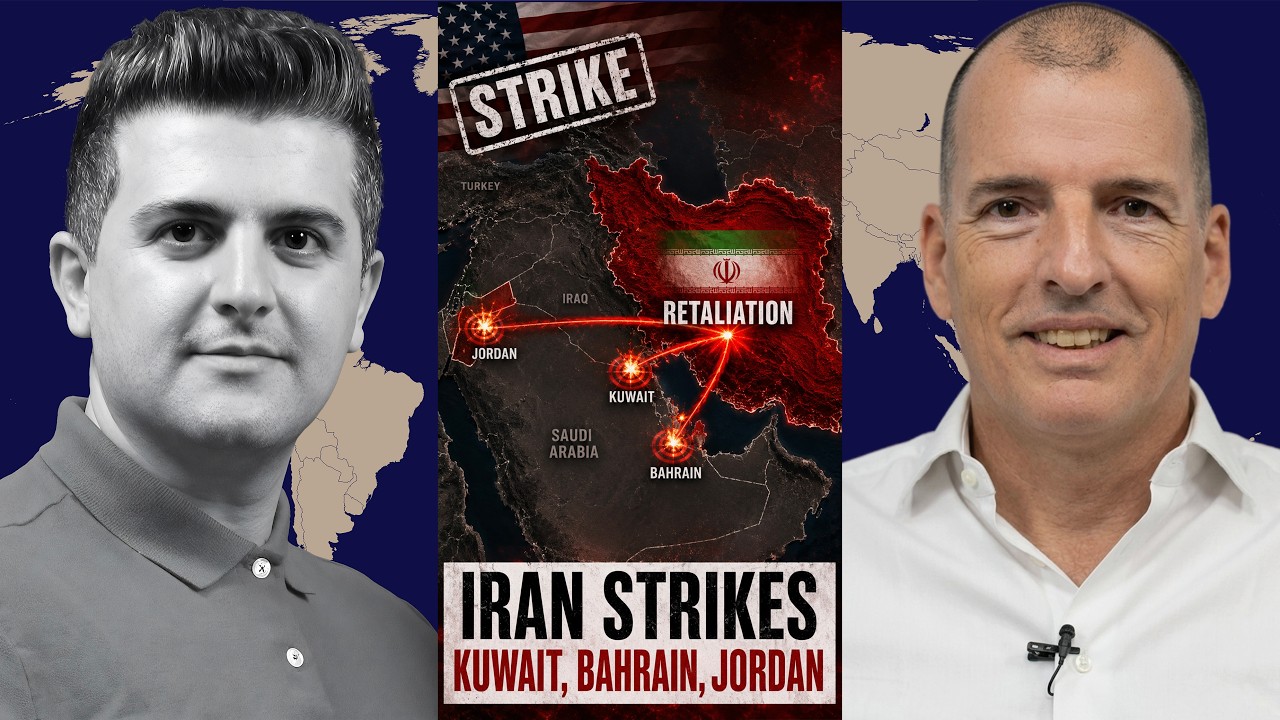
Alex Krainer: US STRIKES Iran – Iran RETALIATES Against Kuwait, Bahrain & Jordan!
"Amidst escalating US-Iran conflict and Iranian retaliation against regional US allies, this episode argues that US foreign policy is deeply controlled by an 'Anglo-Zionist conspiracy' led by the Rothschild banking dynasty, prioritizing Israeli interests over American ones."

Larry Johnson: Iran Missiles Rain Down on Northern Israel – Massive Strikes!
"Geopolitical analyst Larry Johnson details how Israel's recent strike on an 'empty building' in Beirut triggered direct Iranian missile retaliation, escalating regional tensions and jeopardizing a US-Iran peace deal brokered by Pakistan."

Iran Update: Israel’s Newest Bombing Campaign, the Oncoming War With China and How to Avoid It
"Colonel Wilerson reveals how the US and Israel are actively bombing China's strategic infrastructure in Iran, escalating a covert economic war that Beijing intends to win without direct military conflict by dismantling the dollar's global dominance."