Mindscape Ask Me Anything, Sean Carroll | February 2026
YouTube · mlYSvE3XZcQ
Quick Read
Summary
Takeaways
- ❖The US political climate in early 2026 is characterized by increasing authoritarianism, but public sentiment is largely against it.
- ❖Recent DESI and DEES data suggest dark energy might be slightly variable, not a true cosmological constant, but this doesn't imply a 'big crunch'.
- ❖Biological complexity exhibits both fragility (individual organisms) and robustness (the biosphere as a whole) due to diversification.
- ❖The metric system is superior for most measurements, but Fahrenheit is more intuitive for human-centric atmospheric temperatures.
- ❖Universities should take political stances only on issues core to their mission (e.g., academic freedom), not broader contentious topics.
- ❖Sean Carroll and Jennifer Chen's universe theory is a 'sketch' aspiring to an eternal, symmetric, and non-fine-tuned model.
- ❖Mistreating a conscious AI is morally questionable; erring on the side of kindness is prudent, as intuitions about AI morality are underdeveloped.
- ❖The philosophical zombie thought experiment is flawed for physicalists, as consciousness is an emergent physical property.
- ❖Current LLMs are not conscious because they lack internal, dynamic processes like 'getting bored' or a constant metabolic churn.
- ❖The 'fine-tuning' argument in cosmology is a valuable clue for developing better theories, not merely a statistical artifact.
- ❖Computer simulations are crucial for scientific prediction across fields, with limitations stemming from incomplete input knowledge.
- ❖Black hole singularities are points in time, not space, and are very near in the future for infalling objects, typically microseconds for solar-mass black holes.
- ❖The term 'relativistic mass' is conceptually unhelpful; mass should be considered a fixed constant, with energy varying relativistically.
- ❖Infinities in physics (e.g., black hole singularities, quantum field theory divergences) signal a breakdown of the current theory, prompting the search for a better one.
- ❖Life is an out-of-equilibrium system that resists decay by increasing the universe's entropy elsewhere, not by 'countering' entropy directly.
Insights
1US Political Climate and Democratic Resilience (February 2026)
Carroll describes the United States in early 2026 as being under a second Donald Trump administration, which he characterizes as increasingly lawless and authoritarian. He points to specific events, such as the alleged murders of Renee Nicole Good and Alex Prey by ICE agents in Minneapolis, and the administration's pattern of outright lying, even in the face of video evidence. Despite this, Carroll expresses optimism, believing that 'the good guys are going to triumph' because the majority of Americans do not support these authoritarian actions, citing examples like a Republican candidate in Minnesota withdrawing from a race due to national party rhetoric. He emphasizes that maintaining democracy requires continuous effort and active participation, particularly voting.
Host's opening monologue, referencing specific events in Minneapolis and the general political atmosphere.
2New Cosmological Data and Dark Energy Variability
Recent experimental results from the Dark Energy Spectroscopic Instrument (DESI) and the Dark Energy Survey (DEES) show slight tension with the standard Lambda-CDM model. This tension suggests that the dark energy density might be changing gradually over time, rather than being a true cosmological constant. Carroll clarifies that this does not mean the universe's expansion is not accelerating, nor does it favor a 'big crunch' model. Even if dark energy density went to zero, the universe would continue to expand, albeit more slowly, not contract. He maintains that the cosmological constant remains the most credible explanation for dark energy.
Discussion of DESI and DEES results, and their implications for the Lambda-CDM model.
3The Nature of AI Consciousness and Computational Functionalism
Carroll has shifted his view on computational functionalism, now believing that consciousness involves more than just mapping inputs to outputs. He argues that the *processes* occurring inside a system are crucial. For current Large Language Models (LLMs), he points to their 'lack of boredom' as a key indicator of non-consciousness; they don't experience the passage of time or have an internal, constant metabolic churn like biological organisms. To achieve consciousness, an AI would need radical changes to its architecture, incorporating dynamic, out-of-equilibrium processes analogous to those in living beings, rather than trivial additions like access to an electronic clock.
Multiple questions and Carroll's detailed responses on AI consciousness, computational functionalism, and the 'boredom' analogy.
4Fragility and Robustness in Complex Systems (Biosphere)
The biosphere demonstrates both fragility at the individual organism level and remarkable robustness at the systemic level. Individual complex organisms are fragile, requiring specific environmental inputs (oxygen, food) to survive, and are prone to many failure modes. However, the biosphere as a whole is robust due to diversification, with many different organisms filling various ecological niches. This resilience allows the system to bounce back from mass extinctions, even those caused by external events like asteroids, as no event has ever wiped out all life on Earth.
Discussion of the Great Oxidation Event and the general resilience of the biosphere against mass extinctions.
5Career Path for Aspiring Theoretical Physicists
For a 52-year-old former businessman with a history and MBA background aspiring to theoretical physics, Carroll advises against learning physics solely to 'flesh out a specific theory' already conceived. Modern physics theories are deeply mathematical from the outset, and a 'picture' without math is unlikely to be a plausible theory. Instead, he recommends learning physics with an open mind, starting with textbooks, online curricula (like Gerard 't Hooft's), or university courses. He emphasizes that learning from textbooks is a fundamental skill for physicists, and AI tools like ChatGPT can aid in flexible, interactive learning.
Direct advice to Andrew Samri, a 52-year-old former businessman, on pursuing theoretical physics.
Bottom Line
The current political climate in the US, marked by increasing authoritarianism and institutional unpreparedness, suggests a critical period for democratic resilience.
This situation highlights the fragility of established democratic norms and the potential for rapid societal shifts when institutions fail to adapt to unprecedented challenges.
Active civic engagement, informed voting, and broad communication of democratic values are crucial to counter anti-democratic forces and steer society towards a more desirable future.
If dark energy is indeed dynamic rather than a constant, it opens new avenues for understanding the fundamental nature of the universe and could point towards solutions for the cosmological constant problem.
This potential variability implies that our current Lambda-CDM model, while successful, might be an approximation, and a deeper, more complex theory of cosmic expansion is needed.
Further high-precision cosmological observations and theoretical developments in variable dark energy models could lead to a paradigm shift in our understanding of cosmic evolution.
The distinction between 'experiencing' time and merely 'measuring' it is critical for understanding consciousness, particularly in AI. True experience of time may be tied to being an out-of-equilibrium system with constant internal processes.
This implies that simply giving an AI a clock or a 'boredom subroutine' is insufficient for consciousness. A radical redesign mimicking biological metabolism and continuous internal churn might be necessary.
Future AI research could focus on developing 'living' AI systems that are inherently out-of-equilibrium, constantly processing and maintaining their state, which might be a prerequisite for genuine consciousness.
Lessons
- Engage in civic duties, especially voting, to actively counter anti-democratic forces and support the functioning of the democratic system.
- For those interested in theoretical physics, prioritize learning the foundational mathematics and physics with an open mind, rather than solely trying to validate a pre-existing theory.
- When considering AI, avoid anthropomorphizing its capabilities or intentions; instead, focus on understanding its actual operational mechanisms and potential harms stemming from human misuse or misunderstanding.
Quotes
"Here we are in the second Donald Trump administration, an administration which is becoming increasingly lawless and authoritarian."
"I do not regret to inform you that we are going to win."
"I think that the cosmological constant is still by far where most of your credence should be."
"I think that the cosmological constant is still by far where most of your credence should be."
"It is better to err on the side of not being a moral monster."
"The single most important thing is to make sure the system works, to vote."
"The real worry about AI is not that it's going to become super intelligent, but that humans and AIs are going to team up to be stupid."
Q&A
Recent Questions
Related Episodes
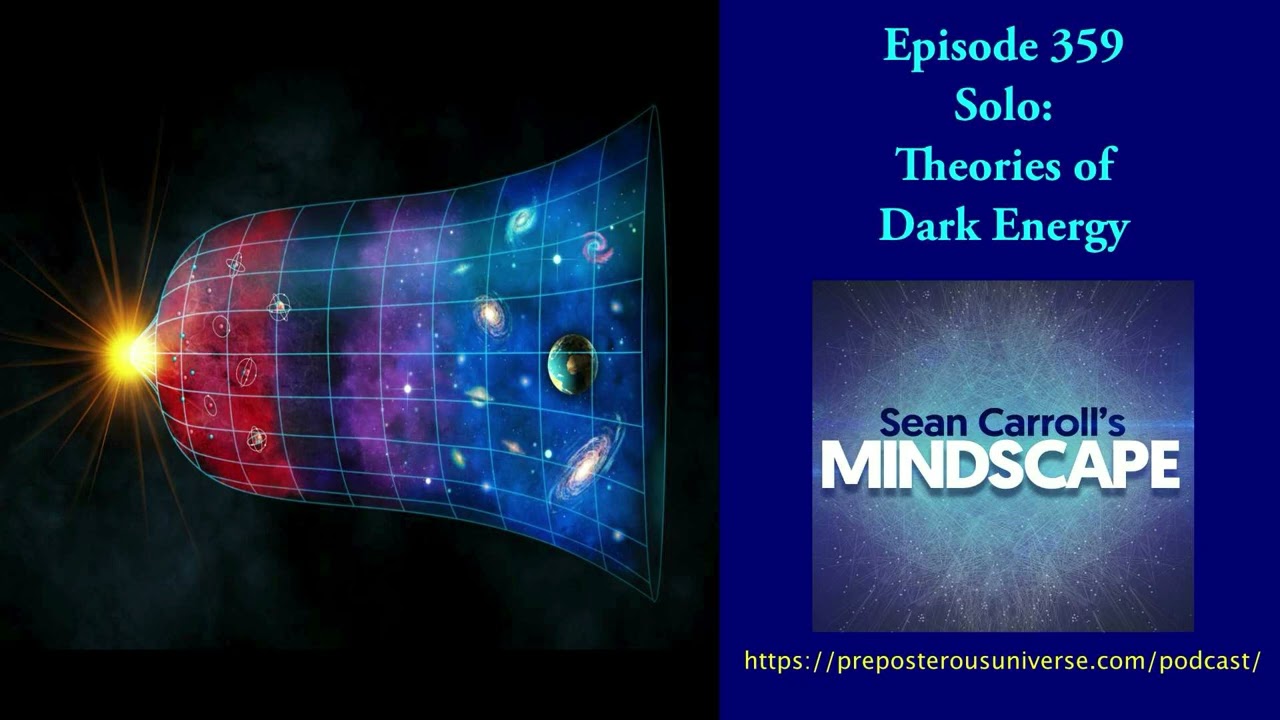
Solo: Theories of Dark Energy | Mindscape 359
"Sean Carroll explores the theoretical landscape of dark energy, dissecting dynamical models like quintessence and phantom energy, and modified gravity, while reflecting on their naturalness, experimental implications, and his personal contributions to the field."

Solo: Vacuum Energy and the Cosmological Constant | Mindscape 358
"Explore the perplexing history and current challenges of the cosmological constant, from Einstein's initial 'blunder' to the modern 10^122 discrepancy and its profound implications for the universe's past and future."
Jeff Coller on mRNA, Vaccines, and Bespoke Therapeutics | Mindscape 357
"mRNA technology, rapidly deployed for COVID-19 vaccines, is poised to revolutionize medicine by enabling rapid, personalized therapies for genetic diseases and cancer, but faces significant delivery and regulatory challenges."
Andrea Wulf on Enlightenment, Nature, Romanticism, and Modernity | Mindscape 356
"Historian Andrea Wulf explores how 18th-century thinkers like Georg Forster, Alexander von Humboldt, and the Jena Circle fundamentally reshaped our understanding of nature, humanity, and the individual, laying the groundwork for modernity and environmentalism."