
"SHOW Me The Evidence!" Israel-Iran War Debate - Trump Threatens To Quit NATO
YouTube · n2wFe1FmeRI
Quick Read
Summary
Takeaways
- ❖Donald Trump is strongly considering withdrawing the US from NATO, calling the alliance a 'paper tiger' and potentially leaving allies stranded.
- ❖The justification for the Iran war has shifted, with initial aims of regime change giving way to claims of preventing nuclear weapons, despite Iran's nuclear material remaining intact.
- ❖Iran has effectively retaliated against US/Israeli military action through economic strangulation via the Strait of Hormuz and attacks on Gulf States.
- ❖Israel's parliament approved a law making the death penalty a default sentence for Palestinians convicted of terror attacks, which critics denounce as a racist, two-tier legal system.
- ❖There is significant contention and accusations of hypocrisy regarding the reliability of casualty figures from both Iranian protests and the Gaza conflict.
- ❖Critics argue the US was dragged into the Iran war on behalf of Israel, which sought regime change and is not committing ground forces.
Insights
1Trump's Shifting War Aims and NATO Stance
Former President Trump initially framed the Iran conflict as aiming for regime change, then shifted to preventing nuclear weapon development. However, critics note Iran's enriched uranium remains untouched, suggesting the objective was not fully met. Trump also threatened to withdraw the US from NATO, labeling it a 'paper tiger,' a move General Sir Richard Sheriff stated has 'torpedoed NATO as an alliance.'
Trump's statements on ending the war in 2-3 weeks (), his consideration to quit NATO (), and his claim of achieving the nuclear mission () are discussed. The host and guests challenge the effectiveness and sincerity of these claims, pointing out the untouched uranium () and NATO's historical support for the US ().
2Economic Warfare and Geopolitical Consequences
Beyond military strikes, Iran has engaged in effective asymmetric warfare by economically strangling global oil supplies via the Strait of Hormuz and attacking Gulf States. This has caused a 'shuddering shock to the global economy,' impacting gas and food prices. Piers Morgan suggests Trump's desire to end the conflict quickly is driven by political concerns ahead of the US midterm elections.
Piers Morgan details Iran's 'skillful and cunning' economic strangulation () and the resulting 'pain at the gas station prices, food prices' (). He links Trump's 'two to three weeks I'm gone' rhetoric to political pressure from the midterms ().
3Israel's Death Penalty Law: A 'Racist, Fascist' Apartheid Measure
Israel's parliament approved a law making the death penalty the default sentence for Palestinians convicted of 'deadly terror attacks.' This law applies exclusively to Palestinians, not Israelis, creating a two-tier legal system. Critics, including Dr. Mustafa Barghouti, condemn it as a 'racist, fascist, and dangerous escalation,' worse than South African apartheid, and indicative of Israel's move towards fascism.
The host details the law's passage (), its celebration by Minister Ben-Gvir (), and its discriminatory application (). Dr. Barghouti explains how a dual legal system defines apartheid (), citing 99% conviction rates for Palestinians versus 8/10,000 for Israelis attacking Palestinians (), and the symbolic wearing of 'hanged man's knots' ().
4The 'Double Standard' in Casualty Reporting
A contentious debate erupted over the credibility of casualty figures, particularly concerning Iranian protest deaths and the Gaza conflict. Piers Morgan accused guests of intellectual dishonesty for questioning Iranian death tolls while defending Gaza Health Ministry numbers, or vice-versa. This highlights the politicization of casualty reporting and the difficulty in verifying information amidst conflict.
Elica claims 36,500 killed in Iranian protests from hospital tallies (), which Anakus disputes, calling it disinformation (). Piers Morgan points out the 'complete reverse' () of how Anakus defends Gaza Health Ministry numbers () but questions Iran's. Elica, in turn, questions the Gaza Health Ministry's separation of civilians from combatants ().
Bottom Line
The US military's perceived omnipotence is challenged by Iran's effective asymmetric economic warfare, suggesting traditional military superiority does not guarantee victory against unconventional tactics targeting global supply chains.
This implies a shift in modern warfare where economic disruption can be as potent as direct military confrontation, forcing powerful nations to reconsider their strategic responses beyond conventional force projection.
Businesses and governments should develop advanced risk assessment models for geopolitical conflicts that prioritize economic vulnerabilities and asymmetric threats, rather than solely focusing on military capabilities.
The celebration of a discriminatory death penalty law by Israeli government officials, complete with 'noose' lapels, is presented as a stark indicator of a society's rapid move towards fascism, even within a self-proclaimed democracy.
This suggests that democratic institutions can erode quickly under extreme political and social pressures, leading to the normalization of practices widely condemned by international human rights standards.
International bodies and human rights organizations face an urgent need to re-evaluate their frameworks for identifying and responding to democratic backsliding and the rise of illiberal policies in allied nations, potentially through stronger sanctions or diplomatic pressure.
Lessons
- Critically evaluate all sources of information during geopolitical conflicts, especially casualty figures, recognizing the potential for propaganda and 'intellectual dishonesty' from all sides.
- Understand that military conflicts often have shifting justifications and significant economic repercussions, such as disruptions to global supply chains and rising commodity prices, which can influence political decisions.
- Recognize that 'internal affairs' of sovereign states, particularly those involving human rights and discriminatory laws, can have profound international implications and warrant scrutiny from a global human rights perspective.
Notable Moments
Heated exchange over Iranian protest death tolls, with Elica claiming 36,500 killed and Anakus demanding sources and accusing her of disinformation, mirroring the Gaza casualty debate.
This segment vividly illustrates the 'double standard' and politicization of casualty figures in conflict, where the credibility of sources is selectively challenged based on political alignment.
Piers Morgan's strong condemnation of Israeli Minister Ben-Gvir celebrating the death penalty law with champagne and 'noose' lapels, calling it 'despicable' and 'sickening.'
This highlights the host's personal outrage at the perceived moral degradation of a government's actions, emphasizing the extreme nature of the new law and its symbolic implications.
Quotes
"Donald Trump has pretty much single-handedly torpedoed NATO as an alliance."
"The worst case scenario is that this war ends and the regime is still in power. That's worse than if the war never happened at all."
"For the Israelis, it was never ever about nuclear weapons... It was always about regime change for them."
"Iran has hit back in a way... by economically strangling the world through the Strait of Hormuz and also strangling the economies of the Gulf States."
"Aggression is the supreme international crime. That is what Trump undertook here."
"It's intellectually dishonest to people, right? To pick and choose which [deaths] you care about."
"Two different systems of laws for two people living in the on the same land is apartheid. That's how you classify and identify apartheid."
Q&A
Recent Questions
Related Episodes

🚨 THEY F*CKED AROUND FOR THE LAST TIME 😭😭😭
"This episode unleashes a torrent of highly opinionated commentary on the US-Iran deal, Israel's role, and a scathing critique of 'leftist' policies and immigration, particularly highlighting the UK grooming gang report as evidence of Western societal decay."
BREAKING: Protests ERUPT In Iran Over IRGC Surrendering To Trump - Infighting Clashes In Tehran
"Iran is experiencing severe internal infighting and protests as hardline IRGC elements clash with government figures over a perceived 'surrender' to the US, while mainstream Western media misrepresents the situation."
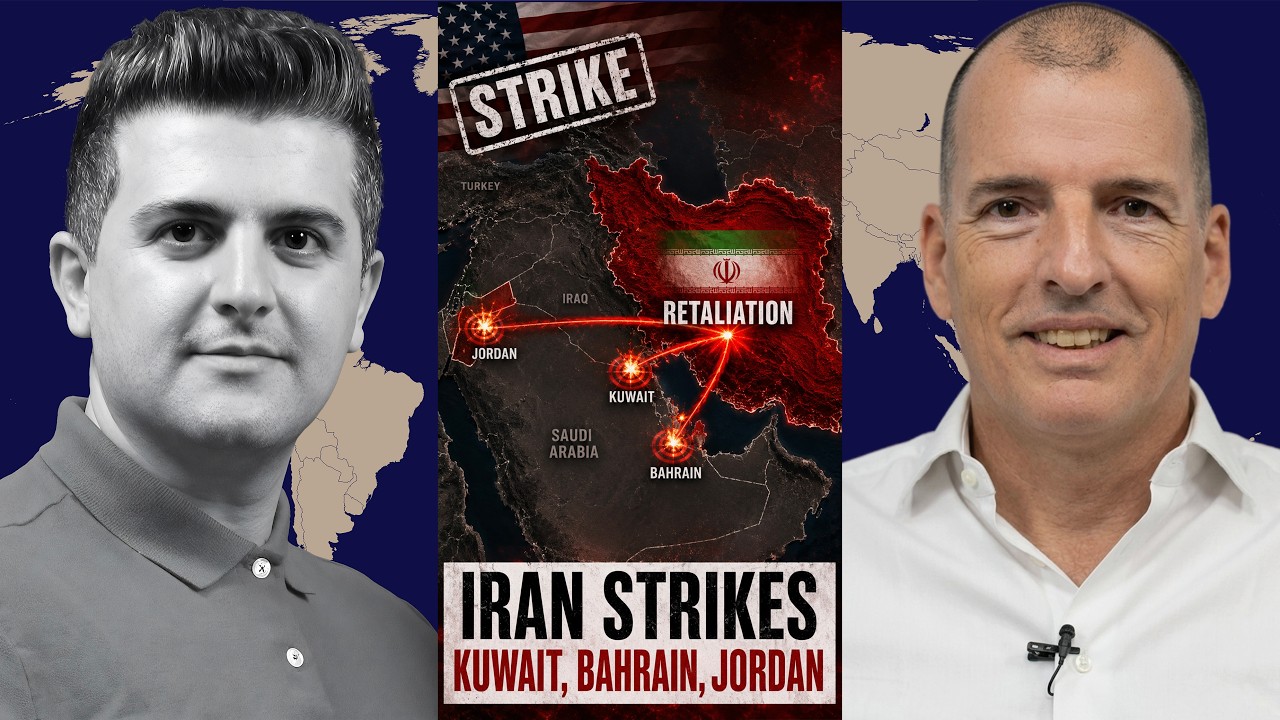
Alex Krainer: US STRIKES Iran – Iran RETALIATES Against Kuwait, Bahrain & Jordan!
"Amidst escalating US-Iran conflict and Iranian retaliation against regional US allies, this episode argues that US foreign policy is deeply controlled by an 'Anglo-Zionist conspiracy' led by the Rothschild banking dynasty, prioritizing Israeli interests over American ones."

LIVE: Trump HIDES FROM PUBLIC as US SOLDIER KILLED!!! 6/2/2026
"The host exposes alleged government cover-ups regarding military casualties, Trump's unexplained public absence, and questionable political appointments, arguing these reflect a 'regime of loser babies' and a failing foreign policy."