Trump makes FATAL MISTAKE with Venezuela invasion
YouTube · pwigFS6vMVA
Quick Read
Summary
Takeaways
- ❖Trump's Venezuela intervention was a deliberate, long-planned military operation, not a distraction from domestic scandals.
- ❖The primary drivers for the intervention were power consolidation and access to Venezuela's oil, directly contradicting Trump's 'America First' rhetoric.
- ❖The US executive branch acted without congressional authorization, bypassing constitutional checks on war powers and financial appropriations.
- ❖The intervention risks ushering in an era of 'ruleless geopolitics,' where major powers disregard national sovereignty and international law.
- ❖Trump's dismissal of opposition leader Maria Machado underscores that the intervention was not about promoting democracy or human rights for Venezuelans.
Insights
1Trump's Venezuela Intervention: A Calculated Power Play for Oil, Not a Distraction
Ben Rhodes refutes the idea that the Venezuela intervention was a distraction from issues like the Epstein files. He asserts it was a long-planned military operation, consistent with Trump's historical foreshadowing of military actions and his administration's national security strategy to reassert US influence in Latin America. The core motivation was the pursuit of power and money, specifically Venezuela's vast oil reserves, which Trump explicitly mentioned wanting for US oil companies.
Trump consistently foreshadowed military operations (Panama Canal, Greenland). The administration's national security strategy focused on Latin America as a US sphere of influence. Trump's press conference explicitly linked the intervention to oil, not drugs, and discussed sending US oil companies to Venezuela.
2Inconsistency with 'America First' and Non-Interventionism
Despite campaigning on an 'America First' platform and non-interventionism, Trump's actions in Venezuela, Iran, and Nigeria demonstrate a pattern of military engagement that directly contradicts his stated ideology. Rhodes argues this reveals the 'America First' posture as 'bogus,' driven instead by Trump's personal desire for strongman power and financial gain for his allies.
Trump bombed Iran, Nigeria, and Venezuela—countries not previously targeted by the US. This runs counter to his campaign promises of ending 'forever wars' and focusing domestically.
3Executive Overreach and Congressional Impotence
The intervention occurred without congressional authorization, representing an unconstitutional action. Rhodes highlights that Congress, particularly Republicans, has largely failed to assert its constitutional role in war powers and appropriations. The administration has shown a willingness to reallocate funds from existing Pentagon budgets to finance such operations, bypassing traditional oversight.
Trump removed a leader and went to war without seeking congressional authorization. The administration has used existing 'giant pots of money' from the Pentagon to fund operations, bypassing congressional appropriation processes.
4The Danger of Ruleless Geopolitics and Imperialism
Rhodes warns that Trump's unilateral actions in Venezuela signal a dangerous return to a world without rules, where major powers disregard national sovereignty. He draws parallels to Putin's view of the former Soviet Union and China's view of its neighborhood, suggesting this approach could lead to increased global instability and conflict, reminiscent of pre-World War eras.
Rhodes states, 'What lesson does Vladimir Putin take from this about what he's allowed to do? What lesson does China take from this about what they might be allowed to do in Taiwan?' He describes it as 'returning to imperial ruleless geopolitics.'
5Dismissal of Opposition Leaders Underscores True Motivations
Trump's public dismissal of Venezuelan opposition leader Maria Corina Machado, despite her support base and past electoral success, confirms that the intervention was not about fostering democracy or human rights. His reasoning that she 'doesn't command enough respect' or isn't 'strong enough' indicates a preference for a pliable 'vassal state government' that will facilitate US oil interests, rather than genuinely empowering democratic forces.
Maria Machado, who had significant support and whose candidate won the last election, was dismissed by Trump as not having enough support or respect, particularly from the military. Trump made 'no pretense that this is about democracy or a better life for Venezuelans.'
Bottom Line
The 'frog in boiling water' effect applies to political normalization: actions once considered extreme (like invading a country without legal basis) become normalized through a gradual ramp-up of threats and smaller actions, desensitizing the public.
This normalization makes it harder for the public and political institutions to recognize and resist authoritarian tendencies or dangerous foreign policy shifts until they are deeply entrenched.
Public discourse and media need to actively resist normalization by consistently framing actions against established norms and highlighting their long-term implications, rather than treating them as isolated events.
Trump's foreign policy, driven by personal power and wealth, creates a political opening for Democrats to campaign on issues of affordability and domestic focus, directly contrasting with expensive, resource-driven foreign interventions.
This provides a clear electoral strategy for opposition parties to highlight the economic costs and misaligned priorities of such interventions to the American voter, including Trump's own base.
Democrats can effectively 'prosecute a case against Trump' by emphasizing that his foreign policy serves 'oil companies' and 'rich oligarchs,' not the average American, linking it to domestic economic concerns.
Key Concepts
The Frog in Boiling Water
This model describes how extreme or dangerous actions become normalized over time. Initial shock gives way to acceptance as a series of escalating events desensitizes the public, making what would once be considered a 'worst-case scenario' seem like just 'another thing that happened.'
Ruleless Geopolitics / Imperialism 2.0
This model suggests a return to a pre-World War II international order where major powers operate without respect for national sovereignty or established international rules. It implies that actions like the Venezuela intervention could embolden other nations (e.g., Russia in Ukraine, China in Taiwan) to pursue similar unilateral, aggressive foreign policies.
Lessons
- Challenge the narrative that opposition to foreign intervention equates to supporting dictators; advocate for alternative methods of promoting democratic change and civil society.
- Demand congressional accountability and the assertion of legislative war powers to prevent unilateral executive military actions and unauthorized spending.
- Educate yourself and others on the true motivations behind foreign policy decisions, looking beyond stated justifications to identify underlying interests like resource control and power consolidation.
Notable Moments
Trump's public dismissal of Venezuelan opposition leader Maria Corina Machado, despite her significant support, as 'not strong enough' or commanding 'enough respect'.
This moment explicitly revealed that Trump's intervention was not about supporting Venezuelan democracy or human rights, but about installing a pliable government that would serve US resource interests, effectively tossing aside a democratic figure who had praised him.
The hosts' discussion about the 'frog boiling in water' analogy regarding Trump's normalization of extreme actions.
This highlights a critical psychological and political phenomenon where escalating authoritarian or unconstitutional acts become less shocking over time, making it harder for the public and institutions to react effectively.
Quotes
"Trump is motivated above all, not by any mega ideology... He's motivated by power and money. And both of those things intersect here in Venezuela."
"He was very clear today that what this was really about was not drugs, it was oil. And he talked a lot in his press conference about sending the US oil companies down there."
"Americans don't want us to be doing this anymore. They want their politicians in Washington to be focused on affordability, right? Not on conquering foreign countries or deposing foreign leaders, no matter how odious."
"We don't support is an illegal war that has nothing to do with democracy that could lead to worse outcomes... but also can lead to a world... where there's just no rules anymore."
"If I had told you a year ago, hey, Trump's going to like invade Venezuela, remove the leader, and say he's running the country, you'd be like, holy this is the worst case scenario. This is like fascism coming to America. But because there was this kind of ramp up to it... now it just kind of feels like this thing that happened."
Q&A
Recent Questions
Related Episodes
Robby Soave GOES OFF On ANNOYING Liberal Black Woman Making Emotional Trump Deranged Arguments!
"The host dissects a heated foreign policy debate, arguing that 'left-wing' emotionalism and 'Trump derangement' prevent a rational understanding of US sanction strategies against Cuba and Iran."

Will Venezuela Be Trump's Vietnam?
"An expert breaks down three perilous pathways for Venezuela under potential US intervention, from a 'Panamanian model' to a 'Libyan-style civil war,' and the broader geopolitical fallout for Latin America."
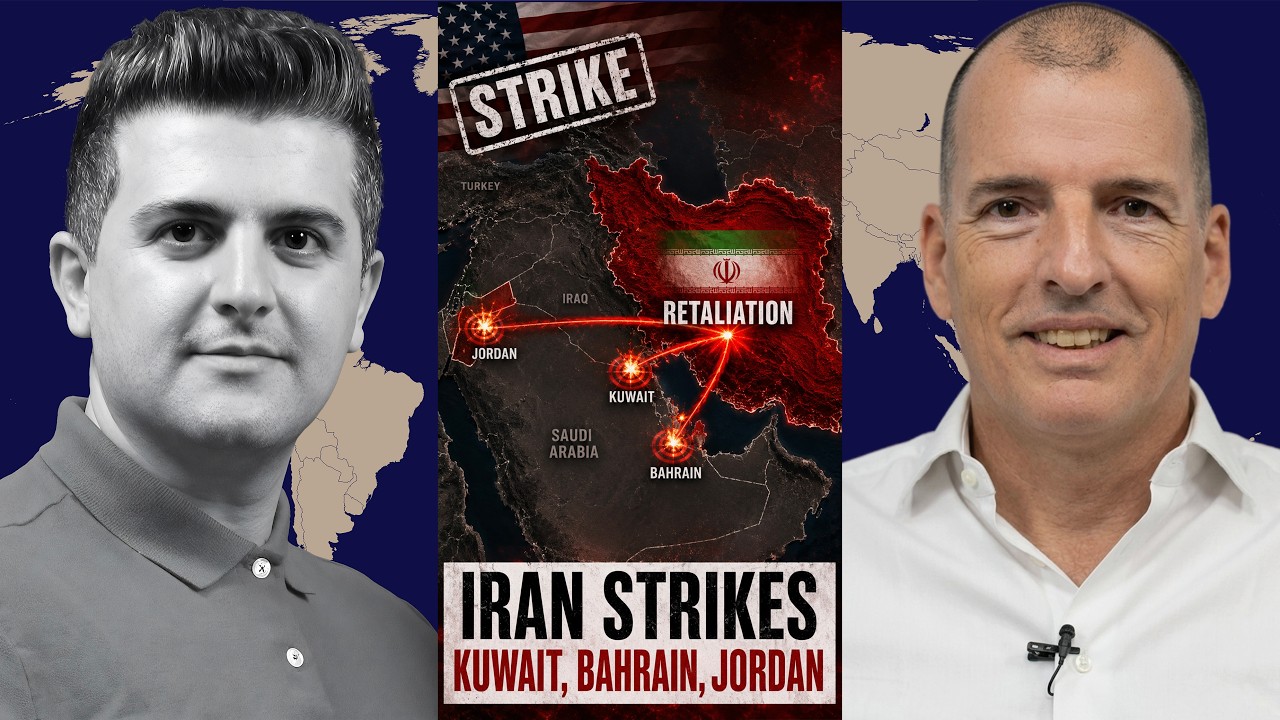
Alex Krainer: US STRIKES Iran – Iran RETALIATES Against Kuwait, Bahrain & Jordan!
"Amidst escalating US-Iran conflict and Iranian retaliation against regional US allies, this episode argues that US foreign policy is deeply controlled by an 'Anglo-Zionist conspiracy' led by the Rothschild banking dynasty, prioritizing Israeli interests over American ones."

🚨 LEFTISTS ARE F*CKING SEETHING 😂😂😂
"The host aggressively celebrates perceived 'wins' for the right-wing, from global conflicts and domestic politics to cultural shifts, framing them as a 'humiliation' for the 'leftist world order' and a testament to Donald Trump's influence."