
Do We Need New Math to Understand the Universe? With Terence Tao
YouTube · vJnkMxx9CEs
Quick Read
Summary
Takeaways
- ❖Interdisciplinary math institutes like IPAM are critical for solving 'blocked' problems in emerging technologies by fostering collaboration between diverse experts.
- ❖Pure mathematics, though curiosity-driven, frequently provides the abstract frameworks that later become essential for scientific breakthroughs, a phenomenon known as the 'unreasonable effectiveness of mathematics.'
- ❖The Collatz Conjecture demonstrates how simple mathematical rules can generate immense, unpredictable complexity, remaining unsolved despite vast computational testing.
- ❖New mathematical systems are likely needed to understand extreme cosmic phenomena like quantum gravity and black holes, requiring an abandonment of current notions of space and time.
- ❖While Bayesian probability offers a framework, proving or disproving the simulation hypothesis mathematically is currently impossible due to unknown prior probabilities and the potential for simulated data.
Insights
1IPAM's Model for Interdisciplinary Innovation
The Institute for Pure and Applied Mathematics (IPAM) serves as a hub for bringing together pure mathematicians, applied mathematicians, scientists, and industry professionals. This interdisciplinary approach allows for the identification and resolution of mathematical obstacles in emerging technologies, leading to significant advancements. For example, early workshops on AI and self-driving cars, and a collaboration that led to MRI scans 10 times faster than traditional methods, now used in modern machines.
IPAM brings together pure and applied mathematicians, scientists, and industry to work on topics where math is needed. They held early workshops on AI, deep fakes, and self-driving cars. A collaboration led to MRI scans 10 times faster, with their algorithms now used in modern MRI machines.
2The Symbiotic Relationship Between Pure and Applied Mathematics
Pure mathematics is curiosity-driven, exploring abstract patterns without immediate practical application, while applied mathematics focuses on developing tools and equations valuable to scientists and engineers. Despite their different motivations, they share a symbiotic relationship where pure math often provides the foundational concepts that applied math later leverages for real-world problems. This exchange can also flow in reverse, with physical observations inspiring new pure mathematical conjectures.
Pure math is curiosity-driven, exploring abstract patterns like digits of pi. Applied math develops software or equations for practical value to scientists, like modeling climate. Physicists' observations, such as universal distributions like the Gaussian curve, can inspire mathematicians to find explanations.
3The Collatz Conjecture: Simple Rules, Unsolvable Chaos
The Collatz conjecture, also known as the hailstone conjecture, is a deceptively simple problem that has stumped mathematicians for over a century. It proposes that any positive integer, when subjected to a rule (divide by two if even, multiply by three and add one if odd), will eventually reach the 1-4-2 loop. Despite extensive computer testing up to quadrillions, no counterexample has been found, yet a formal proof for all numbers remains elusive, illustrating how simple operations can lead to immense complexity and 'chaos.'
The Collatz conjecture involves a simple rule: if even, divide by 2; if odd, multiply by 3 and add 1. It's conjectured that all numbers eventually reach the 1-4-2 loop. Computers have tested numbers up to quadrillions, but no proof exists for all infinite cases. This is an example of chaos from simple operations.
4The Unreasonable Effectiveness of Mathematics in Science
Abstract mathematical concepts, developed purely for intellectual curiosity, frequently find profound and unexpected applications in the physical sciences, often decades later. The most famous example is non-Euclidean geometries, which mathematicians explored for their own sake but later became the precise language Einstein needed to formulate General Relativity and describe curved spacetime.
Eugene Wigner called this the 'unreasonable effectiveness of mathematics.' Non-Euclidean geometries, developed by mathematicians like Riemann for curved space, were later found by Einstein to be almost exactly the language needed for general relativity.
5The Impact of Number Base Systems on Mathematical Discovery
While changing the numerical base system (e.g., from base 10 to base 2 or 60) doesn't alter fundamental mathematical truths (like A+B=B+A), it can influence the speed or direction of discovery. Different bases might highlight or obscure certain patterns, potentially slowing down or accelerating the development of specific theories. Historically, humans have used various bases (Babylonian base 60, remnants of base 12 and 20), and computers now predominantly use binary (base 2) for efficiency.
Babylonians used base 60, influencing time measurement. Humans have used base 12 (dozens) and base 20 (scores). Computers use base 2 (binary). While A+B=B+A remains true regardless of base, using different bases can 'slow it down or speed it up a little bit' in terms of accessing discovery.
6Strategies for Solving Difficult Mathematical Proofs
When tackling complex, unsolved mathematical problems, it's crucial to explore not just what works, but also the 'negative space' – what doesn't work. By actively trying to prove the opposite of a conjecture or finding counterexamples that satisfy hypotheses but not the conclusion, mathematicians can identify missing parameters or flawed assumptions. This process of mapping out pitfalls helps reveal the narrow path to a valid proof, emphasizing the value of partial progress and avoiding emotional investment in a single outcome.
It's important to prove 'negative results' by finding counterexamples that satisfy hypotheses but not the conclusion. This helps identify what's missing. Mapping out the 'negative space' reveals the narrow path to a goal. Mathematicians value partial progress and are not emotionally invested in one outcome.
7The Need for New Mathematics to Understand Extreme Universe Phenomena
While current mathematics excels at explaining most of the universe, it 'breaks down' at extreme scales and conditions, such as the early universe, the centers of black holes, and the realm of quantum gravity. To reconcile these areas, physicists believe new mathematical frameworks are necessary, potentially requiring a complete re-evaluation of our fundamental notions of space and time. Existing concepts like non-Euclidean geometry are insufficient for describing quantum spacetime, prompting theories like string theory to propose entirely new mathematical structures.
Our math breaks down in places like the early universe and black holes. The current math doesn't give sensible answers for these extreme conditions. We need a theory of quantum gravity, which requires abandoning our notions of space and time. Even non-Euclidean geometry won't be enough for quantum spacetime. String theory is a proposal, but it hasn't convincingly fit reality.
Key Concepts
Spherical Cow Assumptions
A simplified model used in applied mathematics and physics to isolate core principles of a problem. Starting with an idealized, often unrealistic, scenario (like a frictionless, spherical cow) allows for initial analysis, with complexity added incrementally. This approach makes 'experiments cheap' in math, allowing for failure without real-world consequences.
Law of Large Numbers
A fundamental concept in probability stating that as the number of trials or observations increases, the observed frequency of an event will converge to its expected probability. This principle explains why most numbers lack 'interesting patterns' and is crucial for statistical polling, allowing accurate predictions from small, representative samples.
Order in Chaos
The idea that even within seemingly random or complex systems, underlying patterns or structures can be found. This applies to problems like the Collatz conjecture, where simple operations lead to chaotic behavior, but also to theorems like Erdos-Szekeres, which guarantees a long increasing or decreasing subsequence within any sufficiently long sequence of numbers.
Lessons
- Foster interdisciplinary collaboration by creating environments where experts from diverse fields (pure math, applied math, science, industry) can interact and identify shared problems.
- Embrace 'toy models' and simplified assumptions as a starting point for complex problem-solving, gradually adding complexity as understanding develops, leveraging the 'cheapness' of mathematical experimentation.
- Improve math education by recognizing and catering to diverse learning styles (visual, narrative, symbolic, competitive) to make mathematics more accessible and engaging for a broader range of students.
- When facing difficult problems, actively explore 'negative space' by seeking counterexamples or attempting to prove opposite conclusions to identify missing parameters or flawed assumptions, rather than solely focusing on a single desired outcome.
Quotes
"Mathematics is the part of science where experiments are cheap."
Q&A
Recent Questions
Related Episodes
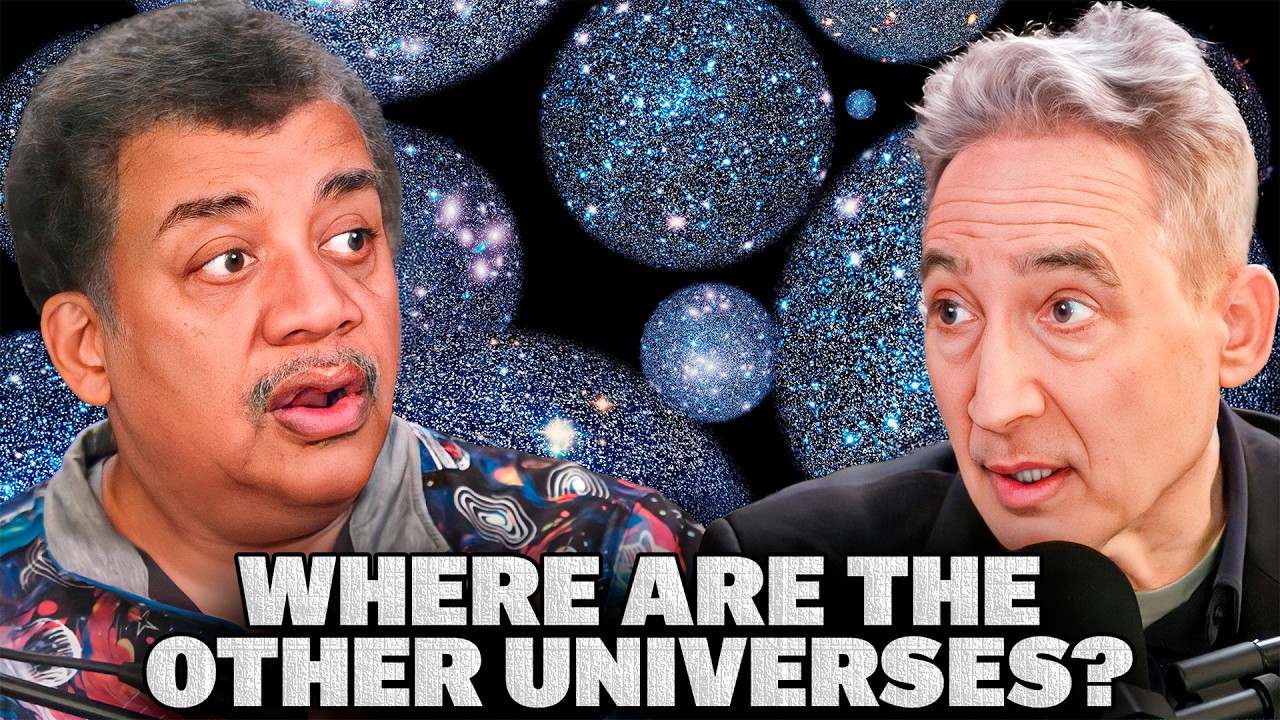
Exploring Hidden Dimensions with Brian Greene
"Theoretical physicist Brian Greene unpacks the universe's most mind-bending concepts, from the many-worlds multiverse to the fabric of spacetime woven by quantum entanglement, with Neil deGrasse Tyson."

Can Science Explain Everything? | World Science Festival
"A mathematician and a physicist debate whether science can explain everything, exploring the intersection of faith, reason, and the search for ultimate meaning in the universe."
5 Papers That Show Where AI Research Is Heading Right Now
"This Y Combinator session explores five cutting-edge AI research papers, revealing advancements in AI for biology, self-play for LLMs, real-time voice agents, formal math verification, and agentic programming workflows."

How to Build the Future: Demis Hassabis
"DeepMind CEO Demis Hassabis details the missing pieces for Artificial General Intelligence (AGI), the strategic role of smaller AI models, and how AI will transform scientific discovery, urging founders to combine AI with other deep tech."