
Pepe Escobar: Trump’s Confrontation Backfires HARD
YouTube · vWd_Q2-6j8Y
Quick Read
Summary
Takeaways
- ❖Pakistan is a key mediator, supported by China and Iran, in efforts to reach a memorandum of understanding with the US regarding Iran.
- ❖High-level meetings in Beijing between Trump, Putin, and a Pakistani delegation underscore a coordinated effort to shape a multipolar world.
- ❖The US administration, particularly Trump, is seen as unreliable and driven by ego, making agreements difficult to sustain.
- ❖The US blockade of Iranian ports is deemed ineffective, with tankers continuing transit by paying 'administrative fees'.
- ❖Iran's potential response to Israeli provocations is being delayed until after the Hajj, indicating strategic patience.
- ❖The speaker contrasts the functional, future-oriented societies in Asia (e.g., Shanghai) with the 'dementia' and 'folly' perceived in the West.
- ❖The 'post-American established order' in West Asia is already a reality, with its final form still emerging.
Insights
1Eurasian Powers Coordinate to Build a Multipolar World
A series of high-level meetings in Beijing—Trump's visit, Putin's visit (resulting in a joint declaration for a multipolar world), and an ultra-high-level Pakistani delegation's visit—demonstrate a coordinated effort by China, Russia, and Pakistan to mediate the West Asian conflict and establish a new global order. China acts as a guarantor, Pakistan as a go-between, and Iran maintains its core positions.
Pepe Escobar details these three visits occurring 'one week after another' in Beijing, with the Pakistani delegation specifically discussing 'mediation sphere with full support from China.' The Russia-China joint declaration is described as 'laying the tracks for building the multipolar world.'
2US Perceived as 'Non-Agreement Capable' and Driven by Ego
The speaker and the negotiators involved in the Iran talks view the US, particularly the Trump administration, as untrustworthy and incapable of upholding agreements. Trump's policies, like the Iranian port blockade, are attributed to personal ego and a lack of sound advice, making diplomatic progress extremely challenging.
The speaker quotes Sergey Lavrov, stating the 'United States is non-agreement capable.' He describes Trump's blockade idea as 'another one of those three in the morning ideas in the mind of a four-year-old' and attributes his inability to backtrack to 'ego, ego, ego, ego, ego plus ego.'
3Post-American Order in West Asia is Already a Reality
The established American order in West Asia has fundamentally changed, even if the new structure is not yet fully defined. This shift contributes to the 'desperation, impotence, and fury' of the US and 'international Zionist side,' who are actively working to disrupt any potential peace deals.
Escobar states, 'It has already changed... we are already in the post American established order in West Asia. We still don't know how this is going to be constituted, but it's already a new ball game.' He also mentions the 'Zionist lobby would go all the way out to smash, destroy, blow up any possibility of a deal.'
Bottom Line
The perceived 'dementia' and 'folly' of the West, particularly US foreign policy, is accelerating the shift of global power and confidence towards Asian nations.
This perception gap means that while Western powers struggle with internal and external crises, Asian nations are strategically building functional societies and alternative global frameworks, viewing Western actions as increasingly irrelevant or self-destructive.
Businesses and investors should increasingly orient towards the stable, future-oriented economies and diplomatic initiatives emerging from Asia, recognizing the diminishing reliability and strategic coherence of traditional Western alliances.
Key Concepts
Realpolitik
The approach of the negotiators (China, Pakistan, Iran) is described as 'real politic practitioners' who have 'no illusions' about the challenges, especially regarding the US's reliability. They focus on practical considerations and power dynamics rather than ideology.
Multipolar World Order
The joint declaration between China and Russia, and the coordinated diplomatic efforts, are explicitly framed as 'laying the tracks for building the multipolar world,' where power is distributed among multiple major poles rather than concentrated in one (e.g., the US).
Lessons
- Monitor the ongoing mediation efforts between Pakistan, China, Iran, and the US for early indicators of shifts in West Asian stability and global power dynamics.
- Evaluate the long-term implications of a 'non-agreement capable' US administration on international treaties and business partnerships, especially in regions critical to global trade and energy.
- Diversify geopolitical risk assessments to account for the growing influence and coordinated actions of Eurasian powers in shaping the global economic and political landscape.
Notable Moments
Pepe Escobar highlights the sequence of high-level visits to Beijing (Trump, Putin, Pakistani delegation) as a roadmap for Eurasian powers to address the West Asian conflict and build a multipolar world.
This sequence of events is presented as concrete evidence of a coordinated strategy by major non-Western powers to actively shape the global order, moving beyond US unilateralism.
Escobar describes the US blockade of Iranian ports as a 'stupid idea' that is not working, with tankers continuing transit by paying 'administrative or environmental fees'.
This illustrates the practical limitations and ineffectiveness of US sanctions and military posturing when confronted with determined actors and alternative economic mechanisms, undermining US credibility.
The speaker contrasts the functional, technologically advanced society of Shanghai with the 'dementia' and 'folly' corroding the West.
This stark comparison underscores a fundamental ideological and practical divergence between East and West, suggesting a growing confidence in the Asian model and a dismissive view of Western governance and foreign policy.
Quotes
"We are already in the post American established order in West Asia. We still don't know how this is going to be constituted, but it's already a new ball game."
"We are dealing with an immensely insecure character and everything about him is of course Narcissus that intergalactic ego and of course the total impossibility to admit that he committed zillions of very serious mistakes."
"The contrast between the future being forged here in Asia and the dementia corroding the west very very far away it's something once again let's go back to the galaxies it's a it's a Star Wars strip really."
"The Chinese look at all that and they said have they gone mad? Yes, they have gone mad. Do we Chinese care? No, we don't. We'll continue doing what we are doing which is forging a future for ourselves and for our partners across the world that is livable and not dominated by folly absolute folly which is what the west is now the empire of folly essentially."
Q&A
Recent Questions
Related Episodes
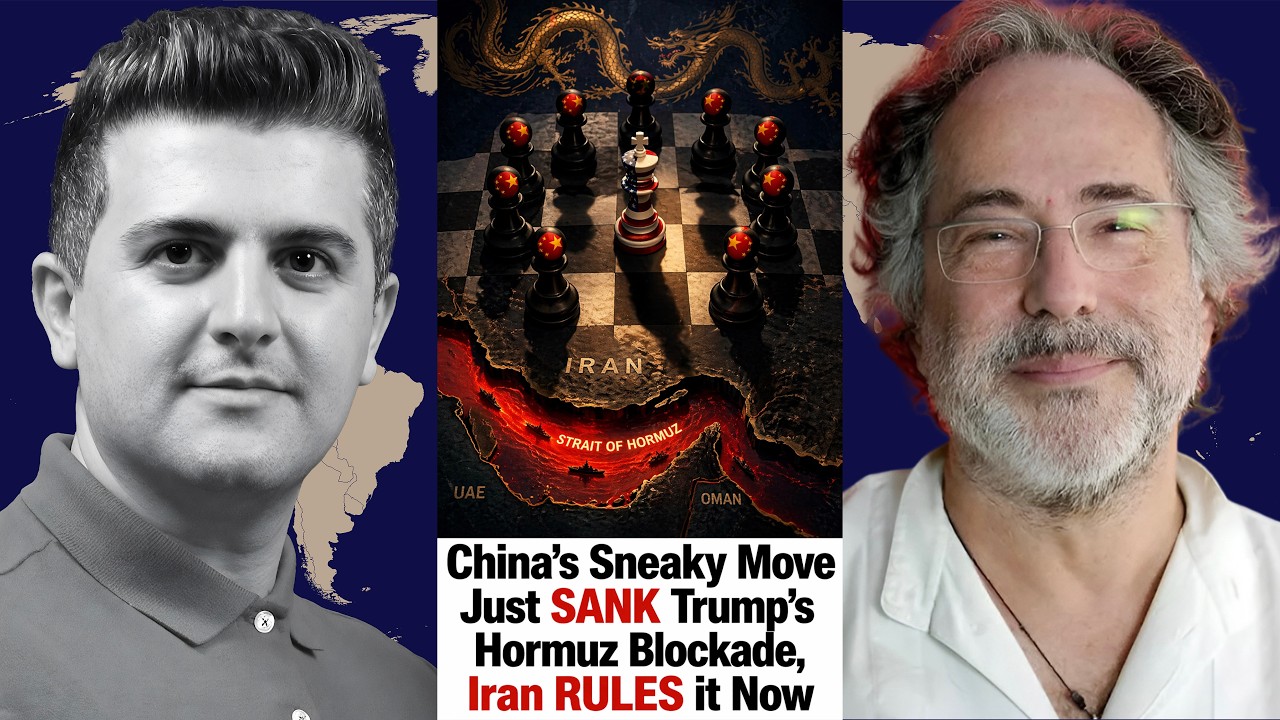
Pepe Escobar: “Total Failure”: Trump’s Blockade Just Backfired Disastrously
"Pepe Escobar argues that the US blockade against Iran, spearheaded by Donald Trump, has utterly failed and backfired, accelerating global economic chaos and challenging US geopolitical dominance."
Robby Soave GOES OFF On ANNOYING Liberal Black Woman Making Emotional Trump Deranged Arguments!
"The host dissects a heated foreign policy debate, arguing that 'left-wing' emotionalism and 'Trump derangement' prevent a rational understanding of US sanction strategies against Cuba and Iran."

Pentagon Prepares For EXTENDED War With Iran
"This episode dissects the geopolitical maneuvers surrounding potential US-Iran conflict, revealing strategic leaks, Netanyahu's diplomatic sabotage playbook, and the true intent behind economic sanctions."

Col. Jacques Baud: The World Is Entering a Lawless Era
"Colonel Jacques Baud details his personal experience with arbitrary EU sanctions and argues that the world has shifted from a law-based international order to a dangerous, rules-based system dictated by powerful actors, exemplified by US actions in Venezuela and the EU's 'teenager decision-making'."