
Amb. Chas Freeman: Trump PUSHES ESCALATION — Israel’s Strategy COLLAPSES Overnight
YouTube · wJcTHrczIgA
Quick Read
Summary
Takeaways
- ❖Donald Trump's recent speech, despite its aggressive tone towards Iran, effectively signaled that military force cannot open the Strait of Hormuz, pushing other nations towards diplomatic engagement with Iran.
- ❖Iran is regularizing transit through the Strait of Hormuz, requiring ships to apply to the Revolutionary Guard, pay a fee, and undergo cargo/ownership checks.
- ❖Ambassador Freeman suggests that the attack on Kuwait's desalination plants was likely an Israeli false flag operation aimed at agitating Gulf Arabs against Iran.
- ❖European nations like Spain, France, and Italy are increasingly decoupling from US policy, banning the use of their bases and airspace for operations against Iran.
- ❖Israel's war strategy, focused on 'utter destruction' without a peace plan, is attributed to the 'Greater Israel Project' and Benjamin Netanyahu's need to remain in office.
- ❖Ambassador Freeman asserts that Iran's acquisition of nuclear weapons is now 'certain' due to the perceived existential threat, which will trigger further proliferation in the region.
- ❖A new regional security architecture, potentially involving Pakistan, China, Saudi Arabia, Egypt, and Turkey, is emerging to manage Gulf stability without US or Israeli involvement.
Insights
1Trump's Rhetoric Inadvertently Forces Diplomacy with Iran
Donald Trump's speech, despite threatening to 'ravage Iran,' included a crucial acknowledgment that military means cannot open the Strait of Hormuz. This statement, Ambassador Freeman argues, effectively incentivizes all nations dependent on the Strait to negotiate directly with Iran for transit, including paying tolls in Iranian Rials or Chinese Yuan.
Trump's speech stated the US 'cannot use military means to open the Strait of Hormuz and we will not do that,' forcing others to 'find their own way to open the strait.' Iran is simultaneously regularizing transit rules, requiring applications to the Revolutionary Guard and cargo inspections.
2Israel's 'Destruction-Only' War Strategy is Failing and Politically Motivated
Ambassador Freeman states that Israel's approach to war, now adopted by the US, is 'utter destruction of the enemy' with 'no negotiation, no peace plan.' This strategy, driven by the 'Greater Israel Project' and Benjamin Netanyahu's need to avoid jail and stay in power, has failed in Gaza and will not work with Iran. He notes that this approach is based on a 'theory with no evidence to support it.'
Freeman states, 'Israel's approach to war is always the same... the utter destruction of the enemy. No negotiation, no peace plan... We're seeing this now in Lebanon... Hamas has not capitulated. It has not worked with Iran. It will not work with Iran.' He adds, 'the war is essential to keep Benjamin Netanyahu in office and out of jail.'
3Growing European Decoupling from US Middle East Policy
There is an accelerating 'decoupling' of Europe from US Middle East policy. Spain, France, and Italy have banned the use of American bases and airspace on their territory for operations against Iran. Even Britain, while complicit, has stated, 'this is not our war.' This rift is aggravated by the US's lack of diplomacy and disregard for allies' interests.
Spain, France, and Italy have banned the use of American bases/airspace for war support. Germany's right-wing opposition demands removal of US bases. Britain has stated, 'this is not our war.'
4Pentagon Internal Chaos and Casualty Cover-Up
Ambassador Freeman highlights significant internal turmoil within the Pentagon, evidenced by Secretary Pete Hegseth's unprecedented firing of Army Chief of Staff Randy George amidst ongoing conflict. He also points to an alleged cover-up of US casualties in the Middle East, with figures in German hospitals suggesting 'many hundreds' of wounded, far exceeding official Pentagon admissions.
Hegseth fired General George, the top general in the US Army, during wartime. Reports indicate hospitals in Germany are 'full' with wounded, suggesting a 'cover up' of casualty numbers, which are 'in the many hundreds, not the minimal figures that the Pentagon has admitted.'
5Iran's Nuclear Weapon Acquisition is Now Inevitable
The speaker asserts that the actions of Israel and the United States have 'proven that those people in Iran who argued that Iran like North Korea needs a nuclear weapon to continue to exist to survive in peace' were correct. He believes it is 'now certain that Iran will build a nuclear weapon,' citing a clause in the religious fatwa that permits WMD development if Iran's existence is directly threatened.
Freeman states, 'it's now certain that Iran will build a nuclear weapon.' He references the fatwa's escape clause: 'if the existence of Iran were in directly threatened, then it would not be haram... to build these weapons. And certainly what has been happening now meets the requirements of that escape clause.'
6Emergence of a New, Non-Western-Led Regional Security Architecture
A new cooperative security architecture for the Persian Gulf is being laid, potentially directed by Pakistan, Saudi Arabia, Egypt, and Turkey, backed by China. This framework would exclude the United States and be fundamentally hostile to Israel, aiming to liberate the region from dependence on foreign arms sales and dictation.
Egypt, Saudi Arabia, and Turkey met in Islamabad with Pakistan to discuss ending the war. Pakistan, backed by China, is acting as a mediator between Iran and the US. This grouping has the capacity to create a military-industrial complex freeing them from US influence. Oman is also a potential mediator.
Bottom Line
Donald Trump's 'America First' policy, when applied to the Middle East, is ironically forcing US allies and global powers to bypass the US and engage directly with Iran, effectively legitimizing Iran's control over critical choke points like the Strait of Hormuz.
This undermines US influence and sanctions regimes, creating a precedent for other nations to prioritize economic necessity over US geopolitical directives. It accelerates the formation of a multipolar world where regional powers solve their own security and economic issues.
Companies and nations can proactively establish direct diplomatic and economic channels with Iran, anticipating a future where the Strait of Hormuz operates under Iranian/Omani management, potentially securing preferential access or trade terms.
The perceived inevitability of Iran acquiring nuclear weapons, driven by the current conflict, will trigger a regional nuclear arms race involving Saudi Arabia, Egypt, and Turkey, fundamentally altering the global non-proliferation landscape.
This creates a highly unstable and dangerous new security paradigm in West Asia, increasing the risk of nuclear conflict and potentially inspiring other non-nuclear states globally to pursue their own deterrents, unraveling decades of non-proliferation efforts.
International bodies and non-proliferation advocates must urgently re-evaluate existing frameworks and engage in preventative diplomacy to mitigate the risks, potentially by offering robust security guarantees or alternative deterrence mechanisms to regional powers.
Lessons
- Recognize that military solutions for securing critical chokepoints like the Strait of Hormuz are increasingly unfeasible; prioritize diplomatic engagement and economic agreements with regional powers.
- Assess the long-term implications of current geopolitical strategies, particularly how 'destruction-only' approaches can backfire by strengthening adversaries and accelerating unintended outcomes like nuclear proliferation.
- Monitor the emergence of new regional security architectures, especially those involving non-Western powers, as they may offer alternative models for stability and influence that bypass traditional alliances.
Quotes
"The problem with this war from the beginning has been that it's had no clear objectives, no achievable objectives. And Secretary of Defense, self-studied Secretary of War, now known more as Secretary of War crimes, Pete Hegseth, has basically defined the purpose of war as death and destruction. But that means that the war has no strategic or other purpose except destruction."
"Basically what Donald Trump has just done is told the world you have to negotiate with Iran. You have to do a deal with Iran."
"If you were an Israeli picking a desalination target to try to agitate the Arabs in the Gulf against Iran and bring them into the war and discredit Iran, this is the target you would choose. So I I don't of course we don't know. I mean everything is speculation. But I think it's very plausible this was in fact a false flag operation."
"The war is essential to keep Benjamin Netanyahu in office and out of jail."
"Israel has become an utterly unacceptable source of instability and evil, murder and mayhem and destruction and death in its region. And if you want peace in West Asia, the principal change that has to occur is not in Iran, it's in Israel."
"It's now certain that Iran will build a nuclear weapon."
Q&A
Recent Questions
Related Episodes

Patrick Henningsen: Hezbollah JUST Fired Back at Israel - Iran Vows to “Crush” All Attacks
"Patrick Henningsen argues that the US and Israel initiated an illegal war against Iran, driven by Trump's incompetence and Israeli influence, leading to an inevitable escalation with severe global economic repercussions."
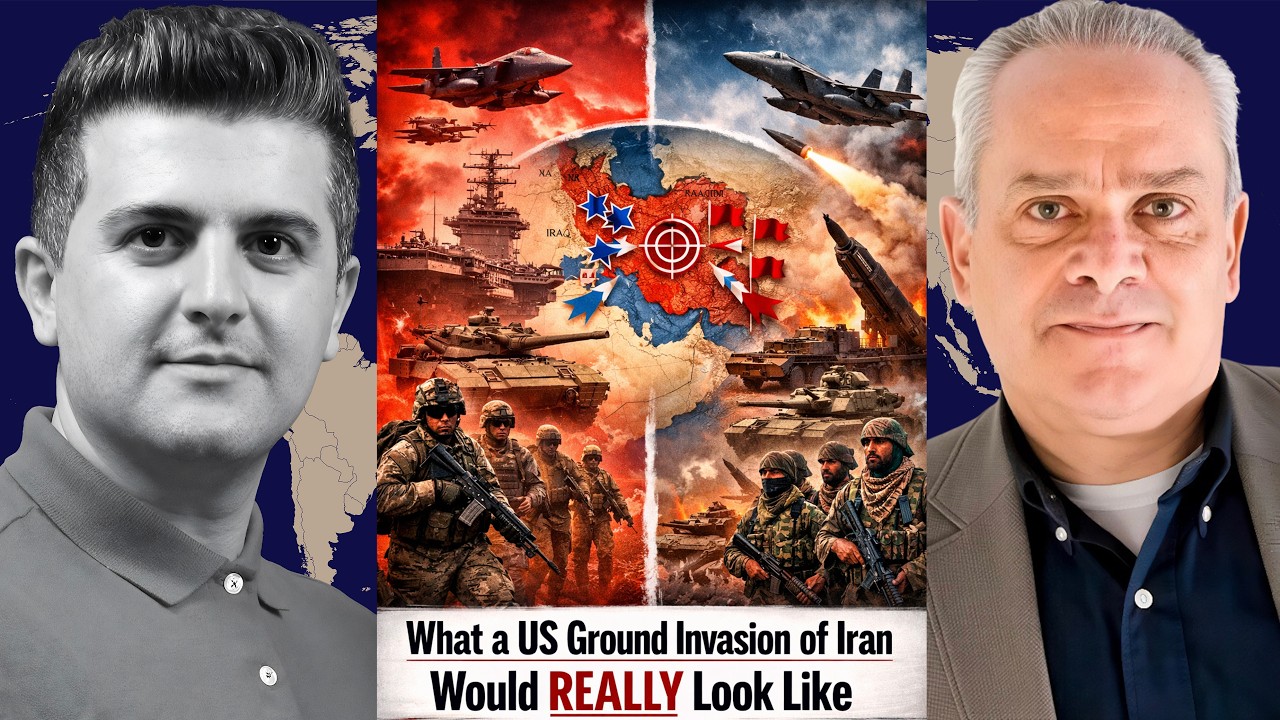
Col. Jacques Baud: What a US Ground Invasion of Iran Would REALLY Look Like
"Colonel Jacques Baud dissects the strategic futility of a US ground invasion of Iran, arguing that current troop levels are insufficient and such an action would backfire, exposing US allies and potentially leading to Iran's nuclearization."
BREAKING: Protests ERUPT In Iran Over IRGC Surrendering To Trump - Infighting Clashes In Tehran
"Iran is experiencing severe internal infighting and protests as hardline IRGC elements clash with government figures over a perceived 'surrender' to the US, while mainstream Western media misrepresents the situation."

BREAKING: Iran Threatens To END Talks; U.S. Vows Retaliation; Hezbollah Collapsing? | TBN Israel
"Iran is leveraging Hezbollah and the Strait of Hormuz to manipulate US negotiations, while Israel asserts its right to dismantle Hezbollah's eroding but still dangerous infrastructure in Lebanon, independent of international talks."