
PBS News Hour full episode, Jan. 8, 2026
YouTube · wanHXx8bN2M
Quick Read
Summary
Takeaways
- ❖An ICE agent fatally shot Renee Nicole Good, a U.S. citizen, in Minneapolis, sparking protests and conflicting accounts from federal and local officials.
- ❖Vice President J.D. Vance defended the ICE agent, attributing Good's death to 'a tragedy of her own making' and 'the far left.'
- ❖Minnesota state investigators withdrew from the shooting probe, alleging federal agencies denied them access to evidence.
- ❖President Trump's administration removed Venezuelan leader Nicolas Maduro and invited Colombian President Gustavo Petro to the White House, reversing prior threats.
- ❖The Senate advanced a bipartisan War Powers Resolution to restrict President Trump's military actions in Venezuela without congressional approval.
- ❖The House passed a three-year extension of Affordable Care Act subsidies via a discharge petition, defying Republican leadership.
- ❖President Trump vetoed two unanimously passed local bills (Colorado water pipeline, Miccosukee Tribe land rights), which sponsors believe was political retribution.
- ❖Senator Elissa Slotkin (D-MI) criticized Trump's foreign entanglements as a distraction from domestic issues like healthcare and housing costs.
- ❖Congressman Ryan Zinke (R-MT) supported presidential authority in Venezuela, citing Maduro's narcotrafficker status and the Monroe Doctrine, but stated military action in Greenland would require congressional approval.
- ❖The HBO medical drama 'The Pitt' is praised by real healthcare workers for its realism, boosting morale and helping justify a $45 million renovation at Allegheny General Hospital.
Insights
1Conflicting Narratives and Federal Obstruction in ICE Shooting Investigation
The fatal shooting of U.S. citizen Renee Nicole Good by an ICE agent in Minneapolis ignited protests and a significant dispute over the incident's facts. Vice President J.D. Vance defended the agent's actions as self-defense and blamed 'the far left' and Good's own actions. Conversely, local officials, including Minneapolis Mayor Jacob Frey and Minnesota Governor Tim Walz, condemned ICE's aggressive presence and accused federal investigators of blocking state access to evidence, leading the state to withdraw from the probe. Bystander video footage, which local officials say contradicts the federal narrative, is central to the controversy.
Vice President J.D. Vance stated, 'What I am certain of is that she violated the law... that officer had every reason to think that he was under very serious threat for injury or in fact his life.' () Governor Tim Walz countered, 'People in positions of power have already passed judgment... have stood and told you things that are verifiably false, verifiably inaccurate.' () Minnesota state law enforcement officials are 'denying the state investigators access to the evidence.' ()
2Trump Administration's Rapid Shift in Venezuela Policy and Congressional Pushback
The Trump administration executed a swift and dramatic reversal in its approach to Venezuela, moving from threats against Colombian President Gustavo Petro to inviting him to the White House after the removal of Nicolas Maduro. This shift is framed by the administration as securing U.S. interests and potentially reviving oil revenues. However, it faces skepticism from lawmakers like Senator Elissa Slotkin, who questions the long-term implications of U.S. 'ownership' of Venezuela and the legitimacy of working with Maduro's former deputies. The Senate, in a rare bipartisan move, advanced a War Powers Resolution to limit the president's ability to take further military action in Venezuela without congressional approval.
President Trump previously threatened Colombia's President Petro, 'He better wise up or he will be next. He will be next too.' () After a phone call, Petro 'flipped the script' () and accepted a White House invitation. Senator Elissa Slotkin noted, 'He literally ran on no foreign wars... And here he is saying that we own Venezuela and it's going to be years that we're going to be responsible for it.' () The Senate voted to advance a bill that would 'ban much of what the president has said he would be doing' in Venezuela. ()
3Healthcare Drama 'The Pitt' Boosts Morale and Justifies Hospital Renovation
The HBO medical drama 'The Pitt,' based on Pittsburgh's Allegheny General Hospital, has resonated deeply with frontline healthcare workers due to its realistic portrayal of emergency room life. The show's authenticity, achieved through on-set medical consultants, has not only boosted the morale and pride of medical staff but also played a role in justifying a significant $45 million renovation of the hospital's emergency department. The show's depiction of crowded waiting rooms and the challenges faced by healthcare workers validated the need for costly infrastructure improvements.
Dr. Brent Rau, Director of Emergency Medicine at Allegheny General, stated the show captures 'The raw emotions... the losses, the downs, sights, sounds that you will never forget, screams that you will never forget.' () Kathy Sikora, Director of Emergency Services, noted, 'What I think the show helped do by what it showed was actually validate what everyone really already knew that we needed to do and spend' on the renovation. ()
Bottom Line
The realistic portrayal of healthcare on TV, exemplified by 'The Pitt,' can serve as a powerful advocacy tool, not just for public awareness but for internal justification of significant capital expenditures in real-world hospitals.
This suggests an unexpected ROI for media partnerships: beyond branding, accurate depictions can influence internal stakeholders and public perception to support critical infrastructure investments, especially in underfunded or strained sectors.
Hospitals and public service organizations could proactively engage with media productions to ensure accurate portrayals that highlight systemic needs, potentially leveraging popular culture to build public and institutional support for funding and policy changes.
Key Concepts
Monroe Doctrine
Discussed by Congressman Ryan Zinke, this doctrine frames U.S. foreign policy in the Western Hemisphere, asserting American influence and responsibility to intervene against perceived threats or instability in the region, as applied to the Venezuela intervention.
War Powers Resolution
A legislative check on presidential authority to commit U.S. armed forces to conflict, requiring congressional authorization. The Senate's bipartisan vote to advance a resolution restricting military action in Venezuela exemplifies this model in practice.
Use of Force Continuum (Dimmer Switch)
Juliette Kayyem describes law enforcement use of force not as an on/off switch, but a 'dimmer' where agents are responsible for de-escalating tension to avoid lethal outcomes, especially when less-lethal options (like license plate tracking) are available.
Lessons
- For policymakers: Scrutinize federal agency claims and ensure independent, concurrent investigations when federal and local authorities clash, especially in high-profile use-of-force incidents.
- For business leaders in international markets: Understand that U.S. foreign policy, particularly under the current administration, can pivot rapidly based on personal relations and perceived immediate interests, requiring agility and direct engagement.
- For healthcare administrators: Consider the value of authentic media representation of your work. It can significantly boost staff morale and, as seen with 'The Pitt,' potentially validate and accelerate necessary infrastructure investments by illustrating real-world challenges to a broader audience.
Quotes
"What I am certain of is that she violated the law. What I am certain of is that officer had every reason to think that he was under very serious threat for injury or in fact his life. What I am certain of is that she accelerated in a way where she ran into the guy. I don't know what was in her heart and what was in her head, but I know that she violated the law and I know that officer was acting in self-defense."
"People in positions of power have already passed judgment. From the president, to the vice president to Kristi Noem have stood and told you things that are verifiably false, verifiably inaccurate."
"Police officers and law enforcement do not shoot into moving cars, do not put themselves in front of cars, because those are things that are easily de-escalated. The car, you can get the license plate. You know where the person likely lives at that stage."
"His personal relations with foreign leaders are really key, a key to how -- what the nature of the bilateral relationship is more generally."
"He literally ran on no foreign wars and complained bitterly about Iraq and Afghanistan. And here he is saying that we own Venezuela and it's going to be years that we're going to be responsible for it."
"I think that's what the president is doing with all these foreign entanglements, right? He's gone after nine different regions of the world militarily, seven countries, two oceans. That's the most any single president has done, for diversity of military operations in their first year, more strikes in his first year than in Joe Biden's four years. So he's really a foreign policy president. And I think he's doing that because he doesn't want to talk about domestic issues."
"The cost analysis proved that demolition and reconstruction provided the lowest total cost ownership and most effective long-term strategy."
"The raw emotions that they do show, especially in that first season. The things that I think a lot of us carry with us are probably more the losses, the downs, sights, sounds that you will never forget, screams that you will never forget. And, unfortunately, you kind of carry those with you."
Q&A
Recent Questions
Related Episodes

Sen. Kaine Forces Vote on Iran War Powers Resolution
"Senator Tim Kaine details his persistent, decade-long fight to compel Congress to vote on acts of war, specifically highlighting his current War Powers Resolution concerning Iran and the historical reluctance of legislators to take a definitive stance on military engagements."
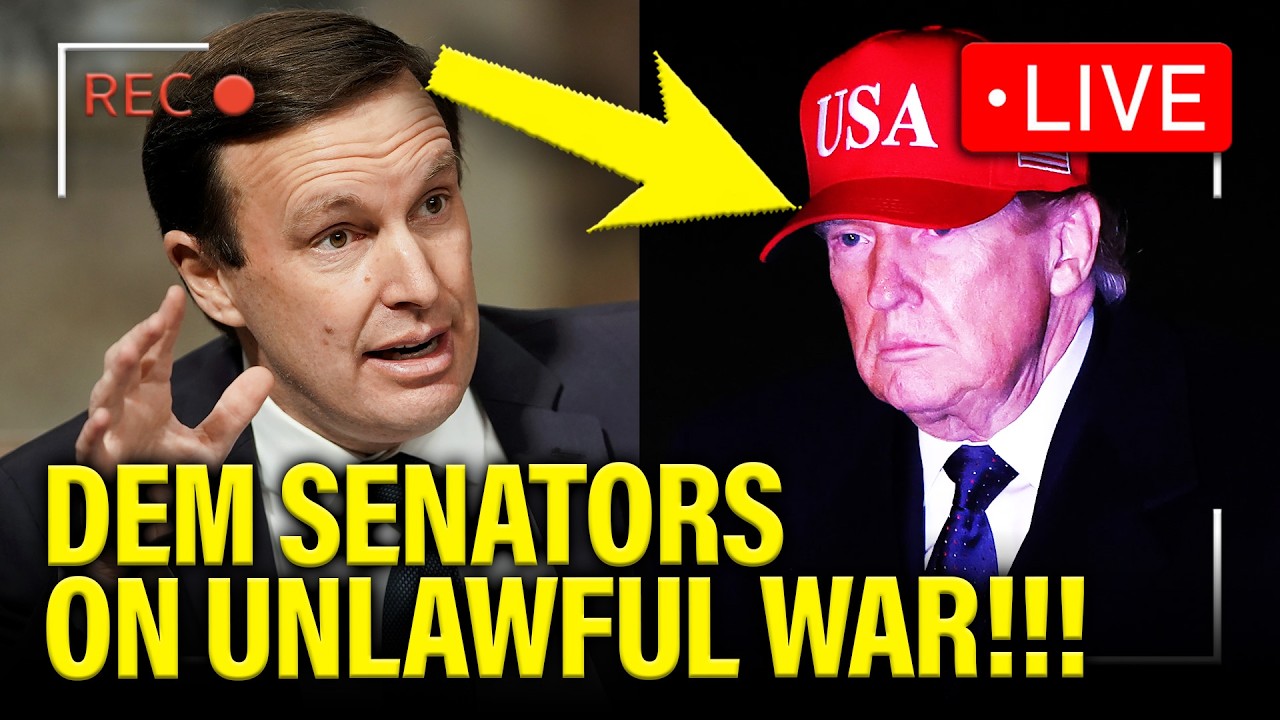
LIVE: DEM SENATORS ADDRESS UNLAWFUL WAR!!
"Democratic Senators, joined by VoteVets, forcefully condemn the administration's 'unlawful war' in Iran, citing constitutional overreach, devastating human and economic costs, and a deliberate lack of transparency and congressional oversight."

Iran Deal Skepticism. Whoopi Vs Vance. Potomac Park Invasion. Racist Hurls Slurs At Black Boy.
"This episode dissects multiple instances of alleged anti-Black policies and racial injustice, from the Trump administration's legal challenges to reparations and the Iran deal, to police brutality and the erasure of Black history."

Alex Krainer: US STRIKES Iran – Iran RETALIATES Against Kuwait, Bahrain & Jordan!
"Amidst escalating US-Iran conflict and Iranian retaliation against regional US allies, this episode argues that US foreign policy is deeply controlled by an 'Anglo-Zionist conspiracy' led by the Rothschild banking dynasty, prioritizing Israeli interests over American ones."