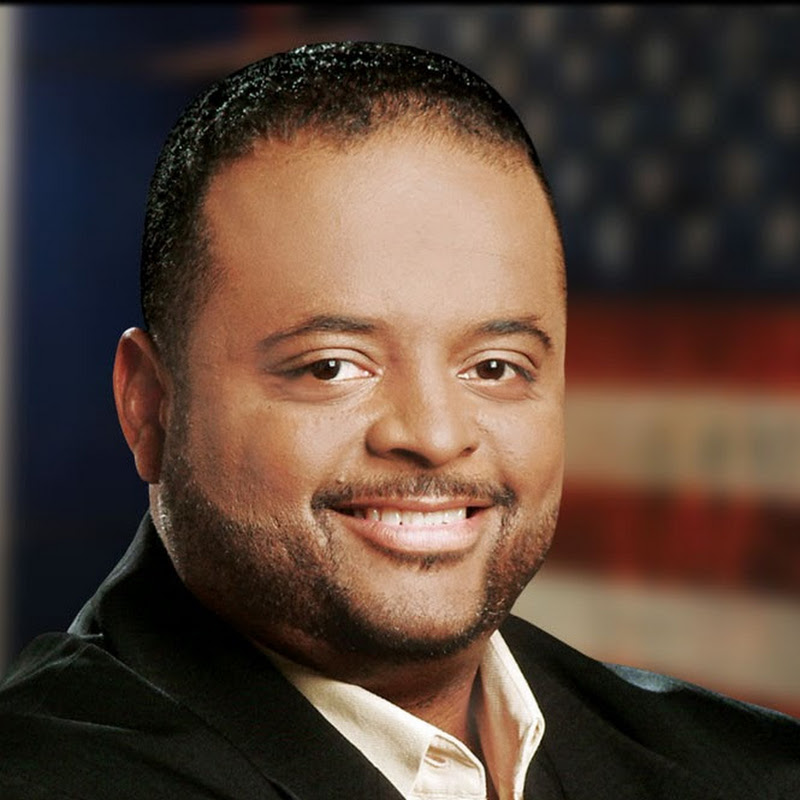
Roland speaks to Northern Va. Baptist Town Hall
YouTube · xnc3MFjZ7t0
Quick Read
Summary
Takeaways
- ❖Black-owned media is essential for centering African-American interests and controlling the narrative, as mainstream and formerly Black-owned outlets have failed.
- ❖A "clear and defined plan to defund Black America" is underway, targeting institutions from academics to civil rights groups through policies like Project 2025 and anti-DEI initiatives.
- ❖The Supreme Court's 'Extreme Court' is actively dismantling Black political power and protections, often dismissing overtly racial statements as 'race-neutral'.
- ❖Many Black institutions, particularly the Black church, are criticized for focusing on 'hooping and preaching' over substantive political and economic action.
- ❖Ineffective boycotts, like the recent Target boycott, fail due to a lack of strategic planning, data, and collective demands, often settling for 'crumbs' instead of billions.
- ❖Black communities are treated as 'sharecroppers' in political campaigns, providing volunteer labor while white strategists profit, underscoring a need for economic demands tied to political support.
- ❖A 'warlike response' requires micro-level organizing: collecting community data (name, address, issues), organizing by zip code/precinct, and leveraging existing capacity (e.g., churches for voter registration and education).
- ❖The power of micro-organizing is demonstrated by how a few text messages led to 250,000 live viewers for a Blackar Network State of the Union coverage, raising significant funds for students.
Insights
1The Decline of Black-Owned Media and the Need for Self-Ownership
Traditional Black media outlets like Ebony and Jet have either declined or ceased to exist, and major networks like BET and TV One are no longer Black-owned or lack substantive news programming. This leaves a void in news and analysis centered on African-American interests. Owning platforms like Blackar Network is crucial to control the narrative and make independent editorial decisions without external influence, operating as a 'dictatorship' for clear direction.
Roland Martin launched Blackar Network after TV One canceled 'News One Now' in 2018, aiming to create a daily online show focused on African-American perspective. He states, 'I own it... If I decide to do it, I do it. If I don't want to talk about it, I don't talk about it.' He notes BET is now owned by the 'right-wing Ellison family' and has no news shows, and TV One also lacks news shows.
2Systemic Attack on Black America: Project 2025 and the 'Extreme Court'
There is a deliberate, coordinated strategy to 'defund Black America' by targeting every institution—academic, economic, political, social, civil rights, and legal. This strategy is outlined in documents like Project 2025 and is being executed through the 'Extreme Court,' which makes rulings that diminish Black political power and dismiss evidence of racial discrimination as 'race-neutral.'
Martin cites Project 2025 as the blueprint. He points to the Supreme Court's ruling in Louisiana, 'wiping out black congressional districts,' and Sam Alito's opinion dismissing overtly racial statements about Haitians (e.g., 'eating dogs,' 'hole country,' 'poisoning the blood of our country') as 'race neutral justifications,' despite Justice Elena Kagan's dissenting citations.
3Critique of Black Institutions' Inadequate Response
Many Black institutions, including the Black church, fraternities, sororities, and professional organizations, are failing to adequately address the systemic attacks on Black America. They are criticized for prioritizing 'hooping and preaching' or 'personal gratification' over substantive engagement with public policy, political education, and collective action, mirroring Dr. King's concerns about these institutions in 'Where Do We Go From Here: Chaos or Community.'
Martin questions why the Hampton Ministers Conference and National Baptist Conference focus on 'hooping' without inviting elected officials or activists to discuss public policy. He quotes Dr. King's critique that 'too many Negro churches... condition their members to adjust to the present evils' and 'too many Negro newspapers have veered away from their traditional role as protest organs.'
4Anti-DEI Efforts' Economic Impact on Black Nonprofits and Employment
The current anti-DEI (Diversity, Equity, and Inclusion) movement is severely impacting Black nonprofits, leading to significant funding reductions (80-90%) and job losses. Corporations are being pressured to withdraw support from Black organizations, and government jobs, where Black Americans are overrepresented, are being slashed, forcing competition for low-wage positions.
The International African-American Museum in Charleston faces a $6.5 million funding shortage, leading to employee furloughs. FCC Commissioner Brendan Carter is reportedly pressuring companies like Paramount and AT&T to eliminate DEI initiatives by threatening to block mergers/acquisitions. Companies are asking Black organizations to 'take black out the name' for sponsorship. Black unemployment rates are rising, with 350,000 Black women and 500,000 Black men losing jobs, particularly in government sectors.
5The Failure of Unstrategic Boycotts and the 'Convenient Boycott' Mindset
Contemporary boycotts often fail because they lack a clear plan, strategy, and collective demands. They are often initiated spontaneously without prior negotiation or a defined escalation process, leading to short-term impact and eventual failure. A 'convenient boycott' mentality, where participants prioritize personal convenience over sustained sacrifice, undermines effectiveness.
Martin critiques a woman complaining about waiting two weeks for a nail appointment during a boycott, stating, 'The point of a boycott is it's supposed to be inconvenient.' He details the failed Target boycott, which was called immediately after a memo leaked, without following a strategic process like Reverend Leon Sullivan's 'Operation Breadbasket,' which involved data collection, negotiation, limited pickets, and monitoring agreements. Target's stock price rebounded to near pre-boycott levels.
6Political 'Sharecropping' and the Demand for Collective Economic Return
Black communities are often treated as 'sharecroppers' in politics, providing volunteer labor and votes for campaigns that primarily benefit white strategists and media agencies, while Black-owned businesses and media receive minimal investment. This dynamic extends to corporate engagement, where Black organizations accept 'crumbs' (e.g., $300,000 from Target) instead of demanding billions in advertising and contracting spend.
Martin recounts the Kamala Harris campaign's initial low ad buys ($10,000, then $8,000 for Black History Month) with Blackar Network, while '599 million dollars' went to large white-owned media. He criticizes four Black Baptist groups for accepting a $300,000 check from Target after a boycott, when Target's market cap is billions. He argues that 5% of PepsiCo's $3 billion annual ad spend ($150 million/year, $750 million over five years) would have a far greater impact than the Urban League's $10 million initiative or $100 million restaurant receipts program.
Bottom Line
The 'Extreme Court's' justification of racially charged statements as 'race-neutral' is a dangerous legal precedent, allowing discrimination to persist under a veneer of impartiality.
This legal framing makes it significantly harder to challenge discriminatory policies and actions in court, as the burden of proving explicit racial intent becomes almost impossible, effectively legalizing systemic racism.
Advocacy groups must develop new legal and public relations strategies to expose and counter this 'race-neutral' justification, potentially by focusing on disparate impact and historical context rather than explicit intent, and educating the public on this judicial tactic.
The anti-DEI movement is not just about 'fairness' but is a direct economic attack designed to defund Black institutions and limit Black economic advancement, as evidenced by corporate pressure and job losses.
This reveals the true intent behind anti-DEI rhetoric, shifting the focus from ideological debates to a tangible economic war. It means Black organizations cannot rely on corporate or government funding tied to DEI initiatives.
Black institutions must pivot to self-funding models, build independent economic ecosystems, and engage in collective bargaining with corporations to demand direct, measurable investments in Black-owned businesses and media, independent of DEI labels.
Opportunities
Black-Owned Media Collective Bargaining Agency
Establish an agency that collectively negotiates advertising and sponsorship deals for a consortium of Black-owned media outlets (TV, radio, digital, print). This agency would leverage the collective audience and cultural influence of Black media to demand significant, measurable percentages of corporate advertising budgets, moving beyond individual 'crumbs' to multi-million dollar deals.
Community-Based 'Freedom Schools' for Civic and Economic Education
Re-establish 'Freedom Schools' within Black churches and community centers, offering comprehensive education on local, state, and federal politics (City Hall 101, School Board 101), economic literacy, and community organizing. These schools would leverage retired educators and community leaders, providing tutoring, meals, and practical skills for civic engagement and economic empowerment.
Key Concepts
Micro vs. Macro Organizing
Instead of attempting large, unfocused macro-level changes, focus on building power and impact at the micro-level (e.g., individual precincts, zip codes, one-on-one invitations) which can then scale exponentially. This approach emphasizes building from the ground up with measurable, localized efforts.
Collective Bargaining for the Collective Good
When negotiating with corporations or political campaigns, Black leaders and institutions should not seek individual gains or 'crumbs,' but rather demand substantial, collective investment (e.g., 5% of a company's ad spend for Black-owned media) that benefits the entire community and its institutions, akin to labor union negotiations.
Lessons
- Implement a 'micro-organizing' strategy by collecting detailed data (name, address, phone, email, top 5 issues) from all attendees at community gatherings, then organizing them by zip code and precinct.
- Leverage existing community infrastructure, particularly churches, to conduct large-scale voter registration training sessions immediately after services, turning attendees into qualified voter registrars for their local precincts.
- Demand collective economic returns from political campaigns and corporations by forming coalitions of Black-owned businesses and media to negotiate for substantial advertising and contracting budgets, rather than accepting token payments.
Micro-Level Community Organizing for Political and Economic Power
**Data Collection & Segmentation:** At every community gathering, collect comprehensive attendee data (name, address, phone, email, social media, and top 5 issues ranked by priority). Segment this data by zip code and precinct.
**Precinct-Level Voter Engagement:** For each zip code, identify the 10 largest Black precincts. Pull public voter data to identify registered voters and non-voters. Organize local volunteers (from the collected data) to canvas these specific precincts, engaging non-voters and reminding registered voters, aiming for at least six 'touches' per voter.
**Leverage Existing Capacity (Churches & Institutions):** Transform churches into hubs for civic education and voter registration. Conduct voter registrar training sessions immediately after services. Establish after-school 'Freedom Schools' using retired educators from the congregation to provide tutoring and civic education (City Hall 101, School Board 101) for local children, utilizing existing church facilities and resources.
Quotes
"The problem that we have today is we are seeing significant amounts of gossip and entertainment and comedy and things along those lines and that's all great. Uh but when things are going crazy then people say well uh I didn't know this was going on that's because your attention was elsewhere."
"There is a clear and defined plan to defund black America. They are targeting every institution. They are targeting academics, economics, political, social, civil rights groups, legal groups. And that is their agenda."
"Haitians are black. Norwegians and Swedes not so much. The references of filth, disease, and primitiveness are shot through with racial stereotypes and tropes. It is hard to imagine the statements being made today of any white community."
"We must admit that these forces have never given their full resources to the cause of Negro liberation. There are still too many negro churches that are so absorbed in a future good over yonder that they condition their members to adjust to the present evils over here."
"The point of a boycott is it's supposed to be inconvenient."
"What I'm describing is what is a fundamental problem that we are dealing with and that is we are operating in so many areas as sharecroppers tilling the soil doing all the work."
"We didn't spend our time hooping and hollering. We didn't spend our time praying alone. We did the other half that Jesus required, which is work."
Q&A
Recent Questions
Related Episodes

The Immortal Jim Crow. 'Goon Squad' Defamation Suit. Google Race Discrimination Case. #TheBreakdown
"This episode exposes the enduring grip of systemic racism through a Mississippi defamation suit, Google's racial discrimination settlement, and a deep dive into how Jim Crow's legacy still shapes Black America today."
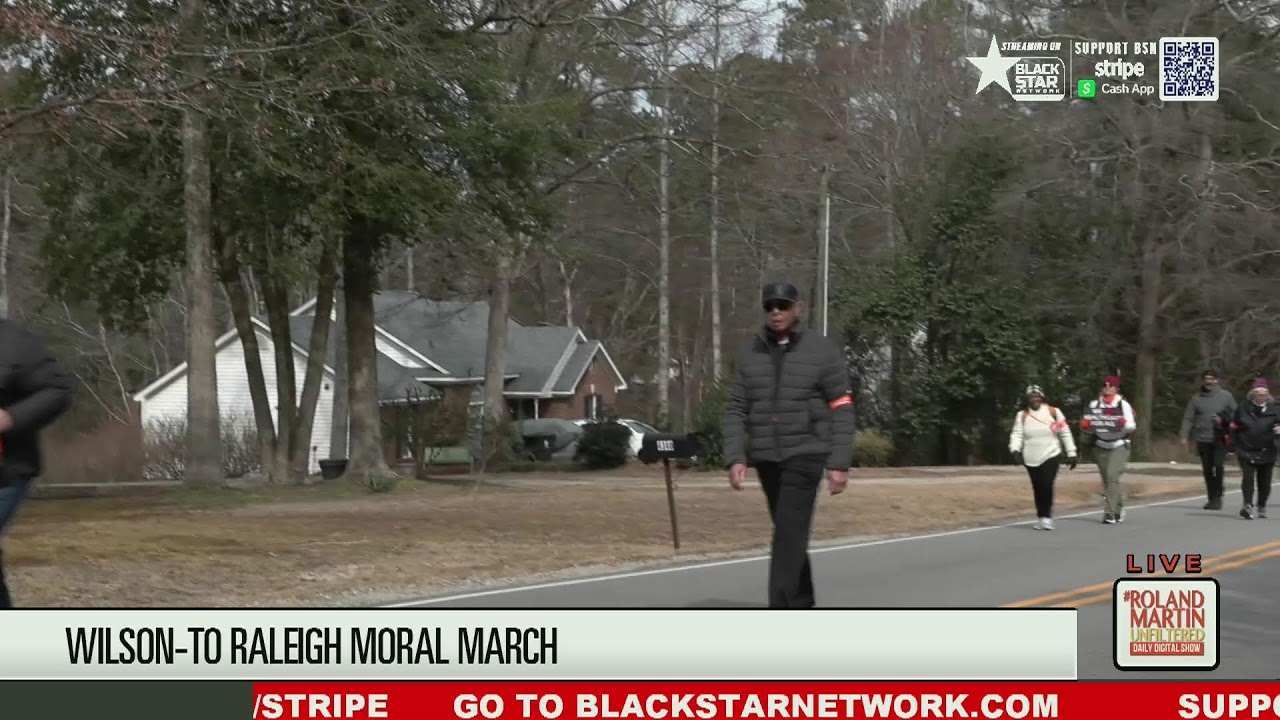
NC Early Voting Push. Cancer Alley Win. NFL Shuts Out Black Coaches.Trump Nominee’s “White Identity”
"Roland Martin Unfiltered dissects systemic racism in politics, sports, and environmental justice, revealing how Black communities are fighting back against gerrymandering, corporate exploitation, and hiring discrimination."

Secret Podcast Preview: The Last Temptation of Sarah Longwell
"Sarah Longwell and JVL delve into Pete Buttigieg's evolving political philosophy and critically analyze a viral tweet about Democratic election lessons, revealing their differing views on institutional reform and voter sentiment."

NC Targets DEI. Trump Blocks Housing Bill. Minority Banks Face New Rules. Kohen Wiley Protests
"This episode exposes how current political actions, from changes in minority bank definitions to attempts to regulate college athlete earnings and block foreign aid, are systematically undermining Black economic power, voting rights, and social justice."