
Col. Jacques Baud: Iran Goes All In -This Could Be the EU’s Biggest Blunder Yet
YouTube · 0ZGC4Uswerk
Quick Read
Summary
Takeaways
- ❖Col. Jacques Baud is under EU sanctions that block his bank accounts and restrict travel, enforced without a legal trial, which he describes as an 'extrajudicial political decision'.
- ❖The US military buildup against Iran, including two aircraft carriers and 600 Tomahawk missiles, suggests a 'quick war' strategy, but Iran's size and complex geography make a sustained occupation improbable.
- ❖US objectives in Iran are unclear, oscillating between nuclear concerns, ballistic missiles, and regime change, leading to erratic decision-making that mirrors past failures in Iraq.
- ❖Western interventions often create chaos by removing existing leadership without a clear plan for a successor or understanding local support, as seen in Iraq and Libya.
- ❖Europe has lost its role as a diplomatic mediator in conflicts like Iran, Ukraine, and Palestine, often acting as a 'promoter of war' and sabotaging peace efforts.
- ❖NATO's design as a nuclear deterrent for a continental war makes it unsuited for limited conflicts, leaving Europe without an effective security architecture for modern threats.
- ❖Europe lacks a unified foreign policy and defense strategy, with internal divisions (e.g., Hungary, Slovakia) and differing national interests preventing a cohesive geopolitical stance.
Insights
1EU Sanctions as Extrajudicial Political Decisions
Col. Jacques Baud describes his personal experience with EU sanctions as an 'extrajudicial political decision,' meaning he was sanctioned without a formal trial, judge, or judgment. This prevents him from appealing the case through legal channels, as the decision is political, not legal. His bank accounts are blocked, and he is restricted from leaving Belgium, with any attempt to bypass sanctions considered a criminal offense. This situation, he argues, demonstrates a systemic failure of the rule of law within the EU, making it 'worse than a dictatorship' in this regard compared to countries like Russia where trials, however flawed, still occur.
Baud's bank cards are blocked, he is fed by friends, and cannot leave Belgium without risking criminal charges for bypassing sanctions. He states, 'In my case, there is no trial, no judge, no judgment, nothing. They just decide you are sanctioned. Period.'
2US Objectives in Iran: Unclear and Erratic
The US military buildup against Iran, including two aircraft carriers and 600 Tomahawk missiles, suggests preparation for a quick, decisive strike rather than a war of attrition. However, the US lacks a clear, rational objective for intervention in Iran. Objectives fluctuate between concerns over nuclear potential, ballistic missiles, and regime change, without a defined plan for the aftermath. This erratic decision-making, reminiscent of the Iraq war where removing Saddam Hussein led to chaos, makes any military operation highly problematic and unlikely to achieve stable, positive outcomes.
Baud notes the US has 'contradictory messages' and 'no clear objective' for Iran, stating, 'Nobody can very much rely on what Trump says. When asked about the objectives of a possible action in Iran, he was not even able to say what he wants to achieve.' He compares it to the Iraq war where removing Saddam Hussein 'didn't solve the problem at all because after that you just had the chaos'.
3Europe's Diminished Diplomatic Role and Pro-War Stance
Europe has significantly lost its diplomatic influence in major geopolitical conflicts, including Iran, Ukraine, and Palestine. While the US, Russia, and regional powers engage in negotiations or mediation, Europe is notably absent from these critical discussions. Baud argues that instead of acting as a neutral 'referee' in conflicts where it is not a direct party, Europe has become a 'promoter of war,' actively sabotaging peace efforts. He cites instances where the EU undermined Minsk agreements, Ukrainian diplomatic efforts in 2022, and even Trump's attempts at dialogue with Russia, prioritizing punishment over accommodation.
Baud states, 'Europe has absolutely lost the ground, lost any any power, has lost any even the confidence of their traditional allies and traditional friends.' He notes that in three phases of peace efforts (Russia 2014-2022, Ukraine 2022, US/Trump post-2022), the 'European Union made every effort to prevent Russia to have the Minsk agreement implemented' and 'sabotage the efforts of all these three actors'.
4NATO's Outdated Design and Europe's Defense Gap
NATO, designed in 1949 to counter the Soviet Union's nuclear threat by placing European states under a US nuclear umbrella, is fundamentally unsuited for modern, limited conflicts. The use of nuclear weapons for regional disputes (e.g., defending a Baltic state or Donbas) is an 'overkill' that no one would initiate, rendering NATO ineffective for the most probable European conflicts. This leaves a significant gap in Europe's security architecture, as there is no conceptual framework for a defense system that can address threats without resorting to nuclear escalation, nor a unified political will to create one.
Baud explains, 'NATO was designed to cope with the nuclear threat of the Soviet Union in 1949.' He argues that 'the nuclear power in that situation is is an overkill for that. Nobody will use the nuclear weapons and start to trigger a nuclear war just for the sake of defending a 1.3 million state inhabit people state.'
Bottom Line
The EU's internal legal framework is being 'bent' to achieve political objectives, creating a system where politics defines law rather than the rule of law defining politics.
This undermines the foundational principles of a democratic society and sets a dangerous precedent for arbitrary power, eroding trust in European institutions both internally and externally.
For non-EU nations and international legal bodies to highlight and challenge these inconsistencies, advocating for a return to strict adherence to legal principles in international relations and domestic governance.
The West's 'obsession' with certain countries (Iran, Cuba, Venezuela) leads to irrational decision-making, preventing effective diplomacy and fostering perpetual conflict.
This irrationality makes genuine de-escalation and mutually beneficial agreements impossible, perpetuating cycles of violence and instability that ultimately harm all parties, including Western interests.
For emerging global powers and non-aligned nations to step into the diplomatic void, offering rational, interest-based mediation platforms that bypass Western obsessions and seek pragmatic solutions.
Key Concepts
The Law of Unintended Consequences in Geopolitics
Western interventions, often driven by assumptions about local populations desiring Western-style democracy, frequently lead to chaos and destabilization rather than desired outcomes, as exemplified by Iraq and Libya. Removing a regime without a clear, locally supported successor often creates a power vacuum and further conflict.
Exporting Domestic Problems
When nations or blocs face internal economic or political challenges, they may resort to external conflicts or aggressive foreign policies as a distraction or a means to project strength, rather than addressing core domestic issues. This can lead to irrational and dangerous international behavior.
Lessons
- Critically evaluate official narratives regarding international conflicts, especially those from Western sources, by seeking out diverse perspectives that question underlying assumptions and stated objectives.
- Recognize the potential for 'extrajudicial' actions by powerful blocs like the EU, understanding that political decisions can bypass traditional legal frameworks and impact individuals and nations.
- Understand that a lack of clear, rational objectives in foreign policy often leads to chaotic and counterproductive interventions, rather than desired outcomes, and advocate for transparent, well-defined strategic goals in international engagement.
Notable Moments
Col. Baud details his personal experience with EU sanctions, including frozen bank accounts and travel bans, without a formal legal trial.
This personal account serves as concrete evidence for his broader argument about the EU's departure from the rule of law, making the abstract concept of 'extrajudicial decisions' tangible and impactful.
Baud's comparison of the EU's legal system to 18th-century French monarchy, where the king could declare guilt without trial.
This historical analogy powerfully underscores the perceived regression of legal standards within the EU, framing it as a return to arbitrary executive power rather than modern jurisprudence.
Baud's assertion that Europe has actively sabotaged peace efforts in Ukraine, even when Russia, Ukraine, and the US attempted diplomacy.
This directly challenges the common perception of Europe as a peace-promoting entity, suggesting a more aggressive, confrontational role that contributes to prolonged conflict.
Quotes
"In my case, there is no trial, no judge, no judgment, nothing. They just decide you are sanctioned. Period. And that makes the the situation in in Europe um in fact worse than in a dictatorship."
"If you act like this and you may remember that with the Iraq is what it was very similar. I mean we we were talking about these weapons of mass destruction. Okay, we knew there were none. Okay. So, exactly same situation and at the end uh it was about removing Saddam Hussein but removing Saddam Hussein didn't solve the problem at all because after that you just had the chaos instead of Iraq."
"Europe has absolutely lost the ground, lost any any uh uh power, has lost any even the confidence of their traditional uh allies and traditional friends."
"Europe has been a promoter of war and not someone who tried to promote peace. They tried to punish Russia for some reason instead of trying to find a to to find some a way uh to accommodate the Russian vision."
"NATO was crafted around the idea of a large war that would be continental in nature, but it's not designed to cope with a situation where you have a limited conflict."
Q&A
Recent Questions
Related Episodes

Bibi DEMANDS Ground Troops As Marines Rushed to Iran
"Benjamin Netanyahu is pushing for US ground troops in Iran, framing air strikes as insufficient, while the US rushes Marines to the region and struggles to secure the Strait of Hormuz against surprisingly capable Iranian defenses."

Col. Jacques Baud: The World Is Entering a Lawless Era
"Colonel Jacques Baud details his personal experience with arbitrary EU sanctions and argues that the world has shifted from a law-based international order to a dangerous, rules-based system dictated by powerful actors, exemplified by US actions in Venezuela and the EU's 'teenager decision-making'."
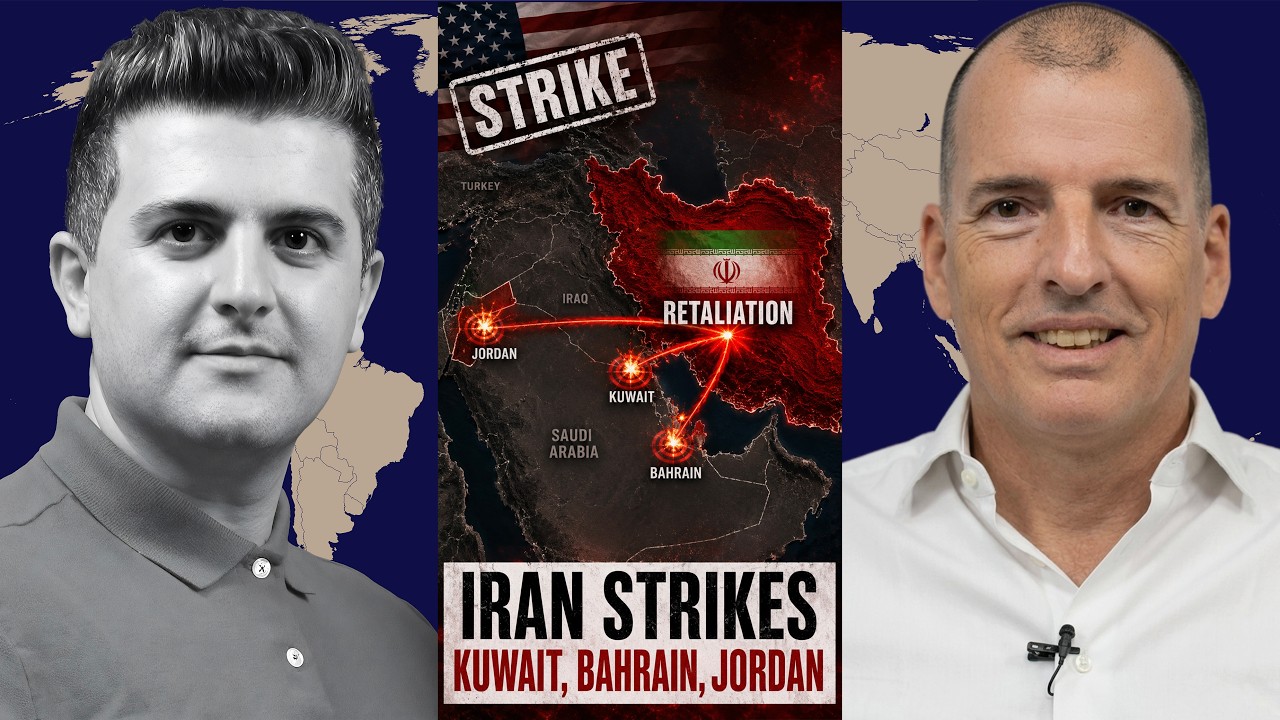
Alex Krainer: US STRIKES Iran – Iran RETALIATES Against Kuwait, Bahrain & Jordan!
"Amidst escalating US-Iran conflict and Iranian retaliation against regional US allies, this episode argues that US foreign policy is deeply controlled by an 'Anglo-Zionist conspiracy' led by the Rothschild banking dynasty, prioritizing Israeli interests over American ones."

LIVE: Trump HIDES FROM PUBLIC as US SOLDIER KILLED!!! 6/2/2026
"The host exposes alleged government cover-ups regarding military casualties, Trump's unexplained public absence, and questionable political appointments, arguing these reflect a 'regime of loser babies' and a failing foreign policy."