
Martin Armstrong: How World War III Begins — And Why It’s Happening Now
YouTube · 1TUEY_XBD30
Quick Read
Summary
Takeaways
- ❖Unelected 'neocons' are the primary drivers of US foreign policy, consistently pushing for regime change regardless of presidential administration.
- ❖Iran has significantly enhanced its military capabilities with Chinese assistance, including satellite targeting, supersonic missiles, and stealth-detecting radar.
- ❖The European Union's internal structural issues and the Euro's fundamental flaws are driving its aggressive, anti-Russia stance.
- ❖Governments frequently use external enemies to silence domestic opposition, a tactic observed in Iran (1979 revolution) and Europe (Russia narrative).
- ❖The US administration is internally divided, with some factions seeking peace while neocons actively push for war and maintain NATO's expansion.
- ❖Centralized governments, like the EU and the altered US Federal Reserve, inherently fight for their own survival and expansion, often at the expense of national interests or democratic principles.
- ❖Current global conflicts represent a 'World War III' characterized by resurfacing historical grudges and localized disputes, rather than a single adversary.
Insights
1Neocon Influence and the Push for War with Iran
A persistent neocon faction, including figures like Netanyahu and Marco Rubio, has consistently pushed for regime change in the Middle East, viewing Iran as a strategic 'prize'. This faction operates across administrations and is not aligned with specific parties, prioritizing the Wolfowitz doctrine of global dominance. Armstrong was called in by the Trump administration to draft a peace plan for Russia, indicating a split within the government, as the neocon faction refused to submit their own.
General Wesley Clark's account of Pentagon plans to invade seven countries; Netanyahu's neocon background and push for regime change; Rubio's consistent advocacy for regime change in Venezuela and Iran; Armstrong's direct engagement by the Trump administration to draft a peace plan for Russia, followed by Rubio's public opposition to exiting NATO.
2Iran's Enhanced Defensive Capabilities and Potential for Protracted Conflict
Unlike previous targets, Iran has received significant technical assistance from China, including access to satellites for targeting ships, supersonic missiles, and radar capable of detecting fifth-generation stealth planes. This makes a conflict with Iran far from a 'walk in the park' and could result in significant psychological blows, such as damaging a US aircraft carrier's flight deck, leading to a protracted war.
China providing satellite access for targeting ships, supersonic missiles, and advanced radar; Ayatollah's public statements about sinking carriers; Armstrong's computer models disagreeing with 'one-week operation' predictions.
3The 'External Enemy' Tactic in Geopolitics
Governments in domestic trouble frequently create or demonize an external enemy to consolidate power and silence internal opposition. This was observed during Iran's 1979 revolution, where the US and Israel were framed as 'Great Satan' to suppress dissent, and is currently employed in Europe, where questioning the anti-Russia narrative leads to accusations of being a 'Putin supporter'.
Ayatollah's use of the US embassy hostage crisis to demonize the US and Israel, silencing opposition; European leaders labeling anyone questioning the anti-Russia narrative as a 'Putin supporter'.
4Structural Flaws and Desperation Driving European Policy
The European Union and the Euro are fundamentally flawed due to a lack of consolidated debt and an intentionally anti-democratic design, where key leaders are appointed, not elected. Facing economic collapse, Europe's leadership is desperate, believing they can conquer Russia to seize its natural assets and 'rise again like the Roman Empire', a delusional belief that fuels their aggressive stance and rejection of peace.
Herman Kohl's unilateral decision to enter Germany into the Euro without debt consolidation; EU leaders being appointed, not elected; Merkel's admission that the Minsk agreement was merely 'buying time' for Ukraine; NATO head's statement about the delusion of conquering Russia without US aid.
5Distortion of the US Federal Reserve's Original Purpose
The Federal Reserve was originally designed with 12 independent branches to address regional capital flows and act as a lender of last resort for private companies. However, its purpose was fundamentally altered by Congress during World War I to buy federal debt, and further centralized by Roosevelt in 1935, destroying its original intent. This centralization and focus on government debt now leaves central banks with limited tools to address complex economic issues like supply-side inflation.
Original design of 12 independent Fed branches; Congress forcing the Fed to buy federal debt during WWI; Roosevelt's 1935 usurpation of power and creation of a single chairman and interest rate; Fed's single tool (interest rates) being ineffective against supply-side inflation.
Bottom Line
Iran may have already developed nuclear weapons covertly, mirroring Pakistan and Israel, making the current conflict even more unpredictable and dangerous.
The assumption that Iran is 'weeks away' from nukes might be a false premise. If they already possess them, the strategic calculus for any military intervention changes drastically, raising the stakes for a direct, potentially nuclear, confrontation.
Intelligence agencies and policymakers need to re-evaluate Iran's nuclear capabilities with a covert development scenario in mind, rather than solely relying on public testing or declared programs.
China's 80% reliance on Middle Eastern oil, with China being the world's largest oil importer, creates a direct national interest for China in any conflict involving Iran's oil supply.
A US-Iran conflict that disrupts oil flows could compel China to intervene directly, transforming a regional conflict into a major power confrontation and escalating the 'World War III' scenario.
Analysts should model scenarios where China actively defends its energy supply routes and potentially Iran itself, rather than assuming passive observation, and policymakers should consider the implications for global trade and alliances.
Removing current leaders like the Ayatollah or Putin, as advocated by some, could lead to even more extreme and less rational successors.
The assumption that regime change will improve a situation is often flawed. In Iran, the Revolutionary Guard's deep economic control means removing the Ayatollah might empower a more radical, less compromising military-economic complex. In Russia, Putin is framed as the most reasonable leader, with those behind him being 'far worse'.
Foreign policy should prioritize understanding the internal power structures and potential succession dynamics within adversary nations, rather than solely focusing on the removal of current leadership, to avoid unintended and more dangerous outcomes.
Key Concepts
External Enemy Tactic
When a government faces domestic trouble, it often creates or amplifies an external enemy to unify the population, silence opposition, and justify its actions. This tactic was used by the Ayatollah in Iran and is currently employed by European leaders regarding Russia.
Military-Industrial Complex (Eisenhower's Warning)
Once an agency or institution, especially a military one, is created, it will fight tooth and nail for its own survival, expansion, and funding, regardless of its original purpose or changing geopolitical realities. This applies to NATO and Iran's Revolutionary Guard.
Centralized Government Collapse
Highly centralized governments tend to collapse due to their inability to adapt to regional differences, override local cultures, and the inherent drive of unelected bureaucrats to expand their power and dictate to the populace.
Lessons
- Critically evaluate mainstream media narratives on geopolitical conflicts, recognizing the potential for propaganda and the 'external enemy' tactic used by governments.
- Monitor the actions and statements of unelected 'neocon' figures in government and think tanks, as they often drive long-term foreign policy agendas regardless of presidential administrations.
- Understand the structural weaknesses of centralized economic and political unions (e.g., EU, Euro) and how their internal desperation can fuel aggressive external policies.
- Recognize that global conflicts are increasingly decentralized and interconnected, driven by resurfacing historical grudges rather than single adversaries, requiring a nuanced understanding of regional dynamics.
- Question the efficacy of regime change as a foreign policy tool, considering the potential for unintended and more dangerous successors or the entrenchment of powerful, self-serving institutions.
Notable Moments
Martin Armstrong's direct involvement in drafting a peace plan for Russia for the Trump administration, highlighting a significant internal division within the US government regarding foreign policy.
This reveals a high-level attempt to pursue peace through unconventional channels, directly contradicting the neocon agenda, and underscores the internal struggle over US foreign policy direction.
Armstrong's personal interactions with neocons, including Bill Kristol, and his conclusion that their motivation stems from a desire for global domination after the fall of communism.
This provides a direct, insider perspective on the ideology and motivations of a powerful, unelected faction influencing US foreign policy, framing their actions as driven by a 'Wolfowitz doctrine' of preventing any rival power from rising.
The host mentioning the date of the podcast as February 27, 2026, and Armstrong's computer models forecasting February 2026 as a target for Iran and the Middle East.
This highlights Armstrong's reliance on his proprietary forecasting models and anchors the discussion to a specific, future-dated prediction that was 'on target' according to his system, reinforcing his analytical methodology.
Quotes
"When any government is in trouble domestically, it must find an external enemy."
"Once you go down that road, how do you get out of it?"
"We have to get out of NATO. They're going to create a false flag to try and drag us in to fund their war again."
"They're not Republican or Democrat and all they give a about is... the Wolfowitz doctrine of basically ruling the world."
"This is World War III with a footnote. Not like World War I or II where we're... facing a single adversary. What this is is more of... wherever the old grudges were are all resurfacing."
"Putin is the most reasonable guy. The ones that behind him are far worse and would push the button."
"NATO wanted to expand, to keep their money, to keep their jobs, their pensions. So they were never going to say, 'Oh, let's have peace with Russia.'"
"The truth is so precious it needs to be protected with a bodyguard of lies."
"The head of the EU never stands for election. Nobody in the European Commission stands for election. They're all appointed."
"The capitalization of just the New York Stock Exchange... is more than all of Europe combined."
"When you only have a hammer, everything looks like a nail."
Q&A
Recent Questions
Related Episodes

LIVE: Trump HIDES FROM PUBLIC as US SOLDIER KILLED!!! 6/2/2026
"The host exposes alleged government cover-ups regarding military casualties, Trump's unexplained public absence, and questionable political appointments, arguing these reflect a 'regime of loser babies' and a failing foreign policy."

Iran Update: Israel’s Newest Bombing Campaign, the Oncoming War With China and How to Avoid It
"Colonel Wilerson reveals how the US and Israel are actively bombing China's strategic infrastructure in Iran, escalating a covert economic war that Beijing intends to win without direct military conflict by dismantling the dollar's global dominance."

Patrick Henningsen: Hezbollah JUST Fired Back at Israel - Iran Vows to “Crush” All Attacks
"Patrick Henningsen argues that the US and Israel initiated an illegal war against Iran, driven by Trump's incompetence and Israeli influence, leading to an inevitable escalation with severe global economic repercussions."
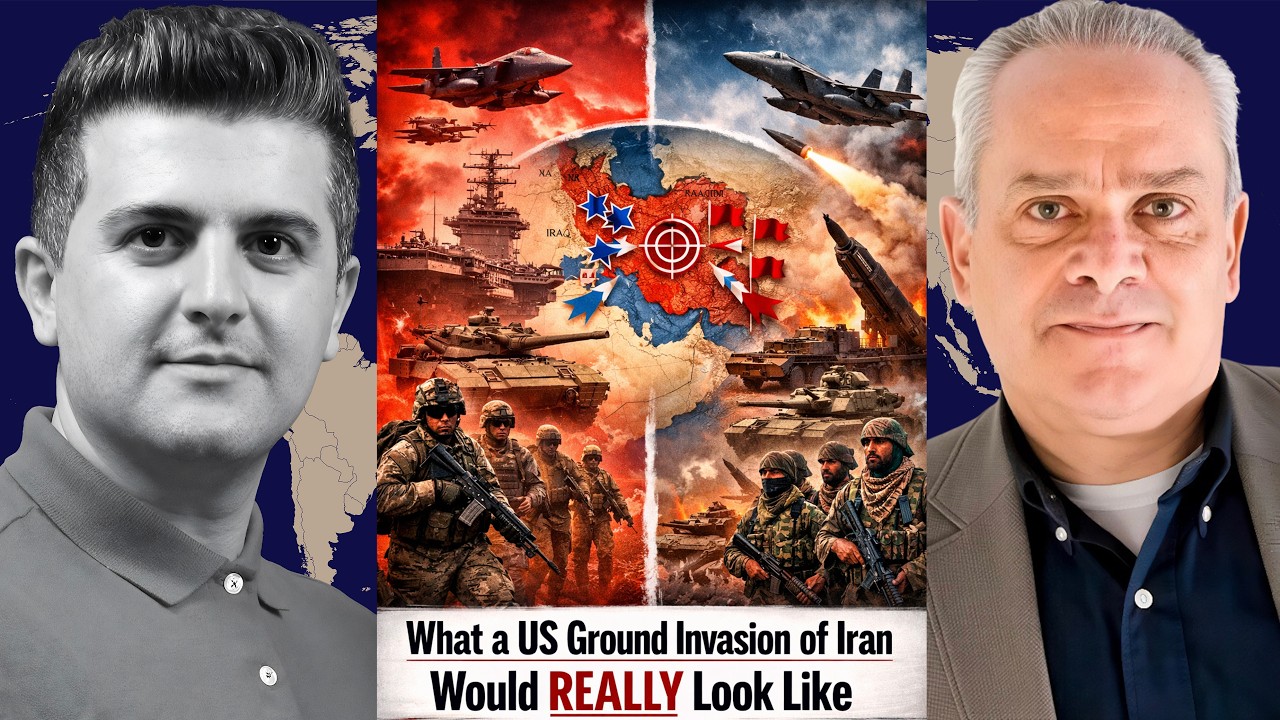
Col. Jacques Baud: What a US Ground Invasion of Iran Would REALLY Look Like
"Colonel Jacques Baud dissects the strategic futility of a US ground invasion of Iran, arguing that current troop levels are insufficient and such an action would backfire, exposing US allies and potentially leading to Iran's nuclearization."