Trump Says He’ll Choose Iran’s Next Leader (w/ Marc Polymeropoulos)
YouTube · 2HsoQ0gNdr0
Quick Read
Summary
Takeaways
- ❖Trump's public assertion of selecting Iran's next leader is unprecedented and undermines traditional covert action protocols.
- ❖The US and Israel have fundamentally different post-conflict goals for Iran; Israel prioritizes a weakened state, even if it leads to civil war.
- ❖Arming Iranian Kurds constitutes a 'regime change finding,' a formal authorization for covert action by the CIA.
- ❖A significant 'brain drain' of experienced personnel, particularly Iran specialists, from the CIA and FBI is compromising US counterterrorism capabilities.
- ❖The ongoing military operations in Iran contradict Trump's 'no more never-ending wars' campaign promise, leading to an extended conflict.
- ❖Ukraine's offer to assist the US with Iranian drone defense highlights a critical oversight in US pre-war planning.
Insights
1Trump's 'Preposterous' Claim to Pick Iran's Leader
Marc Polymeropoulos dismisses President Trump's public statement about personally choosing Iran's next leader as 'preposterous.' He explains that while the CIA might identify potential successors in a covert action plan, such a decision would typically involve an inter-agency process and National Security Council recommendations, not a public presidential announcement. This public declaration undermines the covert nature of such operations.
The guest states, 'the idea that he's going to kind of pick and choose is is rather preposterous.' He contrasts this with the normal inter-agency process for covert action plans.
2Divergent US and Israeli Goals in Iran
Polymeropoulos highlights a significant separation in US and Israeli post-conflict goals for Iran. While pre-war intelligence cooperation was strong, Israel's primary objective is a weakened Iran, even if it means fomenting civil war by arming groups like the Kurds. The US, however, has less clear and potentially contradictory goals, not prioritizing the same destabilization.
Polymeropoulos explains, 'there's going to be a natural separation in terms of US goals whatever they may be disjointed and Israeli goals because the Israelis actually don't care other than Iran is weakened.' He adds, 'if they want to arm the Kurds... for them that's what they want. It's a weakened state.'
3Arming Kurds Implies a 'Regime Change Finding'
The guest clarifies that if the US is indeed arming Kurds to instigate an uprising in Iran, this legally requires a 'finding'—a written order from the President to the CIA authorizing covert action with a specific end goal. This implies that 'regime change' is formally on the table, a significant policy shift that may not be fully understood or publicly acknowledged.
Polymeropoulos states, 'If we're going to arm a group in order to conduct covert action, that takes a finding. And that finding is a regime change finding. And so that means that there is actually regime change on the table.'
4Brain Drain and Loss of Expertise in US Intelligence
Polymeropoulos expresses deep concern over a 'brain drain' within the CIA and FBI, citing a mass exodus of experienced personnel, including Iran specialists. He specifically mentions the firing of FBI Iran specialists just before the conflict. This loss of institutional knowledge and expertise leaves the US vulnerable to terrorist attacks and hinders effective policy planning.
Polymeropoulos states, 'I have no friends left there [CIA].' He later adds, 'Cash Patel last week fired... Iranian specialists in the FBI because they were involved in the Mara Lago... classified documents case.' He emphasizes the need for 'experienced people to have... the history of Iranian terrorism in the US.'
5Poor Planning and Contradiction of 'No More Never-Ending Wars'
The administration's initial 'short-term strategy' in Iran has failed, leading to an extended conflict, potentially lasting months. This directly contradicts Trump's campaign promise of ending 'never-ending wars.' The lack of foresight is also evident in the delayed evacuation of Americans and the apparent unpreparedness for Iranian drone attacks, despite Ukraine's prior experience.
Polymeropoulos notes, 'We're talking and the Pentagon I think announced today it might go the the Cobbs might last until September. And so we're talking that's that's six months from now. This is getting to be exactly what Trump said he would never do.' He also points to the delayed evacuation of Americans and the lack of understanding regarding drone vulnerabilities.
Bottom Line
The public nature of Trump's statements on picking Iran's leader fundamentally misunderstands or intentionally disregards the covert nature of intelligence operations, potentially compromising future clandestine efforts.
This public 'picking' of a leader, if attempted, would likely be seen as illegitimate by the Iranian populace and international community, hindering any genuine transition and potentially fueling further instability or resentment against US interference.
Future administrations could re-emphasize the importance of discreet, professionally managed covert actions, ensuring that intelligence operations are not undermined by political rhetoric, and rebuilding trust with intelligence agencies.
The 'brain drain' of Iran specialists from US intelligence agencies creates a critical gap in understanding a complex adversary, making the US more susceptible to asymmetric attacks.
Without experienced analysts, the US risks misinterpreting Iranian intentions, failing to detect threats, or executing poorly informed strategies, potentially leading to increased casualties or policy failures.
There is an immediate need to rebuild and retain specialized expertise within intelligence and law enforcement agencies, potentially through incentives, improved work environments, and a commitment to non-politicized intelligence analysis, to safeguard national security.
Lessons
- Scrutinize public statements by political leaders regarding covert operations, as they can undermine intelligence efforts and international relations.
- Recognize the potential for divergent national security interests among allies, particularly in complex geopolitical scenarios like Iran, and avoid assuming aligned objectives.
- Understand that a 'regime change finding' by the CIA is a significant policy shift, indicating a formal commitment to overthrowing a foreign government through covert means.
- Be aware of the critical importance of institutional knowledge and specialized expertise within intelligence agencies for effective national security and counterterrorism efforts.
- Question political rhetoric that promises to end 'never-ending wars' when current actions appear to escalate conflicts, and demand transparent long-term planning.
Notable Moments
The guest recounts a personal experience with a senior Kurdish official in 2002-2003 who predicted US betrayal, stating, 'You will betray us.' This foreshadows current concerns about arming the Kurds.
This anecdote provides historical context and a poignant warning about the long-term consequences of US foreign policy decisions and the perception of betrayal among allies, directly relevant to the current discussion of arming the Kurds in Iran.
Polymeropoulos highlights Ukraine's offer of expertise against Shahed drones as a 'greatest trolling of all time' but also a serious offer.
This moment underscores the US's apparent lack of preparedness for Iranian drone capabilities and the irony of needing assistance from a nation that has been heavily impacted by similar weaponry, while also serving as a subtle critique of US foreign policy towards Ukraine.
Quotes
"The idea that he's going to kind of pick and choose is is rather preposterous."
"You will betray us. And by the way, I know it's coming, so don't give me any of this BS about democracy."
"If we're going to arm a group in order to conduct covert action, that takes a finding. And that finding is a regime change finding."
"I have no friends left there. Literally, it's and and these are my friends across the political aisle."
"This is getting to be exactly what Trump said he would never do."
Q&A
Recent Questions
Related Episodes
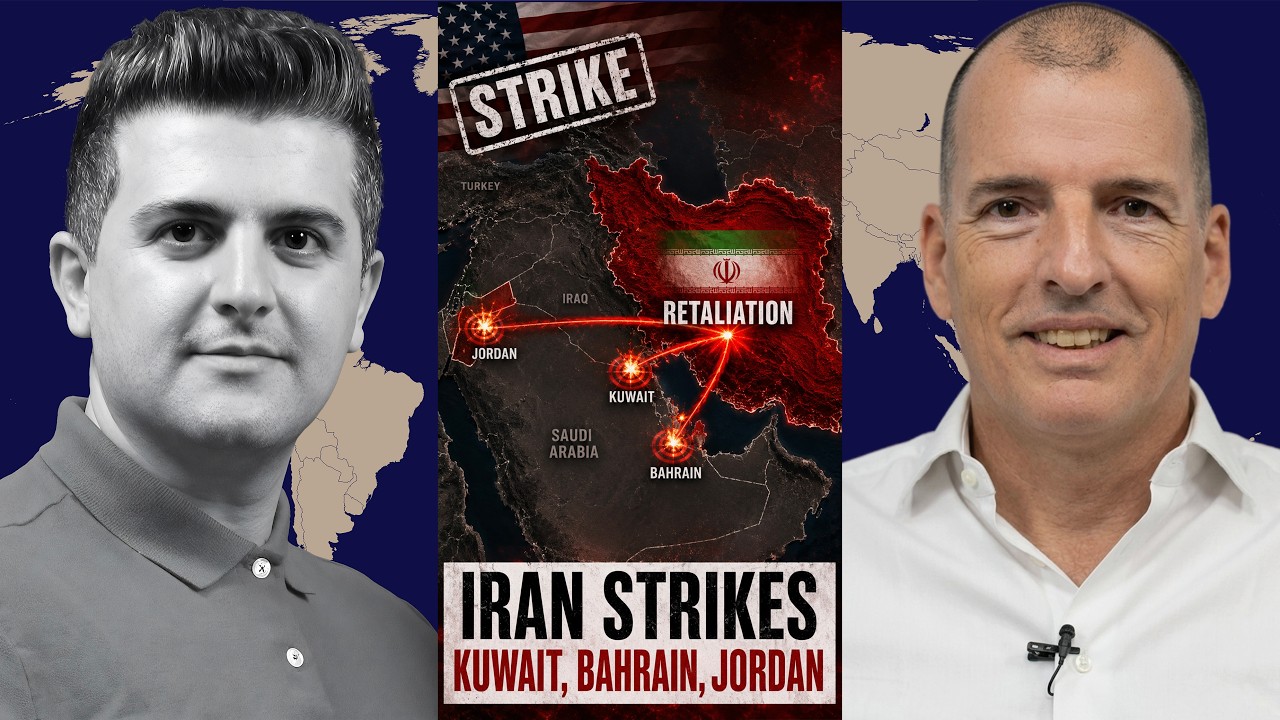
Alex Krainer: US STRIKES Iran – Iran RETALIATES Against Kuwait, Bahrain & Jordan!
"Amidst escalating US-Iran conflict and Iranian retaliation against regional US allies, this episode argues that US foreign policy is deeply controlled by an 'Anglo-Zionist conspiracy' led by the Rothschild banking dynasty, prioritizing Israeli interests over American ones."
Robby Soave GOES OFF On ANNOYING Liberal Black Woman Making Emotional Trump Deranged Arguments!
"The host dissects a heated foreign policy debate, arguing that 'left-wing' emotionalism and 'Trump derangement' prevent a rational understanding of US sanction strategies against Cuba and Iran."

'NOT America First!' Tucker Carlson On Iran, Trump, Ben Shapiro, Cruz & More!
"Tucker Carlson asserts that US involvement in the Iran war is not 'America First,' but rather driven by Israeli interests, weakening the US and fracturing the conservative movement while critics weaponize 'anti-Semitism' to silence dissent."

Will Venezuela Be Trump's Vietnam?
"An expert breaks down three perilous pathways for Venezuela under potential US intervention, from a 'Panamanian model' to a 'Libyan-style civil war,' and the broader geopolitical fallout for Latin America."