
Col. Daniel Davis: Trump’s Venezuela Disaster - Greenland Proves NATO Is Collapsing
YouTube · 4tYch_1OqM4
Quick Read
Summary
Takeaways
- ❖The Trump administration's foreign policy is driven by a 'Trump Doctrine' of unconstrained aggression, prioritizing political and resource control over national security.
- ❖Military actions in Venezuela, the Caribbean, Iran, and threats against Cuba and Greenland are framed as opportunistic power grabs, not strategic defense.
- ❖The US military lacks the sustained power to enforce global dominance, making Trump's expansive claims a 'recipe for self-emulation' against capable adversaries.
- ❖Europe's approach to the Ukraine war is criticized as 'kabuki theater,' prolonging the conflict and leading to Ukraine's destruction while waiting for a different US president.
- ❖Colonel Davis suggests the possibility of President Trump's cognitive decline as a factor in irrational and inconsistent foreign policy decisions.
- ❖Comparing the Venezuela operation to the Ukraine war is 'humiliatingly incomparable,' as the former was a swift, likely insider-assisted capture, not a full-scale war against a well-backed nation.
Insights
1Trump's Foreign Policy Lacks Coherent Strategy, Driven by Transactional Aggression
Colonel Davis asserts that the Trump administration operates without a true national security strategy, instead following a 'Trump Doctrine' focused on taking what it wants, when it wants, without constraints. This is exemplified by actions like seizing a Russian tanker, military operations against alleged drug boats, and interventions in Venezuela, which are not justified by US national security but by a desire for political and economic control.
The host asks about the latest escalation with Russia and the tanker, and Trump's Venezuela actions (). Davis states, 'Trump is facing a situation to where he has no constraints to using military' (). He describes the Venezuela endgame as 'political control of the country... so that they'll do what I tell them to do and physical control of the oil supply so that we can enrich ourselves' (). He explicitly defines the 'Trump doctrine' as 'I will take what I want when I want and you won't do anything about it and if you do I'll kill you' ().
2US Overestimates Its Military Capacity for Global Dominance
Despite aggressive posturing and tactical successes like the Venezuela operation, the US military is not equipped for sustained, large-scale conflicts against peer or near-peer adversaries. Colonel Davis warns that Trump's expansive claims of global control ('It's the world. It's our hemisphere. It's the Middle East... and in Europe') are a 'recipe that will lead to self emulation, self-destruction' because the US lacks the military power and manpower to make good on these threats.
Davis states, 'We don't have the military power to make good on all these checks he's writing' (). He contrasts the 'successful tactical operation' in Venezuela with fighting a war 'against anybody who can fight back' (). He concludes, 'If we fought a conventional war with Russia or with China, we would get our clocks clean because they both have the ability to sustain war over a period of time. We don't.' ()
3Europe's Ukraine Strategy is 'Theater,' Leading to Ukraine's Destruction
Colonel Davis dismisses European efforts regarding Ukraine, such as the Paris meeting, as 'kabuki theater' designed for domestic audiences, not genuine peace efforts. He argues that the West's refusal to consider Russia's non-negotiable demands (territorial claims, demilitarization, denazification, constitutional changes) means they are 'laying the foundation for the destruction of the Ukrainian country,' leading to more deaths and territory loss, rather than a viable resolution.
Davis calls the Paris meeting 'all about TV, man. It was all about show' (). He details Russia's non-negotiable demands () and states, 'They are laying... the foundation for the destruction of the Ukrainian country' (). He emphasizes Ukraine's dwindling manpower despite Western aid, contrasting it with Russia's vast reserves ().
4Trump's Inconsistent Actions and Potential Cognitive Decline
Colonel Davis highlights the profound inconsistency in Trump's approach to Russia—alternating between praising Putin and taking aggressive actions. He suggests this erratic behavior, alongside other irrational decisions, could be evidence of 'significant degradation in his cognitive capabilities,' distinct from Biden's decline, where decision-making is deeply impaired despite apparent faculties.
Davis notes the 'irrational action with on the one hand uh talking about Putin like he's your best pal... and then uh saying he's really angry at him' (). He states, 'We also cannot rule out that Trump is suffering significant uh degradation in his cognitive capabilities. There is a lot of evidence to suggest that is' (). He differentiates this from Biden's decline, describing it as impaired decision-making ().
Bottom Line
The US obsession with Cuba is rooted in historical grievances and emotion, not current national security threats, despite Cuba posing 'no threat to anyone' and being extremely poor.
This emotional, anachronistic policy prevents potential economic engagement and stability in the region, highlighting how past grudges can override pragmatic foreign policy, even when dealing with a non-threatening nation.
A future administration could gain significant soft power and economic benefits by lifting sanctions and normalizing relations with Cuba, treating it as any other country, rather than perpetuating a decades-old vendetta.
The Trump administration's foreign policy is so focused on immediate, transactional gains for Trump and his family that it disregards long-term consequences, such as increased immigration from destabilized Latin American countries.
This short-sighted approach creates a self-defeating cycle: aggressive interventions destabilize regions, which then fuels the very immigration issues the administration claims to oppose, demonstrating a fundamental disconnect between stated goals and actual outcomes.
Understanding this disconnect reveals that addressing immigration effectively requires stable, cooperative foreign policy in Latin America, rather than punitive, destabilizing interventions. Investment in regional stability could reduce migration pressures more effectively than border enforcement alone.
Key Concepts
The Trump Doctrine
Colonel Davis defines this as: 'I will take what I want when I want and you won't do anything about it and if you do I'll kill you.' This doctrine is characterized by transactional decision-making, a lack of long-term strategy, and a focus on personal benefit and subservience from other nations, rather than traditional national security interests or international law.
The Dunro Doctrine (Miller's interpretation)
An evolution of the Monroe Doctrine, as interpreted by Stephen Miller, which shifts from protecting the Western Hemisphere from external manipulation to actively exploiting the entire hemisphere for US benefit, deciding who stays in power, punishing dissent, and excluding any influence from rival powers like China and Russia.
The Illusion of Linear War
The misconception that war outcomes can be predicted by simply extrapolating current trends (e.g., territory lost over time). Colonel Davis argues that war is not a linear calculation; factors like manpower depletion on one side and increases on the other can drastically accelerate the rate of collapse, making long-term predictions based on past rates unreliable.
Lessons
- Challenge the narrative that aggressive, unilateral military actions are always in the national security interest, especially when they lack clear strategic justification or international consensus.
- Advocate for foreign policy decisions based on long-term strategic planning and realistic assessments of military capabilities, rather than short-term transactional gains or emotional impulses.
- Scrutinize claims of military success, distinguishing between swift, limited operations and the capacity for sustained, high-intensity conflict against capable adversaries.
- Recognize that 'peace talks' or diplomatic gestures without the involvement of all key parties and consideration of their non-negotiable demands are often political theater, not genuine efforts towards resolution.
Notable Moments
Colonel Davis's strong assertion that the US has no legal or moral justification for its alleged attacks on drug boats in international waters, killing people without due process.
This highlights a significant concern about the erosion of international law and human rights under the 'Trump Doctrine,' suggesting a disregard for established norms in pursuit of perceived objectives.
The discussion about the 'Dunro Doctrine' as a new interpretation of the Monroe Doctrine, shifting from protection to exploitation of the Western Hemisphere.
This reframes US policy in Latin America as overtly imperialistic and self-serving, rather than defensive, providing a critical lens through which to understand regional interventions.
Davis's direct comparison of the US military's capacity to Russia and China, stating the US would be 'cremated' in a conventional war due to lack of sustainment and manpower.
This is a blunt, contrarian assessment from a military expert, directly challenging the prevailing narrative of US military invincibility and underscoring the dangers of overextension.
Quotes
"The national security strategy of the United States right now is not it doesn't exist. There is the Trump doctrine which is... I will take what I want when I want and you won't do anything about it and if you do I'll kill you."
"We don't have the military power to make good on all these checks he's writing and thinking and we can do this because we had a a pretty successful tactical operation to snatch and grab uh a leader of of a country which was just on the surface of it really successful. But I'm telling you that is radically different than fighting a conflict and a war against anybody who can fight back."
"They are laying and they being the west and all these leaders... are laying the foundation for the destruction of the Ukrainian country. They are they're they're going to lay the foundation for more people to die, more territory to be lost, more cities to be destroyed. That is a fact."
"If we fought a conventional war with Russia or with China, we would get our clocks clean because they both have the ability to sustain war over a period of time. We don't."
Q&A
Recent Questions
Related Episodes

Patrick Henningsen: Hezbollah JUST Fired Back at Israel - Iran Vows to “Crush” All Attacks
"Patrick Henningsen argues that the US and Israel initiated an illegal war against Iran, driven by Trump's incompetence and Israeli influence, leading to an inevitable escalation with severe global economic repercussions."

Will Venezuela Be Trump's Vietnam?
"An expert breaks down three perilous pathways for Venezuela under potential US intervention, from a 'Panamanian model' to a 'Libyan-style civil war,' and the broader geopolitical fallout for Latin America."
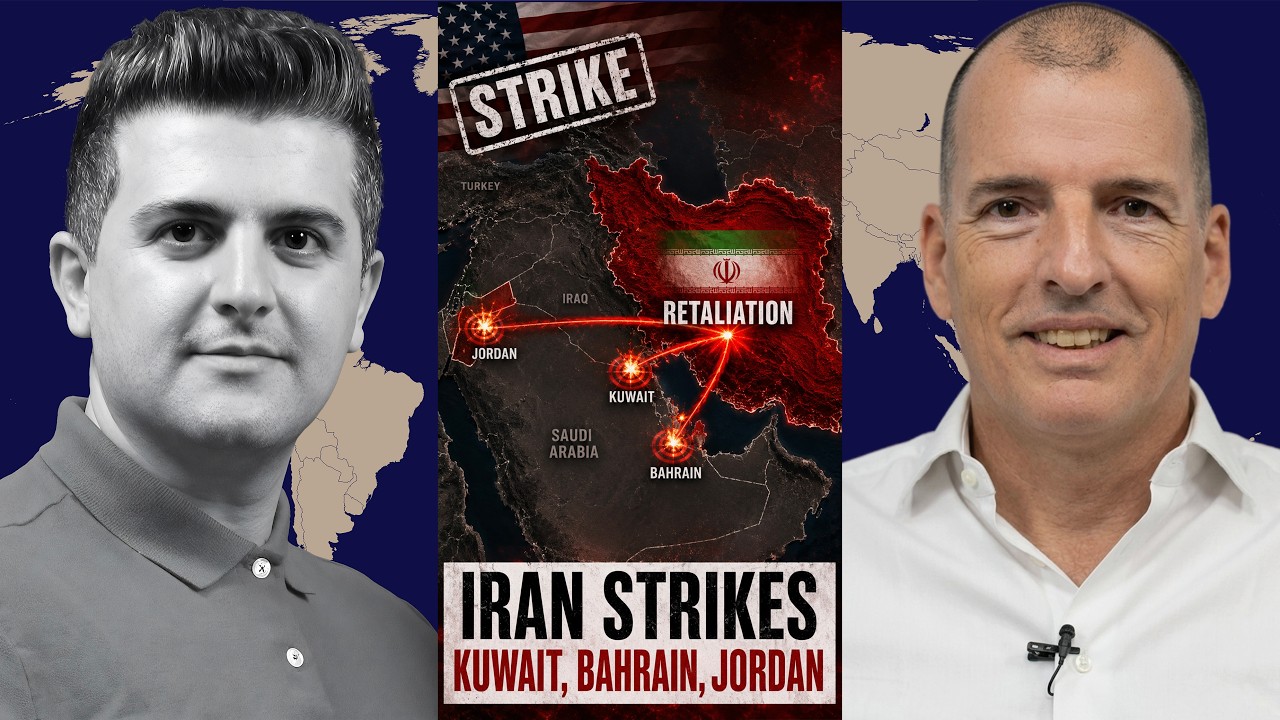
Alex Krainer: US STRIKES Iran – Iran RETALIATES Against Kuwait, Bahrain & Jordan!
"Amidst escalating US-Iran conflict and Iranian retaliation against regional US allies, this episode argues that US foreign policy is deeply controlled by an 'Anglo-Zionist conspiracy' led by the Rothschild banking dynasty, prioritizing Israeli interests over American ones."

LIVE: Trump HIDES FROM PUBLIC as US SOLDIER KILLED!!! 6/2/2026
"The host exposes alleged government cover-ups regarding military casualties, Trump's unexplained public absence, and questionable political appointments, arguing these reflect a 'regime of loser babies' and a failing foreign policy."