
Col. Larry Wilkerson: Israel Can’t Survive This… What Just Happened Changes Everything
YouTube · 7yo7wGFQRYw
Quick Read
Summary
Takeaways
- ❖Donald Trump and Benjamin Netanyahu are described as the 'two greatest lying leaders on the face of the earth.'
- ❖Iran's missile systems possess underestimated precision, destroying key Israeli and US military infrastructure.
- ❖The US is accused of committing numerous war crimes, including bombing schools, hospitals, and oil facilities.
- ❖The conflict is causing severe global impacts on water, food, and energy, especially in the Middle East.
- ❖Saudi Arabia and other Gulf states lack the military capacity to join the US against Iran and are seeking new alliances.
- ❖The US lacks clear strategic objectives for the war, leading to prolonged conflict and unarticulated goals.
- ❖Iran is self-sufficient in weapons and prepared for a long war, viewing the conflict as an existential threat.
- ❖The US is projected to be 'run out' of the Middle East permanently within 5-7 years.
- ❖The Strait of Hormuz will ultimately be arbitrated by Iran, not the US or European powers.
- ❖The conflict is framed as a 'great game' to fight China in a forward way, using Iran as the battleground.
Insights
1Underestimated Iranian Missile Capabilities and Strategic Targeting
Expert analysis, supported by observed video evidence, indicates a significant underestimation of Iran's missile precision and resilience. Iranian missiles are effectively destroying critical infrastructure in Israeli cities like Tel Aviv and Haifa, and notably demolished a key US radar in Bahrain that was central to regional air defense and Strait of Hormuz protection. These missiles are well-hidden, expose themselves only momentarily for firing, and are being used with 'great circumspection' to hit meaningful targets, conserving resources for a projected 'extremely long war.'
Ted Postol's assessment of Iranian missile precision; Wilkerson's personal observation of videos showing destruction in Tel Aviv and Haifa and the demolition of a US radar in Bahrain.
2US Abandonment of International Law and Commission of War Crimes
Wilkerson asserts that the US is systematically negating 50 years of international law by committing 'war crime after war crime.' Specific examples include the bombing of a primary school, an oil facility near Tehran (causing widespread toxic air), and a hospital. He warns that the US will 'regret' this abandonment of the international legal framework it largely crafted, transforming it from a 'force for good' to a 'force for evil' in the eyes of much of the world.
Specific incidents cited: bombing of a school (), oil facility near Tehran (), hospital ().
3Inevitable US Expulsion from the Middle East
Wilkerson predicts that the US will be 'driven out' of the Middle East permanently within 5 to 7 years. This expulsion will be a result of regional powers concluding that the US is 'not dependable,' 'deceitful,' and causes 'more harm than help.' He compares this to the US withdrawals from Afghanistan and Iraq, but emphasizes this will be a 'permanent' departure with 'no return,' especially if ground forces are deployed, leading to 'enormous' casualties and an 'astronomical' cost.
Wilkerson's direct prediction, drawing parallels to Afghanistan and Iraq withdrawals.
4Lack of Clear US Strategic Objectives and Leadership Deception
The US administration, particularly President Trump and Secretary of Defense Pete Hegseth, is criticized for failing to articulate a clear strategic objective or timeline for the war. Hegseth's statements about 'endless will' and a 'specific mission' are deemed meaningless without a defined goal. This lack of clarity, combined with the perceived 'lying, dissembling, and acting like an idiot' by the President, leaves the military without definitive guidance and the American public uninformed about the war's purpose or progress.
Pete Hegseth's public statements () and Wilkerson's critique of their vagueness and Trump's lack of articulation.
5The War as a 'Great Game' Against China and Russia
Wilkerson reveals an underlying geopolitical motivation for the war, framing it as a 'grab for oil' that also serves as a 'deterrent to the power in the world that is triumphant at this moment: China and its ally of convenience, Russia.' He argues that Iran has been chosen as the 'battleground' for this 'great game,' a forward strategy to fight China, echoing historical colonial power struggles over resources.
Wilkerson's explicit statement that the conflict is 'all about in geopolitical geostrategic terms fighting China in a forward way' (), and his historical reference to the 1953 Iranian coup.
Bottom Line
Gulf states, including Saudi Arabia, are actively considering extricating themselves from the US financial and security system to seek a 'new big daddy,' likely China, due to US unreliability and the detrimental impact of US military presence.
This signifies a major geopolitical realignment, potentially accelerating the decline of US influence in a critical region and bolstering China's global financial and strategic power.
Nations could explore diversified alliances and financial systems, reducing dependence on a single superpower and fostering multipolar global governance.
Iran's control over the Strait of Hormuz will be the ultimate arbiter of global oil and gas transit, regardless of US or European military escort missions, due to its advanced interdiction capabilities.
This fundamentally shifts power dynamics in global energy security, giving Iran significant leverage over international trade and potentially leading to extreme price volatility and economic destabilization if the strait is closed.
International bodies and nations could engage in direct, non-hostile negotiations with Iran to ensure safe passage, rather than relying on military force, which risks escalation and closure.
The US military is experiencing a concerning rise in 'Christian nationalism,' with NCOs and others being briefed in command rooms that they are on a 'mission for God' for 'Armageddon,' believing 'God is on their side.'
This indicates a dangerous ideological shift within the US military, potentially undermining secular governance, promoting religious extremism in conflict, and leading to reckless decision-making based on divine mandate rather than strategic rationale.
Vigilant oversight and internal mechanisms are needed to uphold the separation of church and state within military institutions, ensuring professional conduct and adherence to democratic principles.
Key Concepts
Hobbsian World
Wilkerson uses this concept to describe a world without the attenuating force of international law and norms, where nations operate in a state of 'war of all against all.' He argues that by abandoning international law, the US is ushering in such a world, where it is no longer a 'force for good' but a 'force for evil.'
The Great Game
This historical term, traditionally referring to the 19th-century geopolitical rivalry between the British and Russian Empires for supremacy in Central Asia, is invoked by Wilkerson to describe the current conflict. He posits that the war with Iran is fundamentally a proxy struggle for oil and strategic influence, primarily aimed at countering the rising power of China and its ally Russia.
Lessons
- Critically evaluate official government statements regarding military capabilities and war objectives, especially from leaders accused of 'pathological lying.'
- Monitor global energy, food, and water markets for volatility and supply chain disruptions, as the conflict's impacts are far-reaching and destabilizing.
- Recognize the potential for significant geopolitical shifts in the Middle East, including the decline of US influence and the rise of new alliances, and adjust strategic planning accordingly.
Notable Moments
Wilkerson describes seeing videos of Tel Aviv and Haifa being 'ripped apart' by Iranian missiles, with 'firemen and police and security personnel and civilians running around trying to fix things,' and 'civilians lying in the street wounded or dead.'
This vivid, on-the-ground account contradicts official narratives of effective Israeli defense and highlights the severe human and infrastructural cost of the conflict, providing a visceral understanding of the destruction.
Wilkerson states, 'We are no longer a force for good. We're not even neutral. We're a force for evil. Donald Trump has brought evil to the White House of the United States.'
This is a powerful and direct condemnation from a former high-ranking military official, indicating a profound moral and strategic decline in US foreign policy and its global perception.
Wilkerson asserts that 'Iranian democracy is more democracy than exists in Jerusalem or Tel Aviv.'
This is a highly contrarian and provocative statement that challenges conventional Western narratives about democracy in the Middle East, suggesting a deeper, often unacknowledged, political complexity in the region.
Wilkerson predicts that if the US deploys ground troops in Iran, 'the American people will live in shock for the next decade. The casualties will be enormous. The cost will be astronomical and at the end of the day it will make Afghanistan and the ignominious withdrawal there from look like child's play.'
This stark warning from an experienced military strategist underscores the extreme risks and potential for catastrophic failure if the US escalates its ground presence, highlighting the immense human and financial toll.
Quotes
"We're looking at two of the most accomplished... liars on the face of the earth. BB Netanyahu and Donald Trump."
"We are no longer a force for good. We're not even neutral. We're a force for evil. Donald Trump has brought evil to the White House of the United States."
"What I'd be doing if I were the Saudi royal family... is I would be looking for a new big daddy."
"We are going to be driven out of the Middle East by those people whom we said couldn't touch us with a farting."
"Iranian democracy is more democracy than exists in Jerusalem or Tel Aviv. Frankly, it is. We won't admit that, but I will."
"This is all about in geopolitical geostrategic terms fighting China in a forward way. We've chosen Iran as the battleground."
"We're walking into a blind alley with idiots leading us and idiots holding our hands and idiots all around us."
Q&A
Recent Questions
Related Episodes

Patrick Henningsen: Hezbollah JUST Fired Back at Israel - Iran Vows to “Crush” All Attacks
"Patrick Henningsen argues that the US and Israel initiated an illegal war against Iran, driven by Trump's incompetence and Israeli influence, leading to an inevitable escalation with severe global economic repercussions."
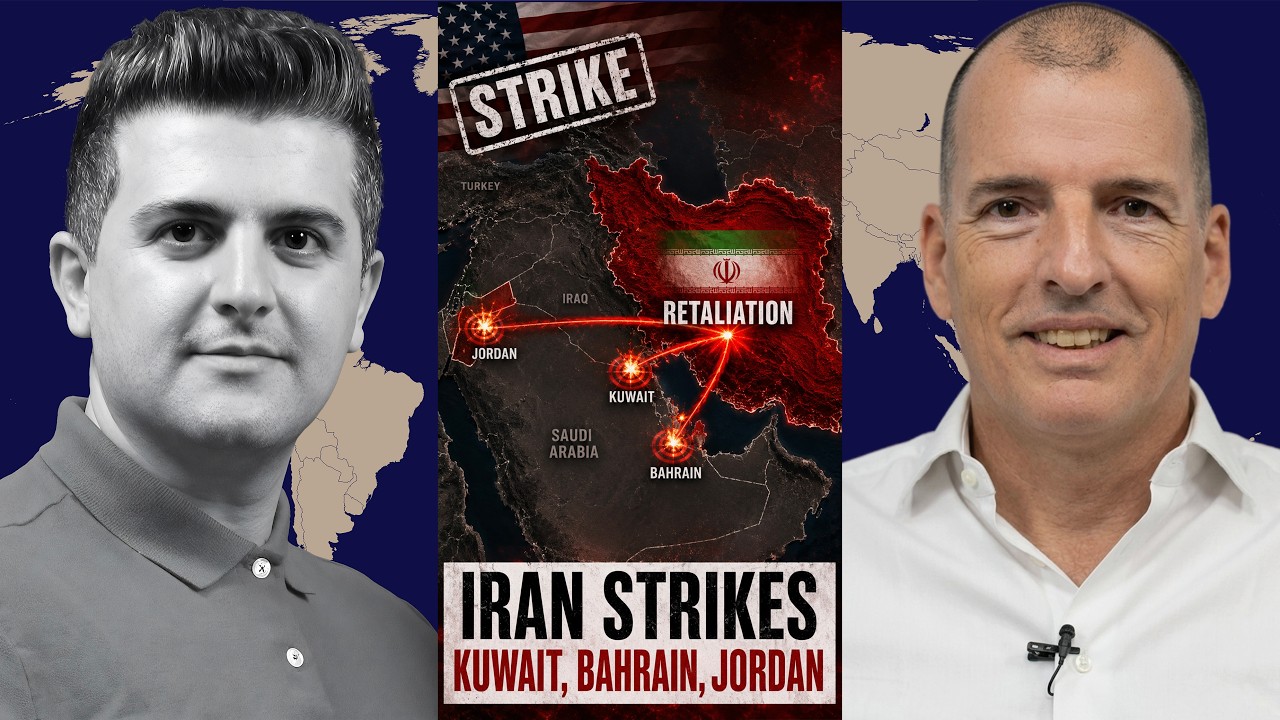
Alex Krainer: US STRIKES Iran – Iran RETALIATES Against Kuwait, Bahrain & Jordan!
"Amidst escalating US-Iran conflict and Iranian retaliation against regional US allies, this episode argues that US foreign policy is deeply controlled by an 'Anglo-Zionist conspiracy' led by the Rothschild banking dynasty, prioritizing Israeli interests over American ones."
BREAKING: Israel BOMBS Major Iran Gas Site; Top Mullah ELIMINATED; Iran Vows VENGEACE | TBN Israel
"Israel and the United States have escalated their 'Roaring Lion War' against Iran, striking its largest gas facilities, eliminating key intelligence and military figures, and disrupting missile production, while Iran threatens a broader energy war in the Gulf."
BREAKING: Protests ERUPT In Iran Over IRGC Surrendering To Trump - Infighting Clashes In Tehran
"Iran is experiencing severe internal infighting and protests as hardline IRGC elements clash with government figures over a perceived 'surrender' to the US, while mainstream Western media misrepresents the situation."