
Stanislav Krapivnik: IRAN TO UAE: ‘Evacuate Now’ After US Kharg Island Strike
YouTube · 9GVD2vm0Z1A
Quick Read
Summary
Takeaways
- ❖Iran's Kharg Island, a major oil fueling station and historical site, was attacked by Himars allegedly launched from two locations in the UAE, including near Dubai.
- ❖US military bases in the Gulf region lack bunkers, leaving personnel highly vulnerable to Iranian missile and drone attacks.
- ❖The F-35 fighter jet requires up to 20 hours of maintenance for every hour of flight, with critical components serviced only by expensive Lockheed Martin civilian contractors.
- ❖US aircraft carriers, like the USS Abraham Lincoln, have retreated over 1000km from Iran's coast due to the threat of Iranian hypersonic missiles (2000km range), rendering their F-35s largely ineffective without extensive air refueling.
- ❖Iran has warned American companies to evacuate personnel from manufacturing plants in the Persian Gulf, signaling potential targeting of US industrial assets.
- ❖Gulf Arab states are highly dependent on desalination for water (Bahrain/Qatar 100%, Saudi Arabia 70-80%) and food imports, making them extremely vulnerable to Iranian strikes on this infrastructure.
- ❖Saudi Arabia has reportedly informed the US it will not get involved in the conflict, recognizing the existential threat to its own oil infrastructure.
- ❖The US State Department advised American civilians stranded in the Gulf to 'survive as best you can,' indicating a lack of evacuation plans for non-military personnel.
- ❖The US military lacks the manpower and public support for a large-scale land invasion of Iran, which would require drafting millions of soldiers and face domestic revolts.
Insights
1Kharg Island Attack and Attribution
Iran's Foreign Minister stated that Kharg Island, a critical oil fueling station, desalination plant, and historical site, was attacked by Himars rockets launched from two locations within the UAE: Ras al-Khaimah and near Dubai. This contradicts initial US claims of fighter jet attacks and directly implicates a Gulf Arab state in the conflict.
Iranian Foreign Minister's statement on the attack origin (), guest's description of Kharg Island's significance (, ).
2Critical Vulnerability of US Bases in the Gulf
US military bases in the Persian Gulf region, including those housing troops, were built without bunkers. This leaves American personnel extremely exposed to missile and drone attacks, a severe oversight attributed to an initial belief the conflict would be short-lived (3-4 days).
Guest's statement: 'Those bases, American bases there, they don't have bunkers. There's no place to hide.' (), 'They ran out of ordinance a long time ago. And Iran is now just working them over.' ().
3F-35 Operational Limitations and Cost
The F-35 fighter jet, central to US air power, is described as 'singularly probably the worst plane of the last 50 years' due to its high maintenance requirements (up to 20 hours of maintenance per flight hour) and contractual limitations that mandate expensive Lockheed Martin civilian mechanics for critical systems. Its limited 'bingo range' (500km) necessitates multiple air refuelings for effective combat operations, especially when aircraft carriers are forced to operate far from Iranian airspace.
Discussion on F-35 maintenance ratios (), contractual civilian maintenance (), and bingo fuel range ().
4Strategic Retreat of US Aircraft Carriers
US aircraft carriers, such as the USS Abraham Lincoln, have moved over 1000 kilometers away from Iran's coast, operating behind coastal mountain ranges in Oman. This retreat is a direct response to the threat of Iran's 2000km-range hypersonic glide vehicles, effectively placing the carriers and their F-35s out of practical combat range without extensive and vulnerable air refueling operations.
Chinese satellite imagery showing USS Abraham Lincoln's new position (), Iran's FA1 hypersonic glide vehicle range ().
5Existential Threat to Gulf Arab States
Gulf Arab states like Bahrain, Qatar, and Saudi Arabia are 'artificial entities' with populations heavily reliant on desalination plants for fresh water (100% for some, 70-80% for Saudi Arabia) and imported food. Iran's capability to target these vital infrastructures would lead to a rapid, massive humanitarian catastrophe and societal collapse, a risk that has reportedly led Saudi Arabia to refuse direct military involvement.
Description of Gulf states as artificial (), reliance on desalination (), food imports (), and Saudi Arabia's refusal to help US (, ).
Bottom Line
The US military's reliance on advanced, high-maintenance platforms like the F-35 and its logistical vulnerabilities (e.g., lack of bunkers, slow resupply for Tomahawks) makes it ill-suited for a prolonged, high-intensity conflict against a regionally entrenched adversary like Iran.
This suggests a significant mismatch between perceived US military dominance and its practical operational capabilities in a contested environment, potentially leading to strategic overreach and unsustainable casualty rates.
Nations seeking to counter US influence or defend against superior air power could invest in asymmetric warfare capabilities like drone swarms, hypersonic missiles, and robust, decentralized defensive infrastructure, leveraging the high maintenance and logistical tail of advanced platforms.
The extreme dependence of Gulf Arab states on centralized desalination and food imports creates an 'Achilles' heel' that Iran could exploit to cause a rapid, catastrophic humanitarian crisis, effectively using water and food as strategic weapons.
This vulnerability means that any direct military involvement by these states against Iran carries an existential risk, forcing them into neutrality or even rapprochement with Iran, regardless of US pressure.
Businesses and governments should reassess supply chain resilience and humanitarian aid strategies for the Gulf, considering the potential for rapid, large-scale population displacement and resource scarcity. Investment in decentralized, resilient water and food production technologies in such regions could become critical.
Lessons
- Re-evaluate geopolitical risk assessments for investments and operations in the Persian Gulf, particularly concerning the stability of oil and gas infrastructure and the humanitarian situation in highly dependent Arab states.
- For military strategists, prioritize defensive infrastructure (e.g., bunkers) and logistical resilience for forward-deployed forces, acknowledging that 'short wars' are often miscalculations.
- For defense procurement, scrutinize the true operational costs and readiness of advanced military platforms, considering their maintenance burden and logistical requirements in real-world combat scenarios.
Notable Moments
The US State Department issued a recording telling American citizens stranded in the Gulf during hostilities that they were 'on their own' and should not count on the US government for evacuation.
This highlights a significant failure in US government responsibility towards its citizens abroad during a crisis, potentially eroding trust and demonstrating a lack of preparedness for mass evacuations from a volatile region.
Quotes
"Last night they have attacked Khark Island and Abu Musa Island with uh you know uh the artill artillery rocket system uh you know high mars as they call it which is a low range rockets and they have done it uh from the soil of our neighbors and this is crystal clear that now they are using this the territory of our neighbors to attack us by these kind of uh you know rockets and this is absolutely"
"Those bases, American bases there, they don't have bunkers. There's no place to hide."
"The Saudis have told the Americans there to to go bugger themselves. They're not going to involve themselves in this war."
"The F-35 is singularly probably the worst plane of the last 50 years if not if not longer."
"Don't count on the US government to get you out. You're on your own. Do what you can."
Q&A
Recent Questions
Related Episodes
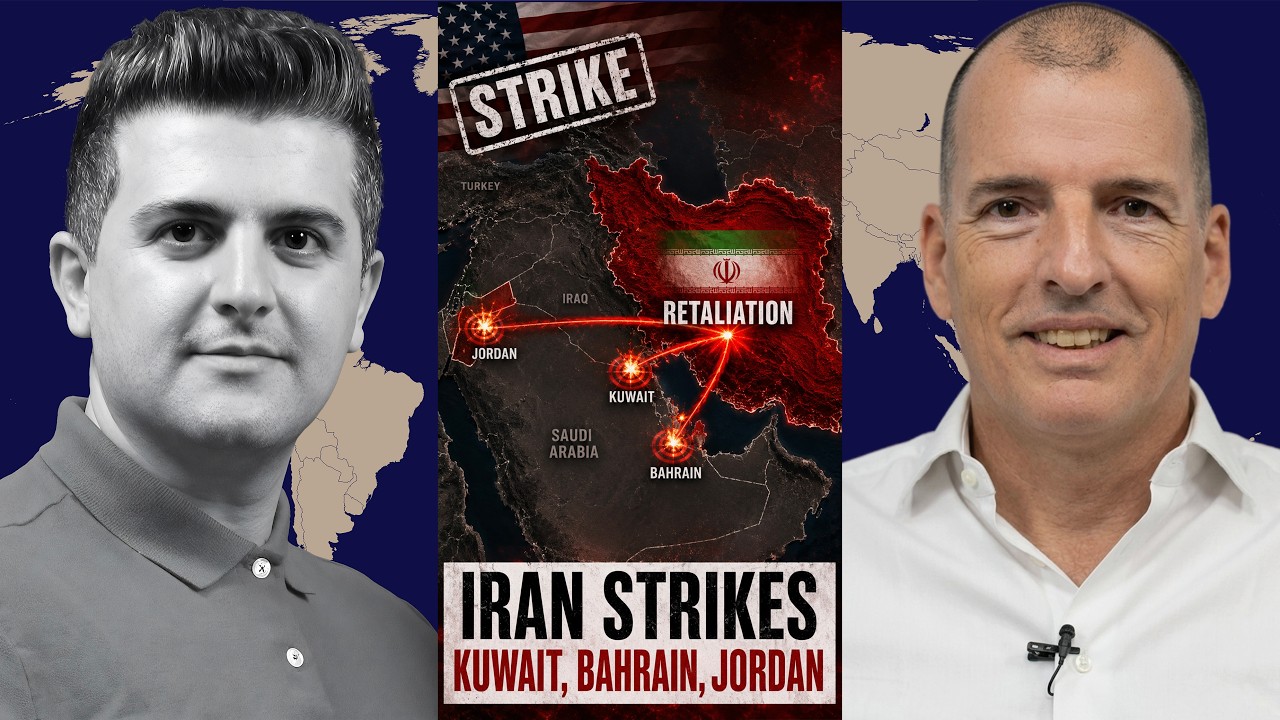
Alex Krainer: US STRIKES Iran – Iran RETALIATES Against Kuwait, Bahrain & Jordan!
"Amidst escalating US-Iran conflict and Iranian retaliation against regional US allies, this episode argues that US foreign policy is deeply controlled by an 'Anglo-Zionist conspiracy' led by the Rothschild banking dynasty, prioritizing Israeli interests over American ones."
Patrick Henningsen: Hezbollah JUST Fired Back at Israel - Iran Vows to “Crush” All Attacks
"Patrick Henningsen argues that the US and Israel initiated an illegal war against Iran, driven by Trump's incompetence and Israeli influence, leading to an inevitable escalation with severe global economic repercussions."
Col. Jacques Baud: What a US Ground Invasion of Iran Would REALLY Look Like
"Colonel Jacques Baud dissects the strategic futility of a US ground invasion of Iran, arguing that current troop levels are insufficient and such an action would backfire, exposing US allies and potentially leading to Iran's nuclearization."

Bibi DEMANDS Ground Troops As Marines Rushed to Iran
"Benjamin Netanyahu is pushing for US ground troops in Iran, framing air strikes as insufficient, while the US rushes Marines to the region and struggles to secure the Strait of Hormuz against surprisingly capable Iranian defenses."