
John Helmer: Iran Just Did the Unthinkable – US & Israel Respond (Middle East on Fire)
YouTube · B1PqtkZS4Ig
Quick Read
Summary
Takeaways
- ❖A recent US military operation in Isvahan, Iran, resulted in catastrophic losses, including two C130 transport planes and multiple helicopters, likened to Jimmy Carter's failed 'Operation Eagle Claw' of 1980.
- ❖Evidence found at the scene, including Major Amanda Ryder's operational documents and Israeli visa, suggests a two-pronged mission: attacking nuclear facilities and a rescue operation, with Israeli involvement.
- ❖John Helmer frames President Trump's subsequent aggressive rhetoric as a reaction to political fear, aiming to avoid a 'Carter-like disaster' that could lead to impeachment.
- ❖A 'Jewish faction' within the White House (Kushner, Vitkov, Miller, Netanyahu) is perceived to be pushing for military escalation and 'genocide' against Iran, often against the advice of military leaders.
- ❖Iran has presented a 10-point reply via Pakistan, including demands for reparations, removal of US bases, lifting of sanctions, and a proposal for a Strait of Hormuz transit fee system.
- ❖The proposed Strait of Hormuz toll system could generate approximately $25 billion annually for Iran (after discounts and sharing with Oman), intended for war damage reparations.
- ❖Trump's response to the toll proposal was 'to the victor go the spoils,' indicating a non-negotiating stance driven by a 'violence makes victory makes spoils makes ours' mentality.
- ❖The global trend of de-dollarization is evident, with Iran accepting yuan for tolls and India purchasing Iranian oil in rupees, challenging the dollar's dominance.
- ❖John Helmer suggests Trump's actions are influenced by a 'god-given mission' and Kabad ideology, leading to a dangerous, non-rational approach to conflict.
- ❖A Bahraini resolution at the UN Security Council, intended to legalize war against Iran, is expected to be vetoed or significantly watered down by Russia, China, and France.
- ❖European countries like Italy are seeking bilateral agreements with Iran, willing to pay tolls, due to energy shortages and a desire to move away from US influence.
- ❖The Arab Gulf states are seen as being in a 'last stand,' with their reliance on US protection proving ineffective against Iranian capabilities, leading to a crisis of legitimacy.
Insights
1Catastrophic US Military Failure in Isvahan, Iran
A US military operation in Isvahan, Iran, on April 7th, 2026, resulted in the destruction of two C130 transport planes and at least two to three helicopters, along with an A10 support aircraft. This event is described as a 'catastrophic failure' comparable to Jimmy Carter's 'Operation Eagle Claw' in 1980, which significantly damaged his presidency.
The host details the destruction of 'airplanes together with pilot jets and together with fighter jets and and blackhawks, little birds and various of these military equipment were destroyed at the scene.' John Helmer specifies 'catastrophic losses of the two C130 transport planes and the destruction of at least two maybe three maybe more helicopters not to mention the loss of of another aircraft the A10.'
2Evidence Reveals Israeli Involvement and Dual Operation Objectives
Documents left behind by US Major Amanda Ryder at the operation site, including her ID, Israeli visa (valid March 20 to June 20, 2026), and operational papers (maps, orders, codes), indicate a pre-planned, two-pronged mission. This mission involved attacking nuclear facilities around Isvahan to capture nuclear material and destroy bunkers, alongside a rescue operation for a downed crew member.
Helmer states, 'Major Amanda Ryder's papers that she has allowed to leave behind not only her ID and her Israeli visa... but a packet of operational documents. You can see it in the video, their maps, their orders, their codes.' He adds, 'there's an operation to attack the nuclear facilities in and around Isvahan, capture nuclear material and kill everybody around... Second, they're trying to rescue the second crew member.' He later notes, 'writers papers show that she was ordered into Israel March 20.'
3Trump's Escalation Driven by Political Fear and Internal Factionalism
President Trump's aggressive post-operation rhetoric and actions are interpreted as a direct response to his 'fear of losing' politically, particularly the risk of impeachment if the military disaster were fully exposed. He relies heavily on a 'Jewish faction' (Kushner, Vitkov, Miller, Netanyahu) that advocates for extreme measures, including 'genocide' against Iran, often overriding military objections to 'adventurism' and potential 'Carterlike disaster[s].'
Helmer asserts, 'what's happened is should be understood politically in the United States as a very very serious problem for President Trump... Trump's fear.' He notes Trump 'admits yes there have been military there's military opposition' to the operations. Helmer identifies 'the Jewish faction, which is in favor of escalation,' including 'Vitkov, Kushner... and Netanyahu,' who 'want genocide against Iran.'
4Iran's 10-Point Diplomatic and Economic Counter-Proposal
In response to US actions, Iran has submitted a 10-point proposal via Pakistan, outlining conditions for peace. Key elements include a permanent end to the war, lifting of sanctions, guarantees against future attacks, reconstruction reparations, and a significant proposal for a Strait of Hormuz transit fee system. This toll system is calculated to generate approximately $100 billion annually, with Iran's share (after discounts for friendly states and sharing with Oman) estimated at $25 billion for war damage repair.
The host mentions, 'They have presented they responded to Donald Trump and his administration in a letter by Pakistani. It's 10 points.' Helmer details, 'The new 10-point reply that came from Islamabad has a couple of extra interesting issues... a transit fee proposal.' He calculates, '50,000 a year roughly at 2 million toll per vessel adds up to a 100 billion... approximately $25 billion for Iran's reparations.'
5De-Dollarization and the Strait of Hormuz Toll as a Challenge to US Hegemony
The Iranian proposal for a Strait of Hormuz toll system, with payments potentially in non-dollar currencies like the Chinese yuan, represents a direct challenge to the US dollar's global dominance. This aligns with broader de-dollarization efforts by countries like Russia, China, and India, which are increasingly conducting trade in local currencies (e.g., India buying Iranian oil in rupees) to circumvent US sanctions and control.
Lindsey Graham is quoted saying, 'they're charging ships, the IRGC, the Iranians, to go through the straits and they're taking the wine, not the dollar. One threat of this whole debacle is if we start allowing the Chinese currency to be traded in oil, that will hurt the dollar.' The host adds, 'India recently bought a new tanker of oil... from Iran in rupee in Indian currency.'
Bottom Line
The US empire might not collapse but could re-anchor itself in the Americas, dominating North, Central, and South America, led by figures like Vance, while disengaging from costly Middle East and Ukraine conflicts to focus on containing China.
This suggests a strategic pivot for US power, potentially leading to a more localized, dollar-dominated 'American empire' rather than a global one. It implies a shift in geopolitical priorities and a different kind of US global influence.
Businesses and nations reliant on global trade or US security guarantees should prepare for a potential reconfiguration of US strategic interests, possibly leading to new regional alliances and economic blocs within the Americas, and reduced US engagement elsewhere.
The Arab Gulf monarchies are in a 'last stand,' facing defeat in their defenses and a crisis of legitimacy as US protection proves unreliable against Iranian capabilities. Their reliance on US force to open the Strait of Hormuz is unlikely to succeed.
This signifies a fundamental shift in the regional power balance. The traditional security architecture of the Gulf, based on US protection, is eroding, forcing these states to confront Iran directly or seek new security arrangements.
This creates opportunities for regional powers like Iran to assert greater influence and for other global actors (e.g., China, Russia) to forge new security and economic partnerships in the Gulf, potentially bypassing traditional US-aligned structures.
Trump's decision-making is heavily influenced by a 'god-given mission' and Kabad Jewish ideology, leading to a non-rational, religiously doctrinal approach to conflict, where adversaries are 'evil' and negotiation is secondary to 'victory.'
This suggests that traditional diplomatic or rational deterrence strategies may be ineffective against a leader driven by such beliefs. It implies a higher risk of unpredictable escalation and a lower likelihood of de-escalation through conventional means.
Understanding this psychological and ideological framework is critical for analysts and policymakers. It necessitates developing non-traditional engagement strategies or preparing for scenarios where rational self-interest is not the primary driver of US foreign policy in certain contexts.
Lessons
- Monitor the geopolitical landscape for signs of the US re-anchoring its empire in the Americas, and assess how this shift could impact global trade routes, security alliances, and economic partnerships outside the Western Hemisphere.
- Evaluate the growing trend of de-dollarization by observing currency choices in international trade, particularly in energy and commodities, and consider its implications for global financial stability and alternative payment systems.
- Analyze the internal political dynamics of major powers, recognizing that leaders' personal fears, ideological beliefs, and factional influences can significantly shape foreign policy decisions, potentially leading to unpredictable escalations.
Notable Moments
Discussion of Major Amanda Ryder's documents, including an Israeli visa and operational papers, left at the scene of the failed US operation in Isvahan, Iran.
This provides concrete 'evidence' of Israeli involvement and the specific objectives of the US operation, framing it as a pre-planned, dual-purpose mission to attack nuclear facilities and conduct a rescue, directly contradicting any narrative of a simple rescue mission.
The host highlights the destruction of a synagogue in Iran by an Israeli attack, and the chief rabbi of Iran's Jewish community visiting the site.
This moment underscores the complex religious and political dimensions of the conflict, demonstrating that the conflict impacts all communities within Iran and challenges narratives that might frame it purely as a religious war against a specific faith group.
Quotes
"What's happened is should be understood politically in the United States as a very very serious problem for President Trump... what you get is a very interesting, I think, insight into Trump's fear."
"They want to annihilate. They want genocide against Iran. They have wanted, if necessary, tactical nuclear weapons."
"To the victor go the spoils. I'll take the tolls. He said why should they have them?"
"The state of Israel's founded on such a doctrine. It's now part of the president of the United States. Some combination of Christian God, uh, evangelical mission, Armageddon coming up, the Messiah arriving. Trump's got all this running around in his head."
"This time tomorrow night we're going to have one of two scenarios. Capitulation of their desire to reign terror on the war world through diplomacy or we're gonna have a massive military attack destroying this regime's capability to ever wage war again."
Q&A
Recent Questions
Related Episodes

Patrick Henningsen: Hezbollah JUST Fired Back at Israel - Iran Vows to “Crush” All Attacks
"Patrick Henningsen argues that the US and Israel initiated an illegal war against Iran, driven by Trump's incompetence and Israeli influence, leading to an inevitable escalation with severe global economic repercussions."

Bibi DEMANDS Ground Troops As Marines Rushed to Iran
"Benjamin Netanyahu is pushing for US ground troops in Iran, framing air strikes as insufficient, while the US rushes Marines to the region and struggles to secure the Strait of Hormuz against surprisingly capable Iranian defenses."
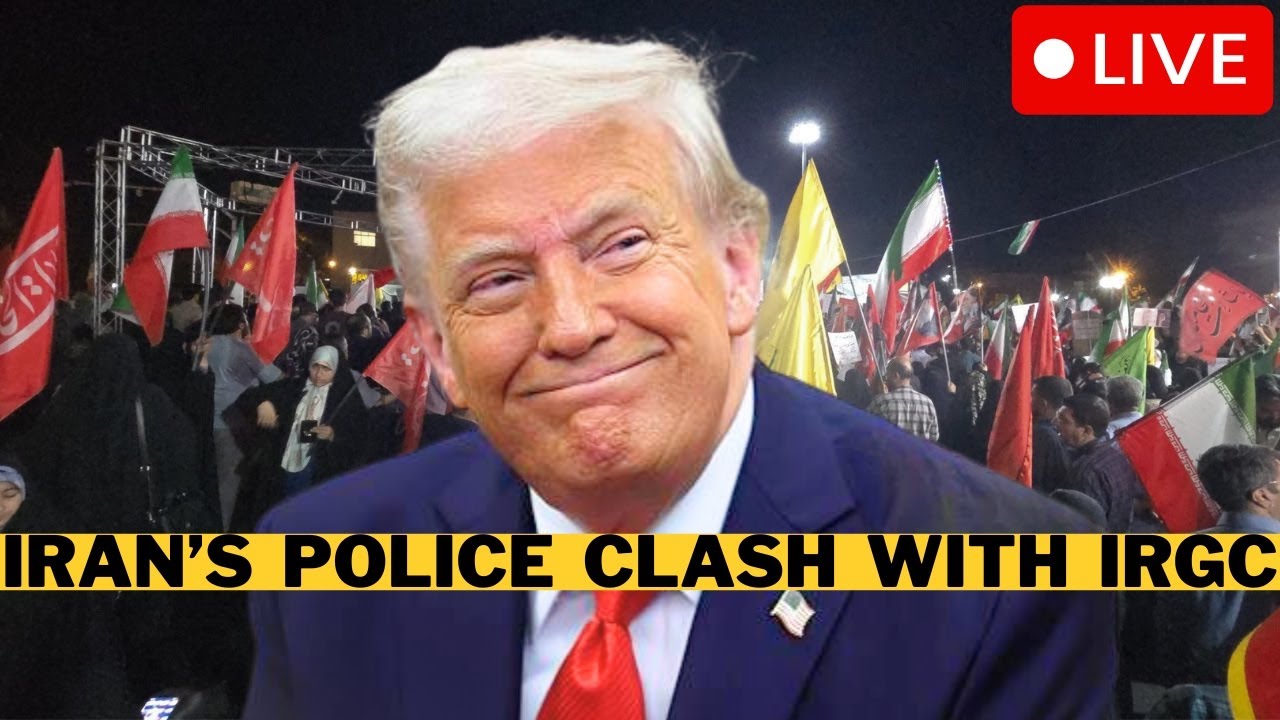
BREAKING: Protests ERUPT In Iran Over IRGC Surrendering To Trump - Infighting Clashes In Tehran
"Iran is experiencing severe internal infighting and protests as hardline IRGC elements clash with government figures over a perceived 'surrender' to the US, while mainstream Western media misrepresents the situation."

Alex Krainer: US STRIKES Iran – Iran RETALIATES Against Kuwait, Bahrain & Jordan!
"Amidst escalating US-Iran conflict and Iranian retaliation against regional US allies, this episode argues that US foreign policy is deeply controlled by an 'Anglo-Zionist conspiracy' led by the Rothschild banking dynasty, prioritizing Israeli interests over American ones."