
Amb. Chas Freeman: The War With Iran Is Breaking Everything the U.S. Planned
YouTube · FM1WOmbdzmA
Quick Read
Summary
Takeaways
- ❖The US-Israeli war against Iran is an Israeli strategy implemented with an American campaign plan, despite Pentagon warnings.
- ❖The assassination of Iran's Supreme Leader, Ali Ham, ironically removed the primary obstacle to Iran developing nuclear weapons.
- ❖Iran's 'rope a dope' strategy aims to exhaust US and Israeli air defenses before launching a decisive counterattack, while simultaneously pressuring Gulf Arab states to remove US military presence.
Bottom Line
The US-Israel campaign plan was agreed upon at Mar-a-Lago on December 29th, with the Pentagon privately advising against it due to its unlikelihood of success.
This suggests a direct political override of military expert advice, indicating a decision-making process driven by external influence rather than strategic feasibility.
Policymakers and analysts should scrutinize the influence of external actors on US foreign policy decisions, particularly when they contradict expert military assessments.
Israel is exploiting the war's confusion to seize and annex southern Lebanon up to the Litani River and to transform parts of Beirut into a 'version of Gaza'.
This reveals a broader Israeli territorial and demographic agenda, using the conflict as cover for expansion and ethnic cleansing, which will further destabilize the region.
International bodies and humanitarian organizations should monitor Israeli actions in Lebanon closely for potential war crimes and violations of international law.
False flag operations, historically used by Israel, are plausible in recent incidents in Saudi Arabia and Azerbaijan, intended to draw these countries into the war against Iran.
This tactic aims to create a broader anti-Iran coalition by manufacturing pretexts for conflict, complicating regional alliances and increasing the risk of wider war.
Regional governments and intelligence agencies should exercise extreme caution and conduct thorough independent investigations into attacks to prevent manipulation and escalation.
China is negotiating with Iran to exempt its ships from the Strait of Hormuz blockade, mirroring its successful approach with the Houthis in the Red Sea.
This demonstrates Iran's leverage and China's pragmatic approach to securing its energy supplies, potentially undermining US efforts to isolate Iran and highlighting a shift in global maritime power dynamics.
The US must recognize that its unilateral actions can create opportunities for rivals to gain influence and establish alternative international norms, requiring a re-evaluation of its blockade strategies.
Lessons
- Scrutinize official narratives during conflicts, as political expediency often distorts truth, as demonstrated by Marco Rubio's contradictory statements.
- Recognize that military interventions without clear, achievable objectives and sufficient resources are prone to failure and can lead to unintended, disastrous consequences.
- Understand that US military resource depletion in one conflict (Iran) can severely impact its ability to respond to other potential global crises (e.g., Taiwan).
Notable Moments
Donald Trump's public comments about cultivating Iranian leadership figures, which Ambassador Freeman describes as 'foolish,' inadvertently exposed secret CIA and Mossad operations.
This leak compromised intelligence assets and likely led to the elimination of potential successors, demonstrating a lack of operational security and strategic foresight at the highest levels of US government.
The assassination of Iran's Supreme Leader, Ali Ham, who was adamantly opposed to nuclear weapons, ironically removed the 'cork in the bottle' on Iran's nuclear ambitions, as his potential successors are all in favor of building a bomb.
This highlights a critical, unintended consequence of the US-Israeli operation, where a primary objective (preventing nuclearization) was undermined by the very actions taken.
The sinking of a US cruiser off Sri Lanka after participating in a multinational exercise, despite being unarmed, signaled Iran's capability and intent to globalize the conflict beyond immediate regional environments.
This event demonstrates Iran's reach and willingness to escalate, challenging the notion of a 'limited war' and indicating potential threats to US assets globally.
The UAE's American air defense system ran out of interception capability, and the US reportedly refused to replenish it, prioritizing Israel's needs.
This incident exposes the unreliability of US defense commitments to Gulf Arab allies in a regional conflict, pushing them to reconsider their alignment with the US and potentially seek alternative security arrangements.
Quotes
"Ali Ham was the cork in the bottle on that issue. He was adamantly opposed to Iran developing weapons of mass destruction, which he described as haram, forbidden in Islam. He's been removed. As I look at the potential candidates, including his son, to succeed him, they're all in favor of building a bomb. So what we've done is not prevent Iran from going nuclear but encouraging it to go nuclear."
"The Iranian campaign plan, if you will, is to emulate Muhammad Ali's strategy called rope a dope. That is take the punches of the other side while you punch at the other side and exhaust the other side. And when you have depleted the ability of the other side to intercept missiles and to fight effectively, then you hit them really hard and knock them out."
"The United States has never been as subservient to Israel as we now are, and we're going to pay a price for that as is Israel."
"If you're going to start a war, first thing you need to do is define objectives that are achievable. Then you need to have a plan for achieving those objectives and devote the resources required to do so to the task. Then you need to conduct the war in a manner that leaves open the possibility of ending it on a satisfactory basis. In the end, you have to reconcile the defeated enemy, assuming you defeat him, to the outcome of the war. The war is not over until the enemy admits defeat. Iran is not going to admit defeat anytime soon."
Q&A
Recent Questions
Related Episodes
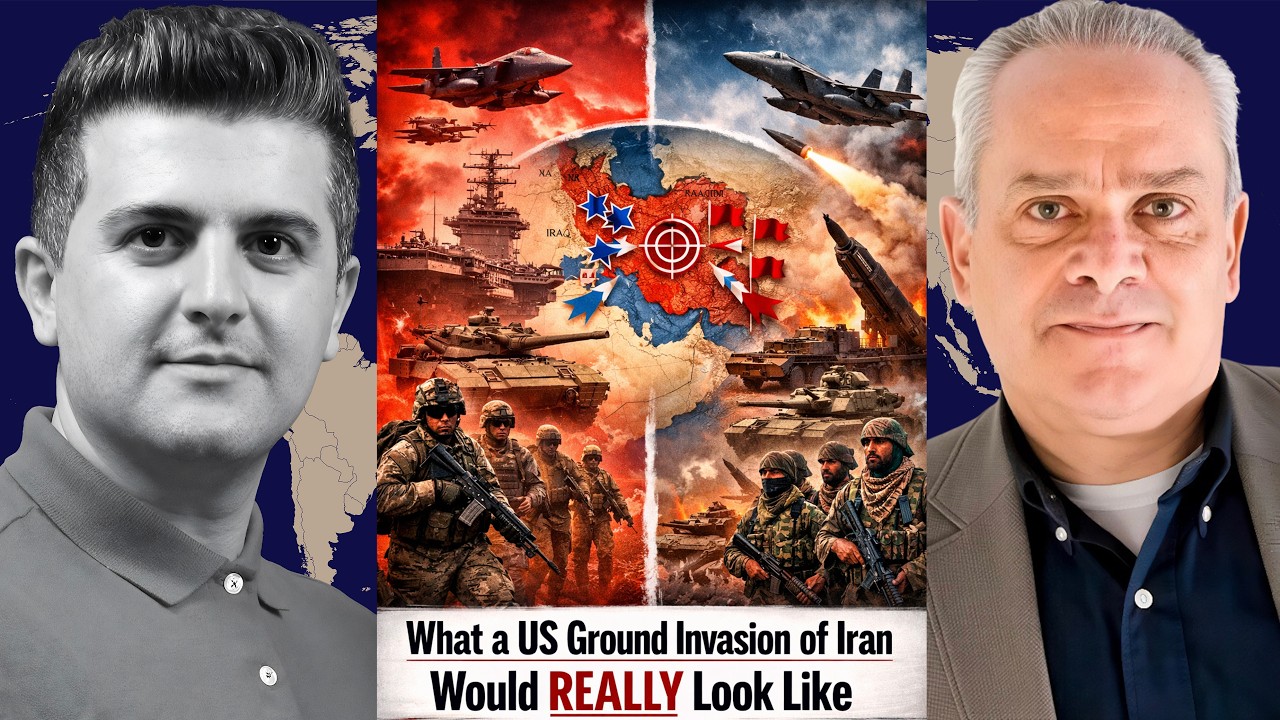
Col. Jacques Baud: What a US Ground Invasion of Iran Would REALLY Look Like
"Colonel Jacques Baud dissects the strategic futility of a US ground invasion of Iran, arguing that current troop levels are insufficient and such an action would backfire, exposing US allies and potentially leading to Iran's nuclearization."
BREAKING: U.S. Weighs INVADING Iran Oil Island; Gulf Energy Crisis Grows | TBN Israel
"As the US and Israel systematically dismantle Iran's military and leadership, the conflict escalates into an energy war, with the US considering ground invasion of Iran's critical Karag oil island to secure global oil routes."
BREAKING: Israel BOMBS Major Iran Gas Site; Top Mullah ELIMINATED; Iran Vows VENGEACE | TBN Israel
"Israel and the United States have escalated their 'Roaring Lion War' against Iran, striking its largest gas facilities, eliminating key intelligence and military figures, and disrupting missile production, while Iran threatens a broader energy war in the Gulf."

Mohammad Marandi & Larry C. Johnson: U.S. & Iran on the Brink as Critical Negotiations Unfold LIVE
"Two geopolitical analysts argue that the US and Israel are on the brink of a catastrophic war with Iran, driven by irrationality and miscalculation, which would lead to global economic collapse and US instability."