Understanding America's Goals in Iran, with Erik Prince and Mark Geist, & Clinton's Epstein Comments
YouTube · GfDUpqo2NBM
Quick Read
Summary
Takeaways
- ❖Public polling indicates significant confusion among Americans regarding the goals and justification for the war in Iran.
- ❖Erik Prince argues the US is being 'dragged in by the Israelis' and that the conflict is burning through critical interceptor missile production.
- ❖Mark Geist asserts that military action against Iran is necessary to prevent nuclear weapon development and support the Iranian people's uprising.
- ❖Bill Clinton denied having an interest in 'young' people and offered a theory that Jeffrey Epstein 'got caught' as the reason for his death.
- ❖The US Olympic men's hockey team's victory was fueled by a strong culture of selflessness and patriotism, with players prioritizing national pride over individual accolades.
- ❖The US is reportedly running low on interceptor missiles, with some Gulf allies having only days of supply left, while Iran's cheaper drones and missiles are plentiful.
Insights
1US Military Resources are Critically Depleted by Middle East Conflicts
The US and its allies are reportedly running low on expensive interceptor missiles (Patriot, THAAD, Standard Missile variants) due to their use in Ukraine, Israel, against Houthis, and in recent operations in Iran. Erik Prince states the 12-day war last summer burned through 16 years of interceptor production, forcing the US to pull supplies from the Indo-Pacific. This depletion leaves US facilities and allies vulnerable to Iran's cheaper, mass-produced drones and missiles.
Erik Prince: 'The last big push last summer, right, the 12-day war, it burned through 16 years worth of interceptor production.' () Kelly Bukar Vleos report: 'The standard missile variant was down 33%. Those cost 12.5 to 28 million a piece. Each interception attempt requires at least two missiles.' () Qatar's Patriot interceptor missiles will last '4 days at the current rate of use.' ()
2Iran War Objectives are Unclear and Public Support is Divided
Polling shows Americans are confused about the Trump administration's main goals in Iran, with no single objective garnering more than 14% support. Support for the war falls along partisan lines, with a majority of Republicans supporting the president, while independents and Democrats are largely against it. The host notes a significant gender divide, with a majority of women opposing the conflict.
Megyn Kelly: 'A Washington Post poll lists eight choices for what people think the Trump administration's main goal is in Iran. The top response, show power or take control, which gets 14%... The American people do not know why we're doing this.' () 'Republicans, a majority support the president. Independents and Democrats are totally against the president.' ()
3Ground Troops in Iran are a Potentially Catastrophic Escalation
Erik Prince strongly warns against sending US ground troops into Iran, calling it a '10x worse decision than going into Iraq.' He emphasizes Iran's prepared homeland, its 44,000 mountains with extensive tunneling, and the loyalty and strength of the 250,000-man Iranian Revolutionary Guard Corps (IRGC). He argues that air power alone cannot achieve regime change and that the US failed to pacify a smaller Iraq, which is now effectively lost to Iran.
Erik Prince: 'The idea of putting ground troops is extremely bad. extremely bad.' () 'It's a 10x worse decision than going into Iraq was.' () 'Iran does not have an independence day because they've not been conquered ex since Alexander the Great.' ()
4Bill Clinton's Evasive Testimony on Jeffrey Epstein
During his deposition, Bill Clinton was evasive when questioned about Jeffrey Epstein's alleged preference for 'young' individuals, denying any personal interest in underage people while acknowledging 'interns' are young. He also claimed not to recall details of a viral photo showing him in a 'Roman bath' with unidentified individuals on Epstein's trip and stated he believed Epstein 'got caught' as the reason for his death, though he 'accepted' it was suicide.
Bill Clinton: 'First of all, that's not true.' () when asked why Epstein would say he 'likes them young.' 'I don't know who that is.' () regarding a woman in a hot tub photo. 'I think maybe that's he finally got caught and I don't know. I've I've accepted it in my own mind.' ()
5US Olympic Men's Hockey Team's Culture of Patriotism and Sacrifice
Matthew Kachchuck, a gold medalist, describes the US Olympic men's hockey team's internal messaging as 'gold or bust,' driven by a culture of selflessness and patriotism. Players were willing to take on different roles and less ice time for the team's success. He highlights the strong connection with alumni and the profound honor of representing the United States, emphasizing the team's collective pride in their country.
Matthew Kachchuck: 'Privately in our room, it was gold or bust.' () 'The sacrifice that guys would make playing less minutes playing different role... that's when I first saw the sacrifice in that first practice I knew we had a real legit shot.' () 'We're so proud to be Americans. We're so proud to represent our country.' ()
Bottom Line
The US's reliance on expensive, high-end defense systems creates an unsustainable 'math problem' against adversaries like Iran, who deploy cheap, mass-produced drones and missiles.
This cost imbalance drains US resources rapidly, making prolonged conflicts financially crippling and potentially leaving critical theaters like the Pacific vulnerable.
Invest in developing cost-effective, high-volume counter-drone and missile defense systems, or alternative asymmetric responses, to negate the adversary's economic advantage.
The debate over US intervention in Iran highlights a deep partisan and gender divide in public opinion, suggesting a lack of clear national consensus on foreign policy.
This division can undermine the legitimacy and sustainability of military actions, making it difficult for leaders to maintain public support for long-term engagements.
Political leaders need to articulate clearer, more transparent objectives and engage in broader public discourse to build consensus before committing to military interventions, rather than relying on partisan backing.
The White House's use of AI-generated voiceovers for political messaging, as seen with the hockey team video, introduces new complexities in public communication and authenticity.
This technology can blur the lines between genuine statements and manufactured content, potentially eroding public trust in official communications and creating 'fake news' controversies.
Develop clear ethical guidelines and transparency standards for government use of AI in public messaging, and educate the public on how to identify AI-generated content.
Lessons
- Demand greater transparency from political leaders regarding the true costs and strategic objectives of military interventions, especially in the Middle East.
- Advocate for defense procurement reforms that prioritize cost-effectiveness and rapid production of essential military assets, rather than solely focusing on high-end, expensive weaponry.
- Scrutinize official statements and media reports, particularly those from political figures, for potential evasiveness or spin, as demonstrated in the Clinton depositions.
Notable Moments
Erik Prince argues the US was 'dragged in by the Israelis' into the Iran conflict, suggesting Israel's problems are not necessarily America's.
This challenges the narrative of independent US foreign policy and highlights potential external influences on military decisions, raising questions about national interest.
Bill Clinton's lawyer attempts to telegraph answers and makes 'speaking objections' during his Epstein deposition, which Megyn Kelly criticizes as inappropriate.
This illustrates tactics used to control testimony and potentially obscure information in high-profile legal proceedings, undermining transparency.
Hillary Clinton reacts angrily to a leaked photo of her during her deposition, highlighting the tension and protocol breaches in politically charged testimonies.
This moment underscores the intense scrutiny public figures face and the challenges of maintaining decorum and agreed-upon procedures in high-stakes legal and political events.
Matthew Kachchuck describes the US Olympic hockey coach's 'American swagger' speech before overtime in the gold medal game, inspiring the team to victory.
This illustrates the power of leadership and national pride in motivating elite athletes, providing a positive example of collective achievement and identity.
Quotes
"I am all in favor as America comes towards 250 years, we probably need to re-declare our independence from what Washington warned about overseas entangling alliances that drag us into this situation."
"The last big push last summer, right, the 12-day war, it burned through 16 years worth of interceptor production."
"Air power alone does not change a regime. And it certainly doesn't create spontaneous order."
"The Iranian Revolutionary Guard Corps really behaves like the old SS in Nazi Germany state. They are a military power unto themselves."
"If we had severed and prevented the Iranians from getting their hooks into Iraqi society, we wouldn't have had all the problems in Iraq. But now to think we're going to wade into Iran... please. That is a bad idea."
"What we have to look at is how do we protect America, our soldiers, our allies that are in the region. And we have to do that by eliminating their capability of bringing offensive action to us."
"If they got a nuclear weapon, what do you think that they would do with it? Would they use that as a deterrent for us to attack them? Or do you think after all of the history that we've seen of them, they would use it to destroy Israel and destroy America."
"I think I think Iran would understand that any sort of attack on the United States of America involving nuclear would be certain annihilation. I mean, they're not dumb."
"I think the investigators are definitely closer to finding Nancy Guthrie and the suspect to finding the Nancy Guthrie suspect is what he says."
"Not a hero, just a hockey player and very lucky to be in the situation that I've been in... But the veterans and all the first responders, military, they're they're all the heroes. Not not me."
"American swagger, American swagger. This is our time. Somebody in this room is going to, you know, make the difference and changed the way hockey's looked at in the United States forever."
Q&A
Recent Questions
Related Episodes

Will Venezuela Be Trump's Vietnam?
"An expert breaks down three perilous pathways for Venezuela under potential US intervention, from a 'Panamanian model' to a 'Libyan-style civil war,' and the broader geopolitical fallout for Latin America."
Robby Soave GOES OFF On ANNOYING Liberal Black Woman Making Emotional Trump Deranged Arguments!
"The host dissects a heated foreign policy debate, arguing that 'left-wing' emotionalism and 'Trump derangement' prevent a rational understanding of US sanction strategies against Cuba and Iran."
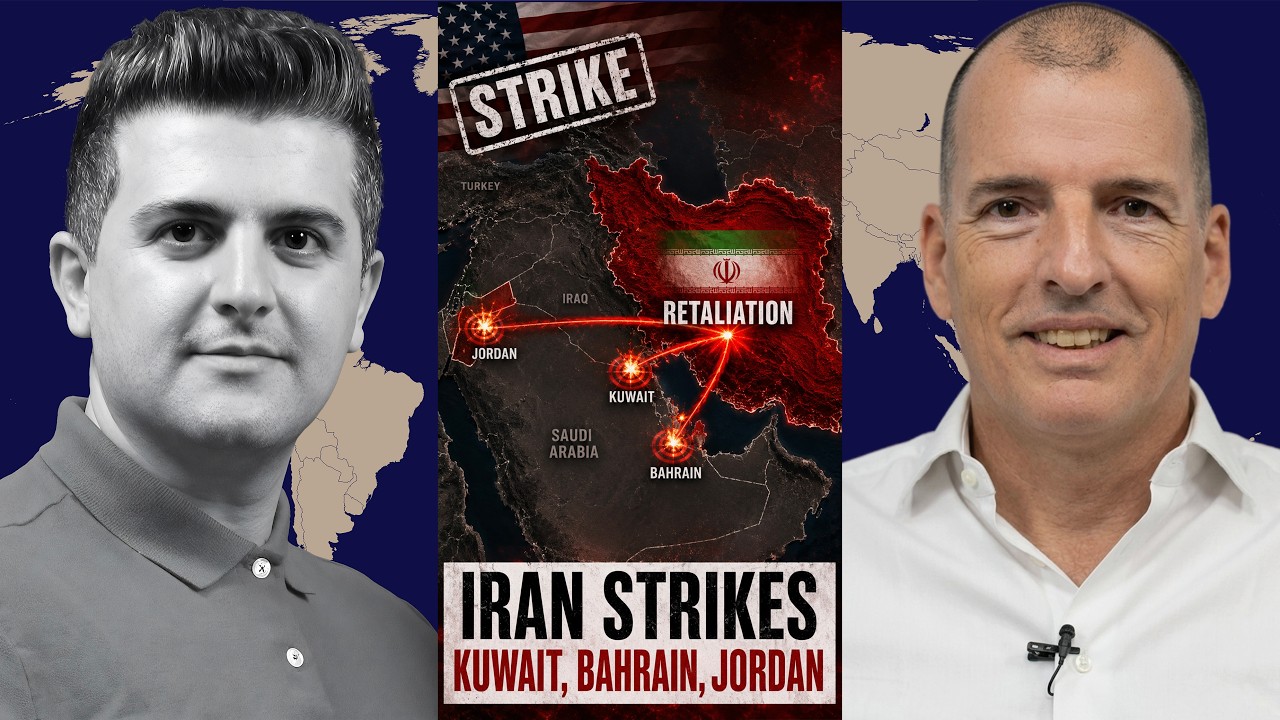
Alex Krainer: US STRIKES Iran – Iran RETALIATES Against Kuwait, Bahrain & Jordan!
"Amidst escalating US-Iran conflict and Iranian retaliation against regional US allies, this episode argues that US foreign policy is deeply controlled by an 'Anglo-Zionist conspiracy' led by the Rothschild banking dynasty, prioritizing Israeli interests over American ones."

Larry Johnson: Iran Missiles Rain Down on Northern Israel – Massive Strikes!
"Geopolitical analyst Larry Johnson details how Israel's recent strike on an 'empty building' in Beirut triggered direct Iranian missile retaliation, escalating regional tensions and jeopardizing a US-Iran peace deal brokered by Pakistan."