
🚨 IRAN RELEASED A F*CKING APOLOGY VIDEO 😂😂😂
YouTube · HIspob8j_cI
Quick Read
Summary
Takeaways
- ❖Iran released an 'apology video' and is 'surrendering' due to US and Israeli military pressure, despite immediately bombing a residential building in Dubai.
- ❖Donald Trump's tweet demanded 'unconditional surrender' from Iran and the selection of a US-approved leader, framing US intervention as 'negative reinforcement' for leadership selection.
- ❖US actions in Venezuela, including capturing Maduro, resulted in Chevron achieving record oil production and a new government cooperating fully with the US.
- ❖The 'America's Counter Cartel Coalition' was formed with 17 Latin American nations to use lethal military force against cartels, asserting US control over the Western Hemisphere.
- ❖The host dismisses critics of US military actions as 'leftists' or 'Eurocs' who are 'neutered' and driven by anti-Trump sentiment, not genuine humanitarian concerns.
- ❖The host advocates for a 'kill them first' philosophy in self-defense against perceived threats, including drug traffickers and terrorists, applying it to both foreign and domestic policy.
Insights
1Iran's 'Apology' and Perceived Surrender
The host claims Iran released an apology video and is 'surrendering' due to US and Israeli military pressure, specifically after bombings of their oil fields. He highlights a statement from Iran's president, Masud, promising no more attacks on neighboring states unless attacked first. This is framed as a humiliating capitulation for a 'death cult' that previously vowed 'death before surrender.' However, the host immediately notes that Iran subsequently blew up a residential building in Dubai with a drone, implying the apology was insincere or a tactic.
Host: 'They've made an apology video. I can't even exaggerate. Iran made an apology video.' () 'The president of the Islamic regime in Iran, Masud, released a message in which he said there won't be any more Iranian attacks on neighboring states unless there are attacks on Iran from those states.' () 'They blew up a tower in Dubai, a residential building in Dubai. Uh got hit by a Iranian drone right after that.' ()
2Trump's 'Unconditional Surrender' Demand and 'Make Iran Great Again'
The host presents a tweet from Donald Trump demanding 'unconditional surrender' from Iran and the selection of a 'great and acceptable leader.' Trump's tweet promises to make Iran 'economically bigger, better, and stronger than ever before' under this new leadership, coining 'Make Iran Great Again.' The host interprets this as the US selecting Iran's leader through 'negative reinforcement,' killing any leader deemed unacceptable until a compliant one is chosen, prioritizing US security over installing democracy.
Trump tweet: 'There will be no deal with Iran except unconditional surrender. Love that. After that and the selection of a great and acceptable leader, we and many of our wonderful and very brave allies and partners will work tirelessly to bring Iran back from the brink of destruction. ... Make Iran great again.' () Host: 'We are selecting uh by means of negative reinforcement exactly who is going to be in charge of Iran. We're not there to install democracy.' ()
3Venezuela's Capitulation and Oil Production Surge Under US Influence
The host details how US actions, including the capture of former Venezuelan leader Maduro, led to Venezuela's 'complete capitulation.' He cites Chevron's 'record levels of production' in Venezuela within two months of these actions, framing it as Trump's '5D chess' and a significant win for US oil interests. The new Venezuelan government, under Deli Rodriguez, is now formally recognized by the US and has entered a 'historic gold deal,' demonstrating full cooperation.
Host: 'We captured their LP presidente that was sending us narco terrorists, but we also got their oil and also now they're completely capitulated to us.' () Guest: 'Chevron, huge producer, uh, told us they are at record levels of production in Venezuela.' () Host: 'We have formally recognized the Venezuelan government. We've actually legally recognized them. We have also just reached a historic gold deal.' ()
4Formation of the 'America's Counter Cartel Coalition'
The episode highlights the launch of a new military coalition, the 'America's Counter Cartel Coalition,' involving 17 Latin American nations under US leadership. The coalition's core commitment is to use 'lethal military force' against cartels and terrorists in the Western Hemisphere. This initiative is presented as a reassertion of US dominance in its 'hemisphere,' extending the Monroe Doctrine, and a direct response to the perceived 'lawlessness' and 'cancer' of cartels.
Trump: 'We come together to announce a brand new military coalition... to eradicate the criminal cartels.' () Pete Hegseth: '18 countries. We're signitories to the the America's counter cartel coalition.' () Trump: 'The only way to defeat these enemies is by unleashing the power of our militaries.' ()
5Critique of 'Leftist' and 'Euroc' Responses to US Actions
The host consistently dismisses criticism of US military and foreign policy actions from 'leftists' and 'Eurocs' as disingenuous, driven by anti-Trump sentiment, or indicative of weakness. He argues that these groups use 'humanitarian reasons' and 'international law' as 'emotional blackmail' while ignoring the atrocities committed by adversaries. He contrasts this with the 'objectively good' act of 'killing terrorists' and securing US interests.
Host: 'The lefttoids and the third worlders are in shambles.' () 'I'm so tired of the the pussification of Western world.' () 'They're willing to arm terrorists with the ability to kill us because they hate Trump.' () 'England, Spain, France, Canada. Spineless cucks. All of you.' ()
Bottom Line
The US is actively re-aligning its global alliances, moving away from traditional European partners (dubbed 'Eurocs' who are 'killing themselves in real time' through mass immigration) towards Latin American countries and specific Middle Eastern states.
This signifies a strategic shift in US foreign policy, prioritizing 'America First' interests and partnering with nations willing to adopt an aggressive stance against perceived threats like cartels and radical regimes, even if it means alienating long-standing allies.
For US businesses, this could mean new opportunities in Latin American markets and a re-evaluation of supply chains and partnerships, potentially favoring 'friendly' nations in the Western Hemisphere. For other nations, it signals a need to understand the new criteria for US partnership: alignment with 'peace through strength' and 'law and order' principles.
The host explicitly connects domestic issues like border security and crime reduction to foreign policy, arguing that 'killing terrorists' abroad and 'jailing criminals' at home are directly linked and equally essential for national well-being.
This perspective blurs the lines between internal and external security, suggesting a holistic approach where aggressive enforcement, both militarily and judicially, is the solution to a wide range of societal problems. It implies that a strong, unyielding stance is necessary to protect 'Western Christian civilization.'
For political strategists, this highlights a potent populist message that resonates with voters concerned about both national security and domestic stability, offering a unified, 'tough-on-crime' platform. For security tech companies, there could be increased demand for surveillance and enforcement technologies applicable across borders and within communities.
Key Concepts
Peace Through Strength
The idea that military superiority and a willingness to use force are the most effective means to deter aggression, maintain peace, and achieve national objectives. The host applies this to both Iran and the anti-cartel efforts.
Might Makes Right
The belief that power, especially military power, is the ultimate determinant of what is just or acceptable. The host explicitly states, 'I'm not saying might makes right. I'm saying might makes. PERIOD. THE END. IT'S OURS. WE SAID SO. TAKE IT IF YOU CAN. YOU CAN'T. AND YOU WON'T even try.'
Monroe Doctrine / Donro Doctrine
The principle that the United States has a right to intervene in the Western Hemisphere to protect its interests and prevent foreign influence. The host refers to a 'Trump corollary of the Monroe Doctrine' or 'Donro doctrine' to justify aggressive action against cartels and hostile regimes in Latin America.
Lessons
- Analyze geopolitical events through a 'peace through strength' lens, considering how military and economic pressure can be used to achieve national objectives.
- Evaluate the potential for new alliances and partnerships, particularly in the Western Hemisphere, based on shared security priorities and a willingness to use decisive force.
- Recognize the rhetorical strategies used to dismiss opposing viewpoints in political discourse, such as labeling critics as 'weak' or 'politically motivated' rather than engaging with their arguments.
Notable Moments
Host claims Iran's oil was 'promised to the United States of America 3,000 years ago.'
This statement, delivered with extreme confidence, sets an immediate tone of historical entitlement and aggressive intent regarding US foreign policy in the Middle East.
The host describes Iranian officials disguising themselves in women's clothing to avoid drone detection.
This anecdote is used to humiliate the Iranian regime and reinforce the narrative of US military superiority and the enemy's desperation.
Trump's statement about building 10 new battleships, 100 times more powerful than old ones, 'not to use them, but by having them, nobody's going to mess with us.'
This illustrates the 'peace through strength' doctrine, emphasizing deterrence through overwhelming military capability, and highlights a focus on traditional naval power.
The host's interpretation of biblical texts to justify warfare: 'It says in the Bible, 'Thou shalt not murder.' It also says in the Bible, 'Win wars. Fight them. Kill them. Win wars.''
This reveals a specific moral framework used to rationalize aggressive military action, directly challenging common interpretations of religious teachings on peace.
Quotes
"My biggest crime in my recent videos is my uh patrioticness and pro-America stance where actually I think we should be killing terrorists before they succeed in killing us."
"There will be no deal with Iran except unconditional surrender. Love that. After that and the selection of a great and acceptable leader, we and many of our wonderful and very brave allies and partners will work tirelessly to bring Iran back from the brink of destruction. ... Make Iran great again."
"We're not there to install democracy. We're there to make sure that you guys aren't governed by a terrorist entity trying to kill us first and foremost. Also, we would very much like if your people were free. Uh but that is secondary quite literally."
"Iran has apologized and surrendered to its Middle East neighbors and promised that it will not shoot them anymore. The promise was only made because the relentless US and Israeli attack."
"I'm not saying might makes right. I'm saying might makes. PERIOD. THE END. IT'S OURS. WE SAID SO. TAKE IT IF YOU CAN. YOU CAN'T. AND YOU WON'T even try. All right. So, it's ours. That's how it works."
"A real man actually solves problems. Doesn't push them down the road. Doesn't give problems money and hope to appease them. A real man solves problems."
Q&A
Recent Questions
Related Episodes

Patrick Henningsen: Hezbollah JUST Fired Back at Israel - Iran Vows to “Crush” All Attacks
"Patrick Henningsen argues that the US and Israel initiated an illegal war against Iran, driven by Trump's incompetence and Israeli influence, leading to an inevitable escalation with severe global economic repercussions."

Will Venezuela Be Trump's Vietnam?
"An expert breaks down three perilous pathways for Venezuela under potential US intervention, from a 'Panamanian model' to a 'Libyan-style civil war,' and the broader geopolitical fallout for Latin America."

Alex Krainer: US STRIKES Iran – Iran RETALIATES Against Kuwait, Bahrain & Jordan!
"Amidst escalating US-Iran conflict and Iranian retaliation against regional US allies, this episode argues that US foreign policy is deeply controlled by an 'Anglo-Zionist conspiracy' led by the Rothschild banking dynasty, prioritizing Israeli interests over American ones."
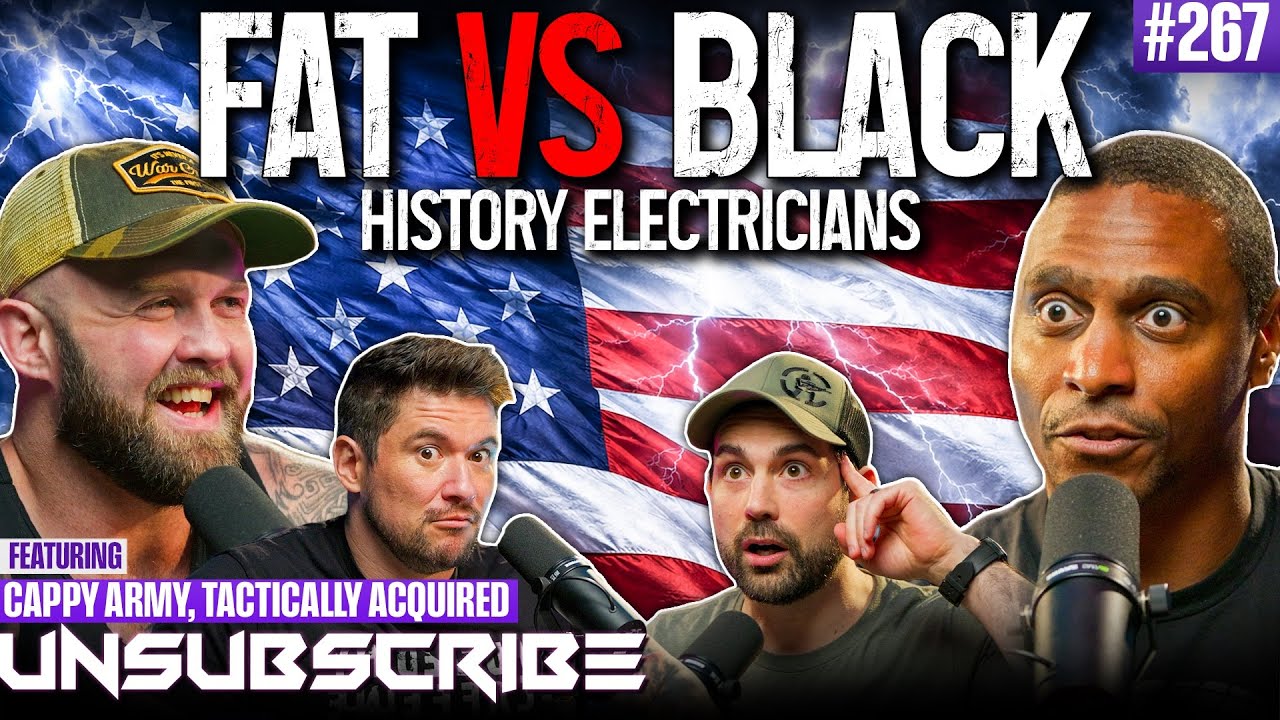
The Fat Electrician Vs Tactically Acquired | Unsubscribe Podcast 267
"This episode features military content creators discussing current geopolitical hotspots, advanced weaponry, and the surprising psychological warfare tactics of modern conflict, alongside their personal journeys building online communities."