
Fighter Jets FALL FROM SKY As Trump Says More US Deaths Coming
YouTube · LaseTqkzWxc
Quick Read
Summary
Takeaways
- ❖Three US fighter jets were shot down, allegedly by friendly fire from Kuwaiti allies, though Iran claims responsibility for one, representing a $300 million loss.
- ❖Four American service members have died, with President Trump indicating expectations for more casualties in the conflict.
- ❖The hosts characterize the situation as a 'humiliation on the world stage' due to military readiness issues and lack of allied coordination.
- ❖The conflict has led to significant regional instability, including missile strikes in Doha and Dubai, and the de facto closure of the Strait of Hormuz due to insurance refusal.
- ❖Iran is employing a 'mosaic strategy' using inexpensive, mass-produced drones to deplete US and Israeli interceptor stockpiles.
- ❖The hosts argue that the US, under Trump, fundamentally miscalculated Iran's willingness to capitulate, leading to a 'disaster' that exceeds the recklessness of the Iraq War.
Insights
1US Fighter Jets Downed Amidst Conflicting Reports
Three US fighter jets were shot out of the sky. CENTCOM attributes this to 'apparent friendly fire' from Kuwaiti allies, while Iran claims responsibility for at least one of the jets. This incident represents a $300 million loss in aircraft and highlights potential coordination failures or misidentification in a complex air environment.
Hosts refer to CENTCOM's statement on 'apparent friendly fire' and Iran's claim of responsibility. They mention six crew members ejected and are safe, and the cost of aircraft.
2Rising American Casualties and Presidential Acknowledgement
Four American service members have died in the conflict. President Trump, in both an interview with the New York Times and a public statement, acknowledged that his administration expects 'quite a bit higher' casualties based on projections, stating, 'there will likely be more before it ends.'
Hosts cite Trump's interview with the New York Times and a 'hastily edited statement' where he discussed expected casualties.
3Widespread Regional Instability and Economic Impact
The conflict has ignited a full-blown regional crisis. Dubai, a global elite playground, has seen hotels hit by missiles, challenging its brand proposition of stability. The Strait of Hormuz, through which 20-25% of the world's oil passes, is de facto closed because insurers refuse to cover cargo ships, causing 'extraordinary disruption' to global oil markets. Saudi Aramco assets and Qatar's LNG production have also been impacted.
Hosts describe missile strikes in Doha and Dubai, the closure of Dubai airport, attacks on Saudi Aramco, Qatar shutting down LNG production, and insurers refusing coverage for ships in the Strait of Hormuz.
4Iran's Asymmetric Warfare Strategy Against US Defenses
Iran is employing a 'mosaic strategy' by deploying numerous inexpensive drones (similar to those used by Houthis, costing $20-30k each) to exhaust the stockpiles of US and Israeli interceptors. This tactic aims to deplete advanced, costly defensive munitions, preserving Iran's 'bigger stuff' for later stages of the conflict, demonstrating a learned lesson from previous engagements.
Hosts explain Iran's 'mosaic strategy' and the use of mass-produced drones to exhaust interceptor stockpiles, noting the Houthis and Hezbollah have joined the fight.
5US Strategic Miscalculation and Lack of a Coherent Plan
The hosts assert that the US, particularly President Trump, made a fundamental miscalculation by believing initial salvos would lead to Iran's capitulation or regime collapse. They argue there was 'no plan,' no clear objective, and a failure to understand Iran's resolve and 'mosaic strategy,' leading to a 'reckless' and 'insane' conflict that exceeds the recklessness of the Iraq War.
Hosts state Trump was 'high on his own supply' from past operations, believed Iran would 'capitulate and negotiate,' and lacked understanding of Iran's 'mosaic strategy' and the IRGC's loyalty.
Bottom Line
The 'friendly fire' incident involving US fighter jets and Kuwaiti allies, alongside Iranian claims, reveals significant operational confusion and potential lack of coordination among allied forces in a high-stakes conflict zone.
This suggests a critical vulnerability in command and control, potentially leading to further costly errors, loss of life, and erosion of trust with regional partners, complicating future joint operations.
Develop and implement more robust, real-time, and interoperable identification and communication systems for coalition forces in complex airspaces to prevent fratricide and enhance operational clarity.
The de facto closure of the Strait of Hormuz due to insurers refusing coverage for cargo ships demonstrates that economic leverage (insurance risk) can be as effective as military force in disrupting global trade and energy markets.
This highlights a non-kinetic, yet highly impactful, vulnerability for global supply chains and energy security, proving that regional conflicts can have immediate, widespread economic repercussions without direct military engagement on shipping lanes.
Governments and international bodies could explore mechanisms for risk-sharing or alternative insurance schemes for critical shipping routes in conflict zones, or invest in diversifying energy transport infrastructure to reduce reliance on single choke points.
Key Concepts
Mosaic Strategy
Iran's military doctrine where IRGC commanders are empowered to make decentralized decisions, and the strategy involves overwhelming an adversary's advanced defenses (like interceptors) with inexpensive, mass-produced drones and missiles, preserving more potent weapons for later stages.
Notable Moments
Footage of US fighter jet wreckage and recovery efforts after being shot down.
Visually confirms the direct military losses and the immediate, tangible impact of the conflict on US assets.
Video showing ballistic missiles falling in Doha and Dubai, and an American soldier filming a suicide drone attack in Kuwait.
Illustrates the widespread geographical reach of the conflict and the direct threat to civilian and military populations across the region, including areas previously considered safe havens for global elites.
Footage of destruction in West Jerusalem, Beirut, and Tehran.
Emphasizes the scale of humanitarian impact and destruction across multiple nations, drawing parallels to 'Gaza level images' and highlighting the regional nature of the war.
Quotes
"This is a humiliation on the world stage. This is equivalent to what happened whenever those fighter jets were lost on the carriers in the middle of high seas and this is what we've been warning about here for weeks is about military readiness lack of coordination with allies."
"And sadly, there will likely be more before it ends. That's the way it is. Likely be more, but we'll do everything possible where that won't be the case. But America will avenge their deaths and deliver the most punishing blow to the terrorists who have waged war against basically civilization."
"The attack was so successful, it knocked out most of the candidates. It's not going to be anybody that what we are thinking of because they're all dead. Second or third place is dead."
"This is a manufactured playground for the rich that is now taking hits by Iran. The damage this will cause long term to you know their whole the sort of value proposition there you can't even wrap your head around."
"It's already an utter shameful, destructive, chaotic catastrophe. it. I was telling you before, Zar, it's hard for me to think of a more reckless action taken by any country, not just our country, but taken by any country in modern history. I mean, the in terms of level of recklessness, it exceeds Iraq."
Q&A
Recent Questions
Related Episodes

Andrei Martyanov: IT’S OVER: The U.S. Just LOST to Iran… Here’s Why
"Andrei Martyanov declares the US has lost the war against Iran, detailing a catastrophic decline in American military capability and a dramatic shift in Middle Eastern power dynamics, signaling the end of the petrodollar era."

BREAKING: Kharg Island HIT By U.S. Bombers; Iran Threatens Gulf Targets | TBN Israel
"The US launched heavy bomber strikes on Iran's critical Kharg Island, destroying military targets while intentionally sparing oil infrastructure, signaling a direct economic threat if Iran continues to disrupt the Strait of Hormuz."
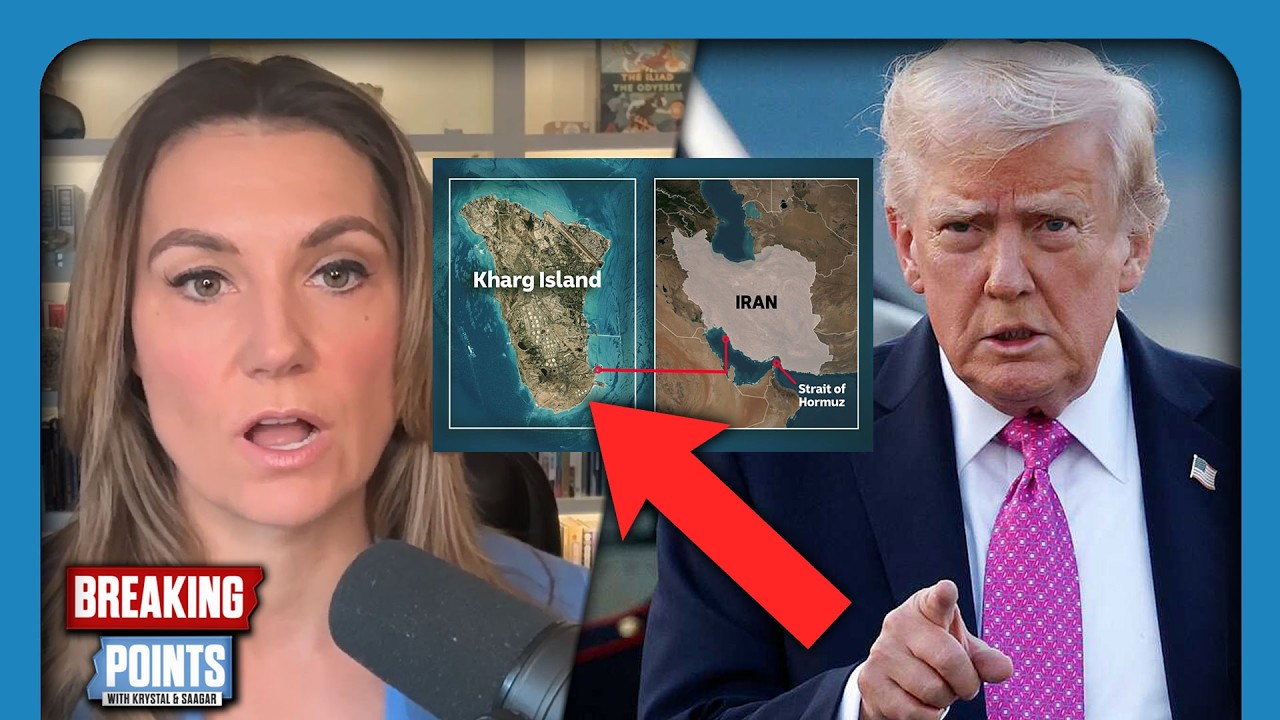
BREAKING: TRUMP ATTACKS OIL ISLAND, MARINES CALLED IN, 5 US PLANES HIT
"The US-Iran conflict escalates with a Trump-ordered strike on Iran's Karg Island, triggering Iranian retaliation against UAE oil facilities and US military assets, while the US deploys Marines and Israel plans a ground invasion of Lebanon."

Richard Wolff & Michael Hudson: Iran Humiliates Trump: The Defeat He Can’t Escape
"Richard Wolff and Michael Hudson argue that the US's military and economic strategy against Iran is failing, leading to a decline in American imperial power and a potential global realignment."