Israel STRIKES Iran Oil; Tehran Threatens New Missiles; Gulf States Join Fight | TBN Israel
YouTube · M_qp7dy4QIA
Quick Read
Summary
Takeaways
- ❖Israel and the US launched extensive air strikes on Iran's oil facilities and energy infrastructure, including over 30 oil tanks, to damage state revenues and military operations.
- ❖Black rain fell in Tehran after strikes on fuel storage facilities used by the Iranian military.
- ❖Iran threatens to use 'truly dangerous missiles' it claims to have saved and is targeting the drinking water of Gulf States.
- ❖American intelligence reported Iran's ability to extract 440 kg of 60% enriched uranium from a buried facility in Isfahan.
- ❖The United Arab Emirates attacked an Iranian desalination facility in response to ongoing Iranian attacks, marking direct Emirati involvement.
- ❖Bahrain announced its desalination facility was hit by an Iranian drone strike, raising fears about water security in the Gulf.
- ❖Saudi Arabia warned Iran it would allow US forces to use its territory and would join attacks if strikes on Gulf neighbors continue.
- ❖IDF struck commanders of the Iranian Quds Force in a Beirut hotel, eliminating four and wounding ten, targeting command and financial access.
- ❖The US and Israel are systematically dismantling Iran's missile production capabilities, from raw materials to assembly facilities.
- ❖The conflict is framed as a test of US/Israeli military technologies against Russian/Chinese systems, with a perceived clear superiority for the former.
- ❖Iran's regime exhibits internal disagreements and fragmentation, particularly regarding leadership succession, with the IDF warning against participating in the selection process.
Insights
1Shift to Economic Warfare and Infrastructure Targeting
Israel and the United States have expanded their military campaign against Iran to include direct strikes on its economic infrastructure, specifically targeting oil facilities and energy reserves. This strategy aims to cut off the financial lifeline of the IRGC and the Ayatollah regime, reduce their ability to sustain prolonged conflict, and exert psychological pressure on the capital. This marks a shift from solely targeting military launchers to dismantling the entire chain of capabilities, including production and logistics.
IDF struck more than 400 targets, including oil facilities (). An Israeli official stated about 30 oil tanks were struck (). The host explains this is 'a move designed to damage state revenues and deepen the psychological pressure' (). Mati Shosani elaborates on cutting the financial lifeline of the IRGC and Ayatollah regime (). Tehran experienced 'black rain' and 'temporary halt in fuel disruption' after strikes (, ).
2Gulf States' Direct Military Involvement and Water as a Weapon
The conflict has expanded beyond Israel and Iran, with Gulf states like the United Arab Emirates and Bahrain now directly involved. The UAE initiated strikes against an Iranian desalination facility, and Bahrain reported an Iranian drone attack on its own desalination plant. This introduces water security as a critical and weaponized element in regional warfare, forcing Gulf states to confront the threat directly or join a broader coalition.
The United Arab Emirates 'struck in Iran' for the first time, responding to Iranian threats (). An Emirati army attack on a desalination facility in Iran was reported (). Bahrain announced its desalination facility was attacked by Iran (, ). The host notes, 'water is a weapon' and 'desalination facilities are not just another facility. They are life itself' in the Gulf (, ).
3Iran's Strategic Threats and Nuclear Ambiguity
Iran continues to issue threats, claiming to possess and withhold 'truly dangerous missiles' for a later stage of the conflict. Concurrently, American intelligence reports indicate Iran's ability to access a significant stockpile of 60% enriched uranium buried in Isfahan, raising concerns about nuclear proliferation. This dual threat of advanced conventional weaponry and potential nuclear capabilities adds a layer of complexity and urgency to the conflict.
Iran claims it 'still has not used the truly dangerous missiles that it has' (, , ). American intelligence reports Iran has a 'narrow path through which it could reach the 440 kilograms of uranium enriched to 60%' (, ). The US is monitoring the site and considering a 'future ground move to seize the stockpile' (, ).
4Systematic Dismantling of Iran's Military Production and Leadership
The US and Israel are conducting a systematic campaign to dismantle Iran's military production industries, moving beyond destroying launchers to targeting factories, raw material facilities, and research/assembly sites for missiles and drones. This strategy aims to severely degrade Iran's ability to replenish its arsenal. Additionally, strikes have targeted senior Iranian Quds Force commanders in Beirut, disrupting command and financial networks supporting proxy operations.
The Air Force struck more than 400 targets, including 'ballistic missile launchers and weapons production sites' (). The IDF spokesperson described 'a systematic expansion of the efforts against Iran's military production industries' (). Specific facilities for explosives, raw materials, and advanced cruise missiles were struck in Parin and Shahoud (). The IDF struck 'commanders in the Iranian coups forces in a hotel in central Beirut' (, ).
5Global Power Dynamics and Military Technology Superiority
The conflict is framed as a proving ground for military technologies, with the hosts asserting a clear victory for US and Israeli defensive and offensive systems over Russian or Chinese manufactured counterparts. This perceived superiority in air, naval, and missile defense capabilities is presented as a potential deterrent for other world powers and a significant factor in the ongoing 'cold war' between the United States and China.
The host states, 'what we have been seen up until now is a clear victory to the United States military technologies compared to the Russian or the Chinese manufactured military defensive systems and offensive systems' (). Mati Shosani notes, 'Israel can outmanufacture interceptors at a much higher rate than the Iranians can manufacture ballistic missiles' ().
Bottom Line
The direct targeting of desalination facilities by Iran and the UAE fundamentally alters the nature of regional warfare, making water security a primary strategic vulnerability and a potential catalyst for broader conflict.
This shift means that future conflicts in the Middle East will likely involve attacks on vital civilian infrastructure, leading to rapid humanitarian crises and forcing nations to prioritize defensive measures for water and energy supplies over traditional military targets. It also compels neutral states to take decisive stances to protect their populations.
There is an emerging market for advanced, resilient, and distributed desalination technologies, as well as robust cyber and physical security solutions for critical water and energy infrastructure in conflict zones.
The perceived superiority of US and Israeli military technologies demonstrated in this conflict could serve as a significant deterrent to other global powers, potentially influencing their strategic calculations and preventing future large-scale conflicts.
This could lead to a re-evaluation of military doctrines and investments by nations globally, potentially solidifying the US-led military alliance's position. Conversely, it might accelerate efforts by rival powers to close technological gaps, leading to an arms race in specific areas.
Defense contractors specializing in advanced missile defense, aerial superiority, and precision strike capabilities, particularly those with US and Israeli ties, could see increased demand and investment from allied nations seeking to upgrade their defenses.
Iran's internal fragmentation, leadership vacuum, and dual messaging (apology vs. threats) indicate a regime struggling for cohesion and control amidst external pressure, potentially creating opportunities for internal change.
This internal instability suggests that sustained external pressure, combined with internal dissent, could lead to a collapse or significant transformation of the Iranian regime. However, it also carries the risk of unpredictable and desperate actions by various factions.
Strategic engagement with Iranian opposition groups or support for internal reform movements could be explored as a long-term strategy to foster a more stable and less aggressive government in Iran, potentially reducing regional tensions.
Lessons
- Monitor the evolving strategies of economic warfare, particularly the targeting of energy and water infrastructure, as this indicates a new dimension of conflict with significant humanitarian and geopolitical implications.
- Analyze the responses and direct involvement of Gulf states (UAE, Bahrain, Saudi Arabia) to understand the formation of new regional alliances and the potential for a broader coalition against Iran.
- Assess the implications of Iran's stated 'doomsday' missile capabilities and its enriched uranium stockpile on regional stability and global nuclear non-proliferation efforts, considering potential preemptive or covert operations.
Notable Moments
Black rain falling in Tehran after Israeli strikes on oil facilities.
This visually dramatic event serves as potent evidence of the direct impact of Israeli strikes on Iran's critical infrastructure, highlighting the environmental and psychological consequences of economic warfare on civilian populations.
The host, Ya Pinto, putting on a bulletproof vest and helmet during a live broadcast due to missile sirens, while his family takes shelter.
This moment vividly illustrates the immediate and personal reality of the conflict for Israelis, emphasizing the constant threat of missile attacks and the need for protective measures, bringing the 'boots on the ground' reporting to life.
The United Arab Emirates directly attacking an Iranian desalination facility.
This marks a significant escalation and a direct entry of a Gulf state into offensive operations against Iran, fundamentally changing the regional dynamics and demonstrating that critical civilian infrastructure like water supply has become a primary target in the conflict.
Quotes
"Iran continues to threaten nonstop, and claims that it still has not used the truly dangerous missiles that it has."
"We will not hesitate to strike anyone planning to participate in the conference to choose the successor."
"This war isn't just about the urgent this war isn't just about the uh the obvious military targets. This war is also about very much so the financial side of things."
"Israel can outmanufacture interceptors at a much higher rate than the Iranians can manufacture ballistic missiles."
"This is dismantling the production machine, not just damaging its edge."
"You have still not seen the truly dangerous missiles that we have."
"If someone begins turning them into targets, the meaning is a rapid humanitarian threat. Water, health, stability, and economy."
Q&A
Recent Questions
Related Episodes
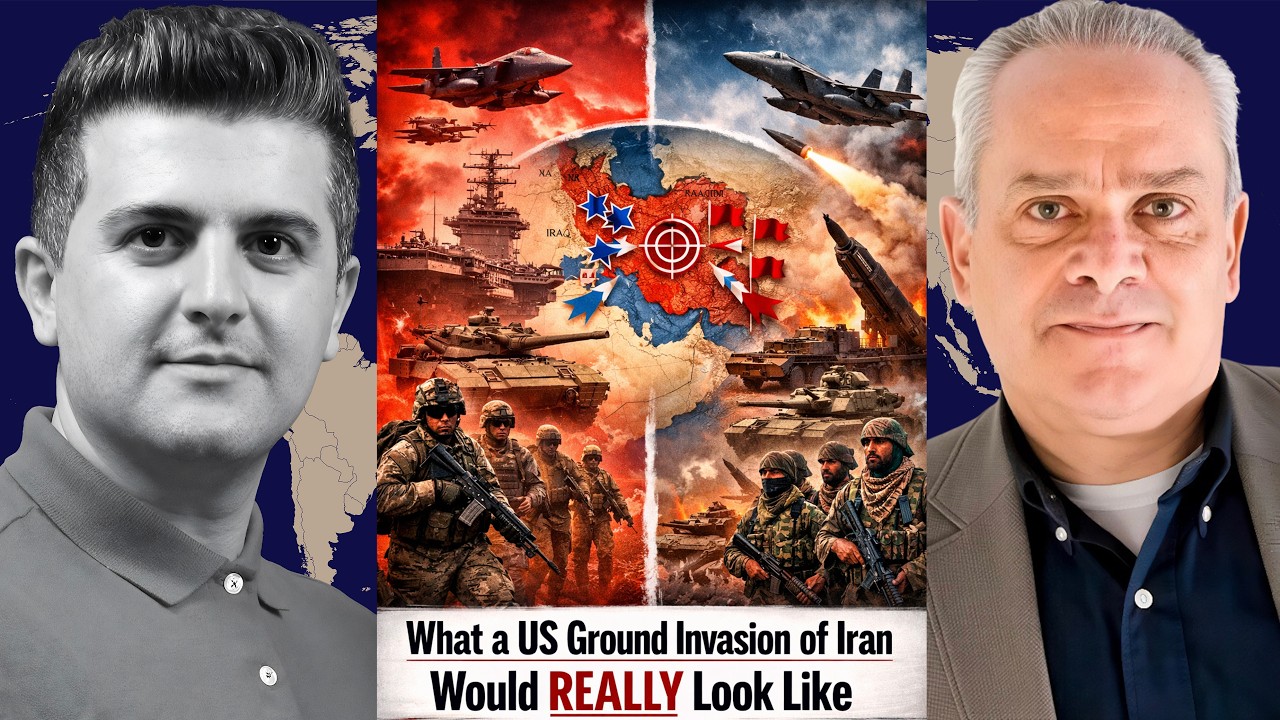
Col. Jacques Baud: What a US Ground Invasion of Iran Would REALLY Look Like
"Colonel Jacques Baud dissects the strategic futility of a US ground invasion of Iran, arguing that current troop levels are insufficient and such an action would backfire, exposing US allies and potentially leading to Iran's nuclearization."

Patrick Henningsen: Hezbollah JUST Fired Back at Israel - Iran Vows to “Crush” All Attacks
"Patrick Henningsen argues that the US and Israel initiated an illegal war against Iran, driven by Trump's incompetence and Israeli influence, leading to an inevitable escalation with severe global economic repercussions."

Will Venezuela Be Trump's Vietnam?
"An expert breaks down three perilous pathways for Venezuela under potential US intervention, from a 'Panamanian model' to a 'Libyan-style civil war,' and the broader geopolitical fallout for Latin America."

🚨 THEY F*CKED AROUND FOR THE LAST TIME 😭😭😭
"This episode unleashes a torrent of highly opinionated commentary on the US-Iran deal, Israel's role, and a scathing critique of 'leftist' policies and immigration, particularly highlighting the UK grooming gang report as evidence of Western societal decay."