
Next Step in West Bank Annexation | Jasper Nathaniel | TMR
YouTube · OJL6a3_DmY4
Quick Read
Summary
Takeaways
- ❖Donald Trump's administration opposed formal West Bank annexation to protect the Abraham Accords and his foreign policy legacy.
- ❖The current annexation strategy is designed to avoid formal declarations, making it harder for international bodies to respond.
- ❖Bezalel Smotrich, as 'governor of the West Bank,' is driving policies that systematically dismantle Palestinian autonomy.
- ❖New Israeli cabinet decisions allow the Civil Administration to enter Palestinian Areas A and B under pretexts like 'environmental hazards' or 'archaeological site desecration,' often after Israel itself has sabotaged Palestinian infrastructure.
- ❖A long-standing Jordanian law prohibiting land sales from Arabs to non-Arabs in the West Bank has been repealed, enabling direct Israeli purchases.
- ❖A new 'Judean Samaria Heritage Authority' acts as a cutout to oversee archaeology in the West Bank, circumventing international law and insulating the main Israeli Antiquities Authority from boycotts.
Insights
1Trump's Opposition to Formal Annexation Driven by Abraham Accords
Donald Trump, despite pressure from donors like Miriam Adelson, expressed opposition to formal annexation of the West Bank. This stance was primarily motivated by the threat of the United Arab Emirates (UAE) backing out of the Abraham Accords, which were a key foreign policy achievement for Trump. The UAE had previously threatened withdrawal, causing Netanyahu to back down from formal declarations.
Trump stated, 'I'm against it. We don't need to be dealing with the West Bank.' (). The UAE threatened to back out of the Abraham Accords if Israel annexed the West Bank, which would be 'a blow to Trump's legacy and his ego.' ()
2Violation of Oslo Accords via Civil Administration Expansion
Recent Israeli cabinet decisions directly violate the Oslo Accords by granting the Israeli Civil Administration the right to operate in Palestinian-controlled Areas A and B. This allows Israel to control zoning, order demolitions, and seize control from the Palestinian Authority under broad pretexts like 'environmental hazards' or 'desecration of archaeological sites.'
The Oslo Accords divided the West Bank into Areas A, B, and C, with the PA administering A and partially B. New cabinet decisions allow the Israeli Civil Administration to 'go into areas A and B to basically control things like zoning and to order demolitions' using pretexts like 'environmental hazards' or 'theft of water.' (, , )
3Smootrich's 'Decisive Plan' as Annexation Blueprint
Bezalel Smotrich's 2017 'Decisive Plan' serves as the blueprint for current Israeli policies in the West Bank. The plan outlines three options for Palestinians: subjugation (colonial subjects swearing allegiance), incentivized immigration (paid emigration), or brute force. Current policies, particularly new real estate laws, are designed to implement the 'immigration' option by making life miserable for Palestinians and then facilitating their departure.
Smotrich's 'Decisive Plan' () outlines three options for Palestinians: 'subjugation' (), 'immigration' () where 'we'll pay you to leave,' and 'brute force' (). The new real estate policies make it 'really easy for Israelis to go directly to Palestinians in the West Bank and buy their land from them.' ()
4Repeal of Jordanian Law Facilitates Direct Land Sales
A new cabinet decision explicitly repeals a long-standing Jordanian law (in effect since Ottoman times and upheld under occupation) that prohibited Arabs in the West Bank from selling land directly to non-Arabs. This change removes a significant barrier, allowing Israelis to directly purchase land from Palestinians, particularly in Areas A and B, without military oversight or the previous bureaucratic workarounds.
Since '67, it was illegal for Arabs in the West Bank to sell land to non-Arabs (). The new cabinet decision 'literally just repeals that. It just says that that is no longer the law.' (). This opens up the public registry allowing direct offers to buy land, and the military can no longer veto purchases. ()
5Creation of Parallel Antiquities Authority as a 'Cutout'
A new bill in the Knesset establishes a 'Judean Samaria Heritage Authority,' a parallel government body specifically to oversee archaeology in the West Bank. This 'cutout' strategy insulates the official Israeli Antiquities Authority and its archaeologists from international boycotts and accusations of complicity in illegal excavations within occupied territory, while still allowing the Israeli government to control and leverage archaeological sites for annexation.
A new bill 'creates a parallel antiquities authority. It's called the Judean Samaria Heritage Authority' (). This 'insulates the antiquities authority and the Israeli archaeologists from being complicit in what they're doing.' ().
Bottom Line
Israel creates environmental problems for Palestinians to justify seizing control of their territory.
This reveals a cynical strategy where the occupier deliberately sabotages civilian infrastructure (e.g., waste management) to generate 'environmental hazards,' which then serve as a legalistic pretext for the Israeli Civil Administration to intervene and take control of Palestinian areas, effectively expanding annexation under a humanitarian guise.
International monitoring bodies and human rights organizations could specifically investigate instances where Israeli actions directly lead to environmental degradation in Palestinian areas, which are then cited as justifications for further Israeli control. This could expose the 'self-fulfilling prophecy' mechanism and challenge its legitimacy in international forums.
The 'Decisive Plan' explicitly outlines a strategy of incentivized emigration for Palestinians, framing it as a 'humanitarian initiative.'
This highlights that the goal is not just control, but demographic change. By making life 'completely miserable' and then offering money for land, Israel aims to achieve ethnic cleansing under the guise of voluntary migration, presenting it as a 'better life' for Palestinians.
Advocacy groups should focus on documenting the economic and social pressures driving Palestinian emigration, connecting them directly to Israeli policies that 'strangle the financial system' and 'revoke work permits.' This can counter the narrative of 'voluntary' emigration and expose the coercive nature of these policies.
Key Concepts
Death by a Million Cuts
This describes a strategy where a large, impactful change is achieved through a series of numerous, small, incremental actions that individually might not attract significant attention or provoke a strong response, but cumulatively lead to the desired outcome. In this context, it refers to Israel's de facto annexation of the West Bank through a multitude of bureaucratic and legalistic changes rather than a single, formal declaration.
Self-Fulfilling Prophecy (Pretext Creation)
This model explains how a prediction or expectation, whether true or false, can become true simply because of the belief or actions taken in response to it. Here, Israel creates conditions (e.g., sabotaging waste management leading to pollution) that then serve as a 'justification' or 'pretext' for further intervention and control, thereby fulfilling its own desired outcome of seizing authority.
Cutout/Shadow Government
A 'cutout' or 'shadow government' refers to an entity or structure created to perform actions that a primary organization wishes to distance itself from, often for plausible deniability or to avoid legal/reputational repercussions. Smotrich's integration into the Defense Ministry and the creation of a parallel antiquities authority exemplify this, allowing controversial policies to be implemented without directly implicating the broader Israeli government or institutions.
Lessons
- Recognize that Israel's annexation of the West Bank is primarily a 'death by a million cuts' process, executed through bureaucratic and legalistic changes rather than overt declarations.
- Understand that pretexts like 'environmental hazards' or 'archaeological protection' are often manufactured justifications for expanding Israeli control into Palestinian areas A and B.
- Be aware that the repeal of laws prohibiting land sales to non-Arabs and the creation of 'cutout' government bodies are key mechanisms designed to facilitate land seizure while insulating the Israeli state from direct accountability.
Quotes
"The entire annexation project is meant to be done without ever having to formally declare annexation because for a guy like Trump, that means he doesn't have to think about it."
"They've left the Palestinians in these places with no choice but to burn the waste and then they use that as their justification to say, 'Look, you're creating air pollution now. We get to go in and take control.' So, it's all a self-fulfilling prophecy."
"What his solution amounts to is three different options that they're going to provide to what he calls the Arabs of Judea and Samaria. The first one is subjugation... Option two is immigration... And then the third option is just brute force."
"Most of these archaeologists and the antiquities authority never had a problem with the illegal archaeology with the occupied excavations until it could potentially affect them in the form of boycotts."
Q&A
Recent Questions
Related Episodes

Patrick Henningsen: Hezbollah JUST Fired Back at Israel - Iran Vows to “Crush” All Attacks
"Patrick Henningsen argues that the US and Israel initiated an illegal war against Iran, driven by Trump's incompetence and Israeli influence, leading to an inevitable escalation with severe global economic repercussions."
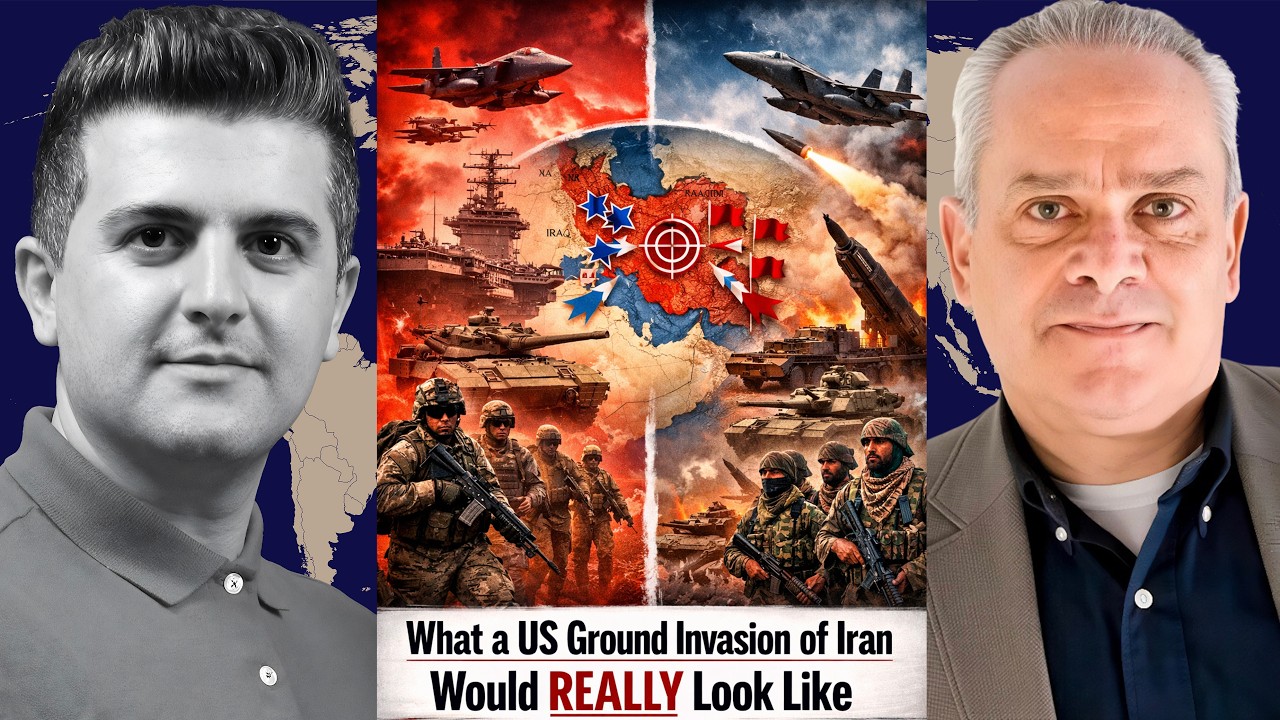
Col. Jacques Baud: What a US Ground Invasion of Iran Would REALLY Look Like
"Colonel Jacques Baud dissects the strategic futility of a US ground invasion of Iran, arguing that current troop levels are insufficient and such an action would backfire, exposing US allies and potentially leading to Iran's nuclearization."

Col. Jacques Baud: The World Is Entering a Lawless Era
"Colonel Jacques Baud details his personal experience with arbitrary EU sanctions and argues that the world has shifted from a law-based international order to a dangerous, rules-based system dictated by powerful actors, exemplified by US actions in Venezuela and the EU's 'teenager decision-making'."

BREAKING: Iran Threatens To END Talks; U.S. Vows Retaliation; Hezbollah Collapsing? | TBN Israel
"Iran is leveraging Hezbollah and the Strait of Hormuz to manipulate US negotiations, while Israel asserts its right to dismantle Hezbollah's eroding but still dangerous infrastructure in Lebanon, independent of international talks."