
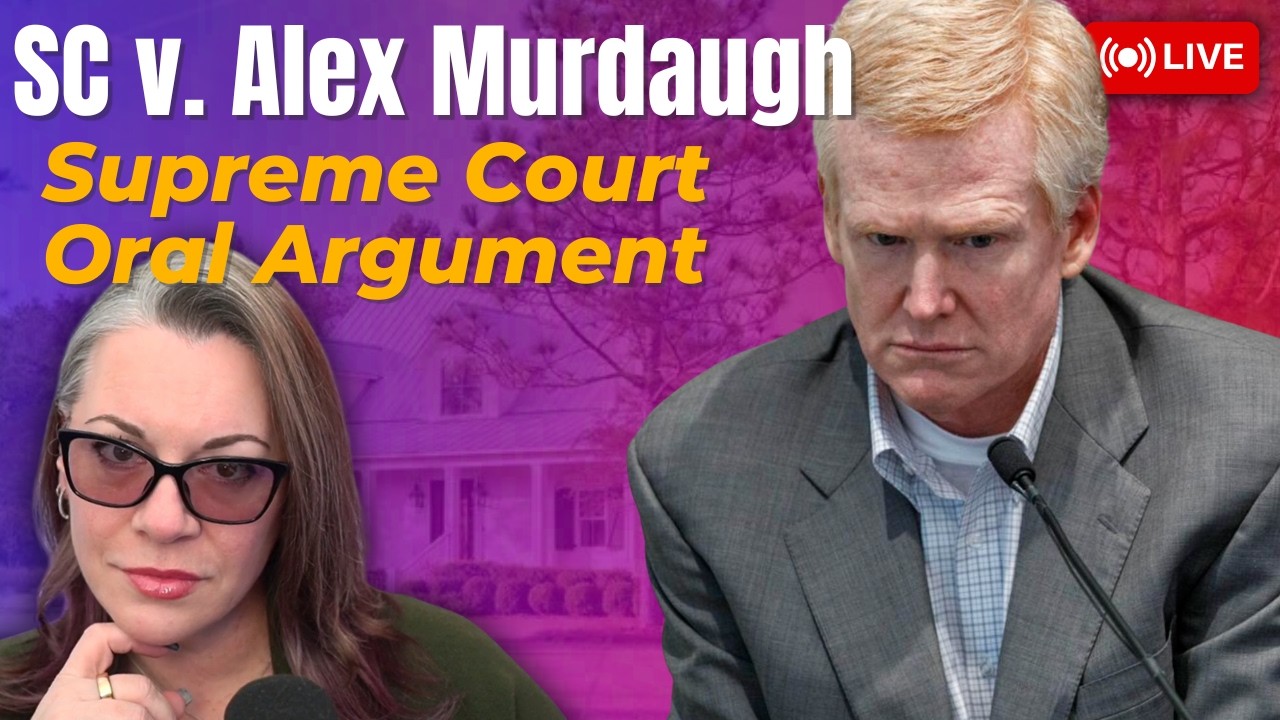
LIVE | SC v. Alex Murdaugh. New Trial. Here we go again.
YouTube · OJsFepBhw5E
Quick Read
Summary
Takeaways
- ❖The South Carolina Supreme Court overturned Alex Murdaugh's murder conviction, citing jury tampering by Colleton County Clerk of Court Rebecca Hill.
- ❖Rebecca Hill, known as 'Courthouse Becky,' made inappropriate comments to jurors, including advising them not to believe Murdaugh's defense and to 'watch his actions' during testimony.
- ❖Hill's motivations included profiting from a book about the trial, which she believed a guilty verdict would help sell, and seeking public attention.
- ❖The Supreme Court explicitly changed South Carolina's legal standard, now presuming prejudice when court officials interfere with a jury, shifting the burden of proof to the prosecution.
- ❖Murdaugh remains incarcerated for 28 years on state financial fraud cases and 40 years on federal financial fraud cases, so he is not released.
- ❖The retrial will involve a new judge and jury, with the same prosecution and defense teams, and a potential change of venue to Charleston.
- ❖Rebecca Hill was prosecuted for financial malfeasance and abuse of office, but not for jury tampering, despite the Supreme Court's findings.
- ❖Hill was found to have lied under oath to Justice Tol during the post-trial hearing and plagiarized portions of her book.
Insights
1Murdaugh's Murder Conviction Overturned Due to Clerk's Misconduct
The South Carolina Supreme Court reversed Alex Murdaugh's murder conviction, citing that Colleton County Clerk of Court Rebecca Hill 'placed her fingers on the scales of justice,' denying Murdaugh his right to a fair trial by an impartial jury. The court stated that despite the efforts of attorneys and the trial judge, Hill's improper external influences on the jury necessitated a new trial.
The South Carolina Supreme Court's opinion explicitly states: 'Colton County Clerk of Court Rebecca Hill placed her fingers on the scales of justice... thereby denying Murdoch his right to a fair trial by an impartial jury.'
2Rebecca Hill's Actions and Motivations for Jury Tampering
Rebecca Hill, the Clerk of Court, made several improper comments to jurors, including advising them 'not to be fooled by the evidence presented by Mr. Murdo's attorney,' to 'watch him closely' during testimony, and stating that deliberations 'shouldn't take us long.' Her motivations were rooted in personal gain, as she repeatedly told a colleague she wanted to write a book to 'buy a lakehouse' and believed a guilty verdict would boost sales. She also brokered media appearances for jurors and engaged in other unethical conduct.
Juror Z's affidavit detailed Hill's comments, and Rhonda Meline, Barnwell County Clerk of Court, testified that Hill 'repeatedly told her she wanted to write a book so she could buy a lakehouse and a guilty verdict would be the best way to sell books.'
3Shift in South Carolina's Legal Standard for Jury Influence
The South Carolina Supreme Court changed its legal standard, now presuming prejudice when a court official, such as the Clerk of Court, improperly influences a jury. This aligns the state's standard more closely with federal law, where the burden shifts to the prosecution to rebut the presumption of prejudice, rather than requiring the defense to prove it.
The Supreme Court stated: 'We agree with Murdo. Prejudice is presumed from Hill's comments. And while this presumption is rebuttable, the state failed to overcome this presumption.' The host notes this is a change in South Carolina's standard to align with federal law.
4Hill's Lack of Credibility and Perjury
Justice Tol, who presided over the post-trial motion, found Rebecca Hill to be an incredible witness, noting her desire for public attention and her willingness to lie under oath. Hill pled guilty to perjury for denying she allowed the press to view sealed exhibits, including graphic images of the victims.
Justice Tol 'determined that Hill's denial of making these statements was not credible,' and Hill 'subsequently plead guilty to perjury stemming from this denial.'
5South Carolina Adopts Federal Reamer Standard for Jury Influence
The South Carolina Supreme Court has explicitly changed its case law to adopt the federal Reamer standard, which applies when there is external influence on a jury from a state actor. This means that any private communication, contact, or tampering with a juror during a trial about the pending matter is presumptively prejudicial. The burden then shifts heavily to the prevailing party (the state) to prove there was no reasonable possibility the verdict was influenced.
The court clarifies today that when faced with a third party's improper contact with a juror, our courts should follow the Fourth Circuit's three-step analysis as set forth in Cheek. This case is now binding precedent and changes the standard South Carolina applies when there is external influence on the jury from a state actor.
6Clerk Becky Hill's Actions Deemed Egregious Jury Tampering
The Supreme Court found that former Clerk of Court Becky Hill's comments to jurors were 'more than innocuous interventions' and directly undermined the defense. Her statements, such as urging jurors 'not to be fooled by the evidence presented by Murdo's attorneys' and to 'watch Murdo's body language closely,' transformed her into a 'character witness on behalf of the state' and essentially implored jurors to find Murdaugh guilty. The court used strong language like 'breathtaking and disgraceful effort' and 'egregious, improper jury interference.'
We hold that Murdo established Hill made comments that the day Murdified was going to be epic or important and urged jurors not to be fooled, confused, thrown off, or convinced by Murdo and to watch Murdo's body language closely. Hill became a character witness on behalf of the state encouraging the jurors to question Murdo's credibility. Hill's egregious, improper jury interference went to the heart of the case and unquestionably was intended to push the jury to a guilty verdict.
7Financial Crimes Evidence Admissible but Must Be Limited in Retrial
The Supreme Court agreed that evidence of Murdaugh's extensive financial crimes was relevant to establish motive for the murders. However, they unanimously held that the first trial allowed the state to go 'far too long and far too deep' into these details, creating 'considerable danger of unfair prejudice.' This guidance instructs the trial court to restrict the extent of such evidence in the new trial to maintain a fair balance between probative value and potential for prejudice.
We unanimously hold that the trial court allowed the state to go far too long and far too deep into aspect aspects of Murdo's financial crimes that were not probitative of the state's theory of motive which gave rise to considerable danger of unfair prejudice and therefore should have been excluded.
8Inadmissibility of Juror Mental Process Testimony
The court clarified that while jurors can testify about improper external comments, they cannot testify about the comments' effects on their deliberative process or mental state in reaching a verdict. The post-trial court erred in questioning a juror about whether Hill's statements or other jurors' conversations were more persuasive, as this violated Rule 606b of the South Carolina rules of evidence.
We find that the plain language of rule 606b authorizers, excuse me, authorizes jurors to testify about improper extraneous comments by a third party but not on the comments effects of the juror's deliberative process. Thus, the portion of Jerz's affidavit in which she disclosed her mental process in reaching her verdict was inadmissible.
9Jury Tampering by Clerk Hill Led to Conviction Reversal
The South Carolina Supreme Court found that former Clerk of Court Rebecca Hill 'egregiously attacked Murdo's credibility and his defense,' triggering the 'reamer presumption' of prejudice. This external interference was deemed so severe that it undermined Murdaugh's right to a fair trial, necessitating the reversal of his murder conviction.
The court's conclusion stated Hill's 'shocking jury interference was accomplished outside the presence and knowledge of the outstanding trial judge and the superbly competent and professional council for the state and defense.'
10Financial Crimes Evidence Deemed Excessive But Not Reversal Basis
While the Supreme Court criticized the state for spending 12.5 hours on financial crimes testimony, calling it 'inflammatory details with little to no probative value' for the murder motive, this was considered 'dicta'—non-binding advice—rather than a direct cause for overturning the conviction. The court advised efficiency and relevance if this evidence is presented in a retrial.
The court stated, 'We do intend to require, however, that if the trial court decides to admit evidence of Murdo's financial crimes on retrial, the state must complete its introduction of that evidence efficiently without the lengthy presentation or inflammatory details with little to no probative value that was permitted in the first trial.'
11State Commits to Speedy Retrial Despite Costs and Existing Sentences
Attorney General Alan Wilson confirmed the state's intention to seek a 'speedy retrial' for Murdaugh, aiming for it before the end of 2026. This decision is driven by the commitment to justice for the victims, even though Murdaugh is already serving decades in prison for financial crimes and the retrial will incur significant taxpayer costs.
Wilson stated, 'It is currently my intention to seek a speedy retrial in the case against Alec Murdo.' He also addressed cost concerns by saying, 'When people are murdered... they have a right to have their case adjudicated in court... we're not going to let that be a factor in our decision to move forward.'
12Defense Confident in Acquittal, No Plea Deal, and Funding Challenges
Murdaugh's defense attorneys, Dick Harpootlian and Jim Griffin, expressed strong confidence that a new trial, stripped of the prejudicial financial crime evidence and jury tampering, would result in an acquittal. They firmly stated Murdaugh would 'never plead guilty' to the murders. However, they admitted they are not being paid for the second trial and will need to find avenues to fund expert witnesses, which cost $600,000 in the first trial.
Jim Griffin stated, 'He will never plead guilty. Killing his wife and son. I promise you.' When asked about payment, he said, 'We got paid to try the first case... there's no more money left... it's a lost leader right now. We're doing it. We're not getting paid, but we're going to see it through.'
Bottom Line
The Supreme Court's 'sassy footnotes' in its opinion, directly criticizing Rebecca Hill's conduct and even her plagiarized book, indicate an unusual level of judicial frustration and a deliberate effort to publicly shame the official responsible for the judicial system's compromise.
This unusual judicial tone suggests a strong desire by the highest court to send a clear message about the severity of Hill's actions and to deter similar misconduct, potentially influencing future court officials to adhere strictly to ethical guidelines.
Legal ethics training programs and court administration oversight could incorporate these footnotes as case studies to illustrate the consequences of breaching judicial integrity, emphasizing not just legal penalties but also public and professional condemnation.
The host suggests that 'neurospicy' individuals might be better suited for roles like Clerk of Court due to their tendency to 'follow the rules to an annoying degree,' providing a unique perspective on ideal traits for maintaining judicial integrity.
This unconventional idea challenges traditional hiring profiles for court administrative roles, suggesting that traits often perceived as social challenges (strict adherence to rules, discomfort with bending them) are actually critical assets in positions requiring unwavering impartiality and procedural rigor.
Court systems could explore diversifying their hiring practices to include individuals with neurodivergent traits, specifically valuing their meticulousness and rule-following tendencies for roles that are critical to maintaining the integrity and impartiality of the judicial process.
Key Concepts
Presumption of Innocence
The fundamental legal principle that every defendant is considered innocent until proven guilty beyond a reasonable doubt, which Rebecca Hill's actions directly undermined by influencing jurors' perceptions before and during the trial.
Judicial Restraint vs. Judicial Activism
Justice Tol, as a 'restrained and mindful jurist,' adhered to the existing legal standard, even if she anticipated the Supreme Court would change it. The Supreme Court, however, took the opportunity to change the case law, demonstrating a form of judicial activism to correct a perceived outdated standard.
Siren Song of Celebrity
A metaphor used by Justice Tol (and adapted by the host) to describe Rebecca Hill's overwhelming desire for public attention and personal gain, which led her to compromise her ethical duties and the integrity of the court.
Lessons
- Court administrators should review and reinforce strict guidelines for interactions between court staff and jurors, emphasizing that communication should be limited to logistical and security matters only.
- Elected court officials must be held to the highest ethical standards, with clear accountability mechanisms and severe consequences for any actions that compromise the impartiality of trials or seek personal gain from official duties.
- Legal education and training for court personnel should include explicit instruction on maintaining neutrality, avoiding public commentary on ongoing cases, and the severe repercussions of attempting to influence jury decisions.
- Legal professionals in South Carolina must now adhere to the federal Reamer standard for evaluating external jury influence, requiring a heightened awareness of potential tampering.
- Prosecutors facing similar challenges must be prepared to meet the 'heavy burden' of proving no reasonable possibility of prejudice from improper jury contact, as the presumption of prejudice is now automatically triggered.
- Trial courts should carefully balance the admission of 'other bad acts' evidence, like financial crimes, ensuring it is strictly limited to probative value for motive and does not lead to 'unfair prejudice' by delving too deeply into extraneous details.
- Legal teams should meticulously document and challenge any perceived external jury contact or interference, as such actions can lead to a presumption of prejudice and trial reversal.
- Prosecutors should carefully balance the presentation of 'other bad acts' evidence (like financial crimes) with its direct probative value to the core charges, avoiding excessive or inflammatory details that could be deemed prejudicial 'dicta' by appellate courts.
- Defense attorneys in high-profile cases should anticipate and prepare for financial challenges in prolonged legal battles, including securing funding for expert witnesses and considering the implications of pro bono work for retrials.
Notable Moments
The South Carolina Supreme Court's opinion directly calling out Rebecca Hill for 'placing her fingers on the scales of justice' and including 'sassy footnotes' detailing her misconduct, including plagiarism.
This highly critical and unusually direct language from the Supreme Court underscores the severity of Hill's actions and the court's strong condemnation, making it a landmark case for judicial ethics and accountability.
The host's strong emotional reaction and explicit criticism of Rebecca Hill's 'clout chasing pickme' behavior and 'depraved, and disgusting' actions regarding sealed victim exhibits.
This highlights the profound impact of Hill's actions on the public perception of justice and the deep frustration felt by legal analysts over such a blatant breach of trust and professional conduct.
The host expresses strong indignation at Clerk Becky Hill's actions, emphasizing the abhorrent nature of those within the system manipulating justice.
This highlights the severe ethical breach and the host's personal outrage, underscoring the gravity of Hill's conduct beyond just legal technicalities.
The South Carolina Supreme Court uses unusually strong language, including 'meddling,' 'self-aggrandizing conduct,' 'siren call of celebrity,' 'breathtaking and disgraceful effort,' and 'nefarious' to describe Hill's actions.
The court's choice of words emphasizes the extreme disapproval and condemnation of Hill's conduct, signaling the unprecedented nature and severity of her interference in the judicial process.
The Supreme Court references the popular band Sum 41's song 'In Too Deep' to describe the excessive amount of financial crimes evidence admitted in the first trial.
This unexpected cultural reference makes the legal point more memorable and accessible, highlighting the court's unanimous agreement that the trial went too far in presenting prejudicial evidence.
Quotes
"Colton County Clerk of Court Rebecca Hill placed her fingers on the scales of justice."
"Our justice system provides indeed demands that every person is entitled to a fair trial which includes an impartial jury untainted by external forces bent on influencing the jury towards a biased verdict."
"Although we are aware of the time, money, and effort extended for this lengthy trial, we have no choice but to reverse the denial of Murdo's motion for new trial due to Hill's improper external influences on the jury and remand for a new trial."
"As her book title suggests, it turned out Hill was quite busy behind the doors of justice, thwarting the integrity of the justice system she was sworn to protect and uphold. The book was pulled from publication because Hill plagiarized portions of it."
"Hill allowed her desire for public attention of the moment to overcome her duty to her oath of office and her oath as a witness."
"We agree with Murdo. Prejudice is presumed from Hill's comments. And while this presumption is rebuttable, the state failed to overcome this presumption."
"This case is now binding president and that's how it changes it doesn't need to change the legislation because this is not based on legislation this is now based on this is based on case law."
"When those within the system put their hands on the scales of justice, it is I don't know how to explain the level of abhorrent it is."
"Hill's lack of credibility during the hearing on Murdo's motion for new trial is further evidenced by her recent guilty plea to perjury stemming from that very hearing for her denial of allowing members of the press to view sealed exhibits."
"Hill became a character witness on behalf of the state encouraging the jurors to question Murdo's credibility."
"The breathtaking and disgraceful effort of Hill to undermine the jury process is unprecedented in South Carolina."
"When a Supreme Court or Court of Appeal feels the need to offer guidance, it's because they are deeply concerned."
"This particular testimony had zero probitative value as to Murdo's motive for the murders. and obviously high potential for unfair prejudice as it portrays Murdo as a man who prays on vulnerable victims."
"Hill's shocking jury interference was accomplished outside the presence and knowledge of the outstanding trial judge and superbly competent and professional counsel for the state and defense. We are accordingly constrained to reverse the posttrial court's denial of Murdo's motion and remand for a new trial consistent with this opinion."
"As to the financial crimes, it's dicta. It is not binding. They say that it's not binding. It is caution. Danger. Danger. It is it is a uh it is a unsolicited advice. Dicta. This is unsolicited advice. This is Hey y'all. Don't do that again."
"It is currently my intention to seek a speedy retrial in the case against Alec Murdo."
"When people are murdered, okay, when victims are murdered, they have a right to have their case adjudicated in court. Even though they're not currently here, their family members who they left behind have a right for those who who want to seek justice, see justice meet it out. They have a right to that. So, we're not going to let that be a factor in our decision to move forward."
"He's he's glad to get that moniker off of him as a convicted murderer of his wife and son."
"We're not getting paid, but we're going to see it through. And and we're looking for avenues to perhaps get some money for expert witnesses."
"No plea. We're not going to under any circumstance. Under any circumstances, he will never plead guilty. Killing his wife and son. I promise you. Why not? Cuz he didn't."
Q&A
Recent Questions
Related Episodes
SC v. Alex Murdaugh Supreme Court Oral Arguments - Will Murdaugh get a New Trial?
"The South Carolina Supreme Court heard oral arguments on Alex Murdaugh's appeal for a new murder trial, with alleged misconduct by Clerk of Court Becky Hill and the extensive financial crime evidence emerging as critical points that could lead to a reversal."

4-Year-Old Killed After Finding ‘Draco-Style’ Gun Under a Pillow
"This episode reconstructs the police investigation into the tragic shooting death of a 4-year-old girl, revealing how detectives used forensic evidence and conflicting testimonies to uncover the truth behind a concealed 'Draco-style' firearm."

I Was Wrongly Convicted To Life In Prison
"A young man recounts his harrowing journey through the Rhode Island justice system, from a self-defense incident that turned into a first-degree murder charge to an eight-year incarceration and eventual plea deal, highlighting systemic biases and the profound impact of legal representation."

Teen Revenge Plot Ends in Mom’s Murder
"A group of teenagers seeking revenge for a robbery mistakenly open fire on an innocent family's car, killing a young mother and leading to their eventual arrests and convictions."