
Decoding Israel’s Superpower Ambitions | Daniel Levy | TMR
YouTube · PWyjl6BKJuA
Quick Read
Summary
Takeaways
- ❖Netanyahu's 'Greater Israel' project is a geopolitical strategy for hard power domination, not just territorial expansion.
- ❖The core of this project is to dismantle Iran as a regional power balancer, requiring US military involvement.
- ❖Netanyahu views the current geopolitical fluidity as a unique opportunity to achieve this dominance before new rules or restraints are imposed.
- ❖Israel's strategy includes weakening surrounding states to create vulnerabilities and co-opt them into its project.
- ❖The Gulf states, feeling betrayed by US actions prioritizing Israel, are now hedging against US unreliability, including threatening to trade oil in Chinese currency.
- ❖Israel aims to position itself as the indispensable security provider and economic hub (e.g., alternative pipelines) for a destabilized region.
- ❖Netanyahu believes Israel's influence in the US (lobby, evangelicals, media ownership) can overcome declining public image and maintain US backing.
- ❖Israel's maximalist military approach is internally critiqued as 'not working,' but the Zionist opposition lacks a viable political alternative.
- ❖Turkey is identified by Israeli leaders like Naftali Bennett as the 'next big target' for Israeli containment efforts, leading to shadow contests in various arenas.
Insights
1Netanyahu's Geopolitical Domination Project
Netanyahu's vision of 'Greater Israel' is not merely about territorial acquisition but a broader geopolitical project to establish hard power hegemony over an expanded Middle Eastern region. This involves ensuring Palestinian rights are denied, dismantling Iran as a power balancer, and weakening surrounding states to create dependencies that Israel can exploit.
Daniel Levy states, 'Netanyahu is pursuing a geopolitical project attempting... hard power domination, the creation of a zone of Israeli hard power hegemony... in a much more expanded region.' He adds, 'Part of that is therefore bringing down Iran as any kind of power balancer.'
2Exploiting Geopolitical Fluidity and US Decline
Netanyahu seized the current moment of global geopolitical fluidity as a unique opportunity to advance his agenda. He recognized that US power might be waning and its image tanking, making it a 'use it or lose it' situation to leverage US military might against Iran, even if it further damaged US standing.
Levy explains, 'Netanyahu almost uniquely saw this as a moment of great opportunity... before a new set of rules comes into place... before some kind of restraint is imposed on him.' He detected that 'American power itself is not what it once was and this was the time therefore to go for it.'
3Gulf States Hedging Against US Unreliability
The war has exposed the US's prioritization of Israel over its Gulf allies' existential interests, leading these states to reassess their dependencies. They are now actively hedging their options, including threatening to shift away from the petrodollar by demanding US dollar currency swaps or trading oil in Chinese currency.
Levy notes, 'The Gulf sees that when it comes to their existential interest, they had virtually no hearing in the White House and the White House did Israel's bidding.' He cites the UAE's threat to trade oil in Chinese currency as putting 'in play the thing that you are most vulnerable on which is precisely... the centrality of the dollar as the global reserve currency.'
4Israel's Post-US Hegemony Strategy
Netanyahu's plan anticipates a potential decline in US influence, aiming to fill the resulting power vacuum. Israel seeks to position itself as the primary security guarantor and economic hub in the region, offering alternative trade routes and forming new alliances, despite its own internal fragilities.
Levy states, 'If I smash this up, if we've created a collapsed state and chaos... the spillover effect is felt in the Gulf. Then as they look around and say, 'Well, what do we base our security on now?' They go, 'We may not like it, but there is the most powerful military in the region is over there. It's Israel.'' He mentions Netanyahu's 'hexagon of alliances' and proposals for pipelines through Israeli ports.
Bottom Line
Israel's strategy explicitly considers the weakening of the US as an 'acceptable outcome' if it leads to the smashing of Iran, demonstrating a transactional view of its most critical alliance.
This suggests a profound shift in Israel's long-term strategic calculations, moving beyond traditional US patronage to a more self-reliant, albeit aggressive, regional posture that could accelerate US disengagement.
For other global powers, this creates an opportunity to fill the void left by a potentially receding US, particularly in economic and diplomatic spheres, as seen with China's role in Saudi-Iran rapprochement.
Netanyahu's 'Greater Israel' project relies on the inability of Gulf states to unify and collectively deter Israel, betting on their internal competitions and divisions.
This highlights a critical vulnerability in the region: a lack of cohesive, collective security architecture among Arab states, which Israel actively exploits to maintain its dominance.
The formation of new groupings like Saudi-Turkey-Pakistan-Egypt suggests a nascent attempt to counter this, indicating a potential future for a more balanced regional power dynamic if these alliances can overcome historical rivalries.
Key Concepts
Monroe Doctrine Analogy
Israel's pursuit of regional hegemony is compared to the US's historical Monroe Doctrine, aiming for exclusive influence and control over its surrounding region.
Lessons
- Monitor shifts in energy trade currency (petrodollar vs. petroyuan) as a key indicator of declining US financial dominance and Gulf states' hedging strategies.
- Observe the development and cohesion of emerging regional alliances (e.g., Saudi-Turkey-Pakistan-Egypt) as potential counterbalances to Israeli hegemony.
- Analyze Israeli domestic political discourse for signs of a viable non-military-first alternative, as the current 'consensus around madness' is unsustainable.
Quotes
"When I think about greater Israel, it's not just about this total victory zero sum project with the Palestinians. And I also don't think it ends with you. Is Israel going to acquire some more territory in Lebanon, in Syria? I don't think that's realistically on the cards right now. And therefore the piece of it that I want to draw to people's attention is that Netanyahu is pursuing a geopolitical project attempting... hard power domination."
"Netanyahu almost uniquely saw this as a moment of great opportunity. He saw this as a moment where before a new set of rules comes into place, before some kind of restraint is imposed on him."
"The Gulf sees that when it comes to their existential interest, they had virtually no hearing in the White House and the White House did Israel's bidding and to hell with the consequences for the Gulf."
"If I smash this up, if we've created a collapsed state and chaos, not regime change... the spillover effect is felt in the Gulf. Then as they look around and say, 'Well, what do we base our security on now?' They go, 'We may not like it, but there is the most powerful military in the region is over there. It's Israel.'"
"This is a ticket to a very bad place for Israel. I think that is the outcome. Interestingly, you're increasingly hearing that kind of a critique elements of it at least inside Israel itself. It's like, oh, who would have thunk it? After 2 and a half years, Hamas is still there because you can't defeat the resistance movement militarily if the cause of the resistance is still in place."
Q&A
Recent Questions
Related Episodes

Iran Update: Israel’s Newest Bombing Campaign, the Oncoming War With China and How to Avoid It
"Colonel Wilerson reveals how the US and Israel are actively bombing China's strategic infrastructure in Iran, escalating a covert economic war that Beijing intends to win without direct military conflict by dismantling the dollar's global dominance."

Patrick Henningsen: Hezbollah JUST Fired Back at Israel - Iran Vows to “Crush” All Attacks
"Patrick Henningsen argues that the US and Israel initiated an illegal war against Iran, driven by Trump's incompetence and Israeli influence, leading to an inevitable escalation with severe global economic repercussions."

Bibi DEMANDS Ground Troops As Marines Rushed to Iran
"Benjamin Netanyahu is pushing for US ground troops in Iran, framing air strikes as insufficient, while the US rushes Marines to the region and struggles to secure the Strait of Hormuz against surprisingly capable Iranian defenses."
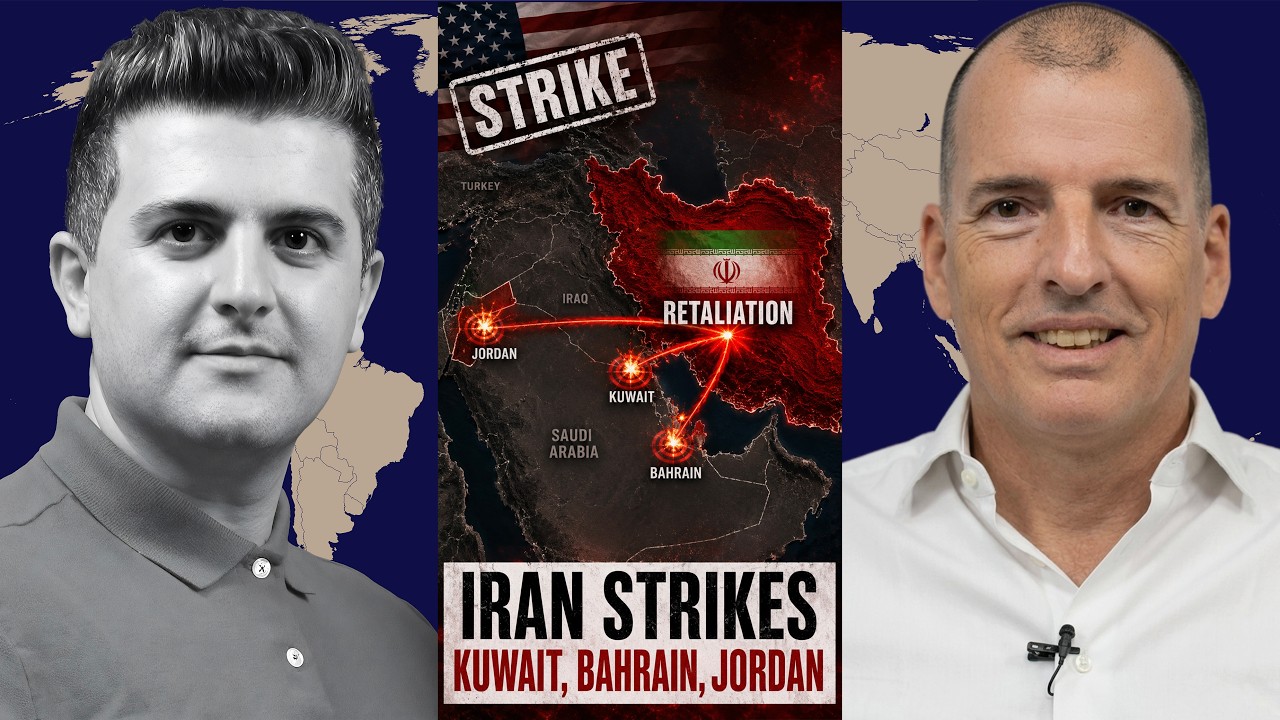
Alex Krainer: US STRIKES Iran – Iran RETALIATES Against Kuwait, Bahrain & Jordan!
"Amidst escalating US-Iran conflict and Iranian retaliation against regional US allies, this episode argues that US foreign policy is deeply controlled by an 'Anglo-Zionist conspiracy' led by the Rothschild banking dynasty, prioritizing Israeli interests over American ones."