
"There Were NO Talks!" Trump Calls Off Iran Deadline on Strait of Hormuz
YouTube · PsM3OFaVXYE
Quick Read
Summary
Takeaways
- ❖Donald Trump's decision to postpone military strikes on Iran's energy facilities for 5 days was reportedly influenced by stock market fluctuations and a desire to declare a diplomatic victory.
- ❖Iran's state news agency denied any contact with Trump regarding talks, asserting the US backed down due to Iranian threats and claiming Trump's statements were market manipulation.
- ❖Some analysts suggest the US intelligence (Mossad) miscalculated Iran's response, leading to an unexpected economic counter-strategy by Iran through the Strait of Hormuz.
- ❖Hogan Gidley, a former Trump aide, argued that the US achieved key objectives: preventing Iran from acquiring nuclear weapons, neutralizing ballistic missile capabilities, and cutting off terrorist funding.
- ❖Critics, like Brian McInness, contend the war primarily serves a 'greater Israel project' to weaken the West and elevate Israel's regional dominance, a view vehemently opposed by Goldie Gamari.
- ❖The closure of the Strait of Hormuz by Iran has created a 'seismic shock' to the global economy, threatening significant spikes in oil, food, and commodity prices, with Iran strategically allowing its own tankers through.
- ❖Professor Muhammad Mirandi from Tehran University asserted that all 'red lines' were crossed by the US and that Iran would not cease actions until assured of no future attacks, refusing to condemn Hamas's actions as terrorism.
Bottom Line
The 'invisible force of the stock market' wields equally outsized sway on presidential decision-making as geopolitical influence, with Trump famously waiting for markets to close before announcing war and postponing strikes based on market reactions.
This suggests that economic stability and market sentiment can be a primary, if unstated, driver of military and diplomatic strategy, potentially overriding traditional national security concerns in the short term.
Analysts and investors can gain an 'edge' by closely monitoring market movements and presidential statements in tandem, anticipating policy shifts that might appear contradictory from a purely geopolitical lens but make sense economically.
Iran has demonstrated a 'canny' strategy by allowing its own tankers to pass through the Strait of Hormuz while effectively closing it to most other traffic, causing global economic turmoil but maintaining its own revenue streams.
This highlights Iran's sophisticated understanding of economic warfare and its ability to leverage critical chokepoints to its advantage, complicating efforts to isolate or pressure the regime through conventional means.
Businesses reliant on global shipping and energy markets should develop robust contingency plans for prolonged disruptions in critical maritime routes, recognizing that adversaries may employ asymmetric economic tactics beyond direct military confrontation.
The argument that the US military action against Iran is primarily driven by Israeli influence to weaken the West for a 'greater Israel project' is a significant, albeit controversial, contrarian viewpoint.
This perspective challenges the official narratives of national security and self-defense, suggesting a deeper, more complex geopolitical agenda at play that could lead to different policy recommendations and public skepticism.
Understanding this alternative framing allows for a more critical evaluation of foreign policy decisions, encouraging scrutiny of alliances and potential hidden motivations beyond stated objectives, which can inform more nuanced risk assessments in international affairs.
Lessons
- Monitor global oil and commodity markets closely, as the Strait of Hormuz situation could lead to prolonged spikes in prices, impacting supply chains and consumer costs.
- Analyze official statements from world leaders, particularly regarding 'talks' or 'ceasefires,' with skepticism, considering potential underlying motivations like market manipulation or political posturing.
- Recognize the deep ideological and geopolitical divides in the Middle East, understanding that 'terrorism' and 'liberation' are often subjective terms depending on the perspective of the involved parties.
Notable Moments
The host, Piers Morgan, directly challenges Professor Muhammad Mirandi to condemn Hamas's October 7th attacks, which Mirandi refuses to do, equating them to the French resistance against Nazis.
This exchange starkly illustrates the irreconcilable moral and historical narratives at play in the Middle East conflict, highlighting the difficulty of finding common ground even on acts widely condemned as terrorism.
Goldie Gamari delivers a passionate rebuke to Brian McInness's claims of Israeli influence, recounting atrocities committed by the Iranian regime against its own people and accusing McInness of spreading 'Islamic regime propaganda.'
This heated debate underscores the profound human rights concerns within Iran and the emotional intensity of discussions about external intervention, revealing the deep personal stakes involved for those with ties to the region.
Quotes
"My guess is he's working on himself to find a way to pull out of this thing and claim some type of victory, which of course he will do."
"It's for the greater Israel project. And a key aspect of that project is to weaken the West so Israel can be the dominant power in the Middle East."
"The only side crowing about victory will be Iran. Whether the markets like it or not, it's hard to see how President Trump will settle for that."
"Some people think this military operation is going to make Iran more radical and more angry. That's insanity. They already want to kill everyone that isn't of their belief."
"There's so much craziness that I just heard. I don't even know where to begin. Do not interrupt when I'm speaking. I let you speak. Do not interrupt me when I'm speaking."
"No, there's no moral equivalence between an evil empire and its victims. There never was moral equivalence. Iran does not have terrorist organizations in the region."
Q&A
Recent Questions
Related Episodes

Patrick Henningsen: Hezbollah JUST Fired Back at Israel - Iran Vows to “Crush” All Attacks
"Patrick Henningsen argues that the US and Israel initiated an illegal war against Iran, driven by Trump's incompetence and Israeli influence, leading to an inevitable escalation with severe global economic repercussions."

BREAKING: Iran Threatens To END Talks; U.S. Vows Retaliation; Hezbollah Collapsing? | TBN Israel
"Iran is leveraging Hezbollah and the Strait of Hormuz to manipulate US negotiations, while Israel asserts its right to dismantle Hezbollah's eroding but still dangerous infrastructure in Lebanon, independent of international talks."
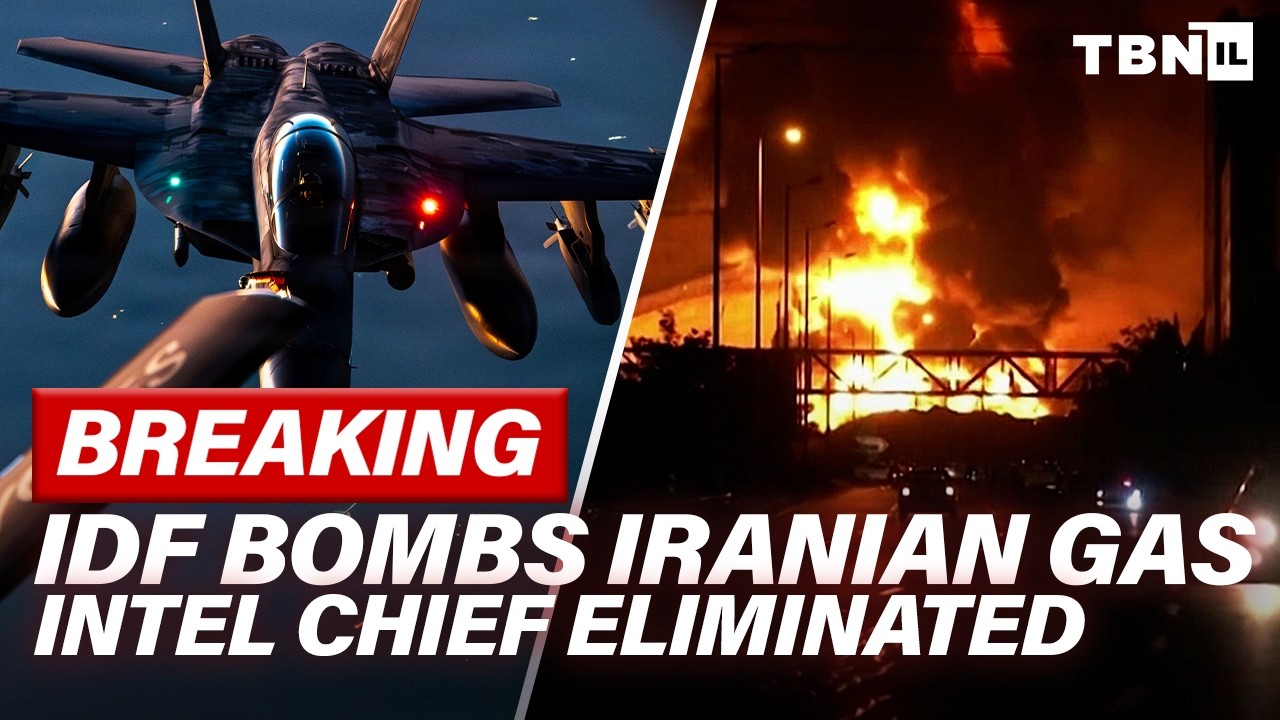
BREAKING: Israel BOMBS Major Iran Gas Site; Top Mullah ELIMINATED; Iran Vows VENGEACE | TBN Israel
"Israel and the United States have escalated their 'Roaring Lion War' against Iran, striking its largest gas facilities, eliminating key intelligence and military figures, and disrupting missile production, while Iran threatens a broader energy war in the Gulf."

Pentagon Prepares For EXTENDED War With Iran
"This episode dissects the geopolitical maneuvers surrounding potential US-Iran conflict, revealing strategic leaks, Netanyahu's diplomatic sabotage playbook, and the true intent behind economic sanctions."