
IRAN CIVIL WAR: CIA To ARM Rebel Kurds
YouTube · ZDd8UUL4nK8
Quick Read
Summary
Takeaways
- ❖The Trump administration publicly signaled its intention to arm Iranian Kurdish proxies to ignite an uprising, a move seen as a psychological operation.
- ❖The strategy targets Iran's ethnically heterogeneous population, specifically focusing on Kurdish and Baloch groups for destabilization.
- ❖The US objective appears to be 'regime destruction' and dissolution, turning Iran into a failed state akin to Iraq in the 1990s, rather than engineering a new government.
- ❖Iranian territorial integrity is a unifying factor across political divisions, suggesting external intervention could backfire by strengthening nationalistic support for the current government.
- ❖Implementing this strategy would require significant, ongoing US military involvement, including special forces and air cover, leading to greater ground engagement.
- ❖The 'Shah restoration' plan (Reza Pahlavi) conflicts directly with the strategy of sparking separatist armed uprisings, as Pahlavi advocates for a unified Iran.
- ❖Potential consequences include a massive refugee crisis (Iran has 90 million people), the breakdown of state authority, and the risk of nuclear material proliferation.
- ❖Iran's current retaliatory strategy involves a sustained campaign of short-range, one-way attack drones against US and Gulf targets, aiming for a long war of attrition rather than large, short-term missile salvos.
Insights
1US Strategy: Sparking Uprisings for Regime Destruction
The Trump administration publicly signaled plans to arm Kurdish proxies to initiate an uprising in Iran. This is not a clandestine operation but a deliberate public telegraphing, possibly a psychological operation. The goal is to exploit Iran's ethnic heterogeneity (Kurds, Baloch) to destabilize the country, aiming for 'regime destruction' rather than traditional 'regime change' or state-building, turning Iran into a failed state similar to Iraq in the 1990s.
US intelligence officials signaling plans to spark an uprising in Iran (), the host and guest discussing the 'psyop' aspect (), and the guest stating, 'they're going to be deliberately trying to start a civil war' () and 'they're trying to do regime destruction, regime dissolution' ().
2Kurdish Involvement and Internal Iranian Dynamics
The US has reportedly made intelligence contacts with PJAK (Iranian branch of PKK) and transferred weapons. While Kurds are a stateless population seeking autonomy, the guest argues the US motive is not to help Kurds but to destabilize Iran. Iranians, despite political divisions, are highly patriotic regarding territorial integrity, meaning external attempts to break up the country could unify them around the flag or even the current government.
Reports of US intelligence contacts with PJAK and weapons transfers (), guest stating US actions 'would not be to really help the Kurds' (), and 'one thing that really reunites them though is the territorial integrity of Iran. They're very patriotic across political divisions' ().
3Conflict with Shah Restoration Plan
The strategy of sparking armed uprisings directly contradicts the 'Shah restoration' plan championed by Reza Pahlavi. Pahlavi advocates for a unified Iran and does not tolerate separatist movements, reflecting his father's historical actions. Trump's dismissal of Pahlavi suggests a lack of US commitment to this specific 'regime change' figure.
Kurdish mother's quote against Pahlavi (), guest explaining Pahlavi speaks to the Persian segment and imposes 'Persian ethnic chauvinism' (), and the host noting the Shah restoration plan 'runs kind of in direct conflict and contradiction to this like we're going to spark armed uprisings' ().
4Catastrophic Potential Consequences
The 'regime destruction' strategy risks turning Iran into an apocalypse. Potential outcomes include a massive refugee crisis (Iran has 90 million people), severe destabilization for neighboring countries and Europe, and a breakdown of state authority that could lead to factions fighting over or developing nuclear material outside international oversight.
Guest discussing turning Iran into 'something like Iraq in the 1990s' (), the potential for a 'major refugee crisis' with 90 million people (), and the risk of 'different factions fighting over nuclear material, people trying to develop nuclear weapons outside of the cohesive state structure' ().
5Iran's Response: War of Attrition with Drones
Iran's current response relies heavily on short-range, one-way attack drones (Shahed drones) targeting US positions and Gulf states. This strategy aims for a long war of attrition to preserve capacities and deplete US and Israeli interceptor stockpiles over time, rather than a large, short-term ballistic missile salvo. Iran has successfully hit US equipment and radars, demonstrating a non-trivial response.
Guest explaining Iran is 'relying more on these short-range shorter-range one-way attack drones' (), the strategy to 'fight a long war of attrition' (), and reports of Iran destroying 'billions of dollars of US equipment at these bases' ().
Bottom Line
The US strategy of publicly telegraphing plans to arm proxies for an uprising in Iran is a deliberate psychological operation, not a failure of clandestine security.
This suggests the primary goal isn't covert action but rather to sow fear, uncertainty, and internal division within Iran, potentially provoking a preemptive Iranian response or internal collapse.
Analysts should scrutinize public US statements on Iran not just for policy intent, but for their psychological warfare component and intended impact on Iranian domestic stability.
The US is prioritizing 'regime destruction' over 'regime change' in Iran, aiming to create a failed state rather than install a new, pro-Western government.
This represents a significant and dangerous shift from previous interventions, implying no post-conflict reconstruction or political engineering, leading to an uncontrolled power vacuum.
Policymakers and international organizations must prepare for the unprecedented humanitarian and security challenges of a 90-million-person failed state, including refugee flows and the potential for nuclear material proliferation, rather than assuming a conventional regime change outcome.
Key Concepts
Regime Destruction vs. Regime Change
This distinction highlights a shift in US foreign policy, where the goal is not to replace a government with a preferred one (regime change) but to dismantle the state entirely, creating a power vacuum and a failed state. This avoids the complexities of state-building but creates profound instability.
Mowing the Lawn Strategy
A military doctrine, often attributed to Israel's approach to Gaza, where periodic, intense bombing campaigns are conducted to degrade enemy capabilities and prevent reconstruction, ensuring a constant state of misery and instability without a full occupation or resolution.
Security Dilemma (Inversion)
Normally, a state's efforts to increase its security can inadvertently decrease the security of others, leading to an arms race or conflict. In this context, the US is deliberately creating a security dilemma by arming proxies to provoke internal conflict, aiming to drain the resources of the Iranian military and break its territorial integrity.
Lessons
- Recognize that US foreign policy towards Iran may have shifted from regime change to deliberate state destruction, implying a different set of risks and outcomes.
- Understand that public signals about arming proxies might be part of a psychological operation designed to destabilize, rather than a leak of covert plans.
- Consider the unifying effect of external threats on nationalistic sentiments within Iran, which could inadvertently strengthen the current government's support base.
Notable Moments
A Kurdish mother's direct message to Reza Pahlavi, warning him against returning to Kurdistan and referencing his father's execution of Qazi Muhammad.
This quote highlights the deep-seated historical grievances and ethnic divisions within Iran, particularly among Kurds, against the Pahlavi dynasty's 'Persian ethnic chauvinism,' demonstrating the complexity and potential backlash against any 'Shah restoration' plan.
Quotes
"The CIA is also capable of sparking uprisings without telling CNN that they're about to spark an uprising."
"If they were to do this, it would not be to really help the Kurds per se. It would be kind of an inversion of the Iraq war situation where the US basically accidentally started a civil war by creating a security dilemma. In this case they're going to be deliberately trying to start a civil war."
"One thing that really reunites them though is the territorial integrity of Iran. They're very patriotic across political divisions."
"Let me make this clear. When your dictator father executed Qazi Muhammad, there was only one Qazi Muhammad, but now millions of Qazi exist in Kurdistan. We promise we will not allow you to enter any part of Kurdistan in Iran."
"I don't think that's what they're trying to do here. I think they're trying to do regime regime destruction, regime dissolution. They would like to turn Iran into something like Iraq in the 1990s."
"You could have a breakdown of state authority. You could have different factions fighting over nuclear material, people trying to develop nuclear weapons outside of the cohesive state structure such that no one could see that."
"If you continue bombing them, you'll generate patriotic sentiments that they can challenge."
Q&A
Recent Questions
Related Episodes
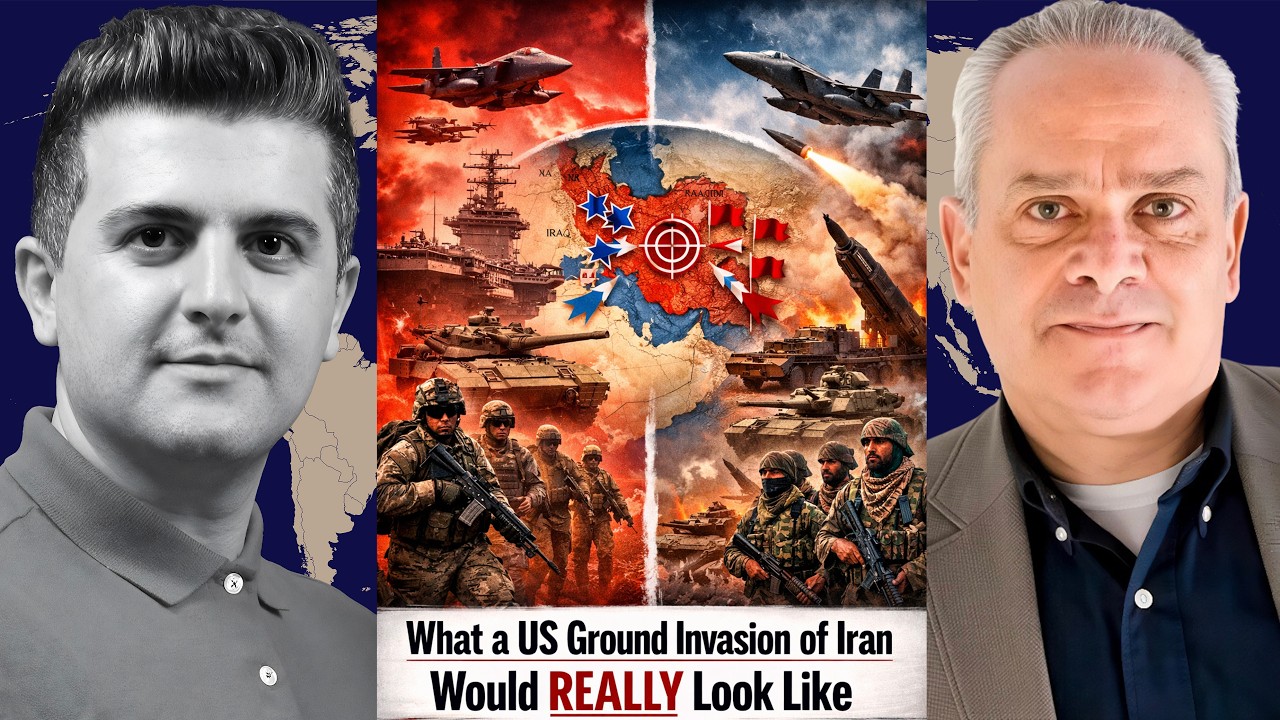
Col. Jacques Baud: What a US Ground Invasion of Iran Would REALLY Look Like
"Colonel Jacques Baud dissects the strategic futility of a US ground invasion of Iran, arguing that current troop levels are insufficient and such an action would backfire, exposing US allies and potentially leading to Iran's nuclearization."

Will Venezuela Be Trump's Vietnam?
"An expert breaks down three perilous pathways for Venezuela under potential US intervention, from a 'Panamanian model' to a 'Libyan-style civil war,' and the broader geopolitical fallout for Latin America."

Patrick Henningsen: Hezbollah JUST Fired Back at Israel - Iran Vows to “Crush” All Attacks
"Patrick Henningsen argues that the US and Israel initiated an illegal war against Iran, driven by Trump's incompetence and Israeli influence, leading to an inevitable escalation with severe global economic repercussions."

Alex Krainer: US STRIKES Iran – Iran RETALIATES Against Kuwait, Bahrain & Jordan!
"Amidst escalating US-Iran conflict and Iranian retaliation against regional US allies, this episode argues that US foreign policy is deeply controlled by an 'Anglo-Zionist conspiracy' led by the Rothschild banking dynasty, prioritizing Israeli interests over American ones."