
Prof. Theodore Postol: Iran War Is HERE — U.S. & Israel ATTACK & Iran’s Devastating Counterattack
YouTube · iH6nN0EUGvM
Quick Read
Summary
Takeaways
- ❖US and Israeli air defenses (Patriot, THAAD, Iron Dome) are largely ineffective against ballistic missiles, making Israel highly vulnerable to sustained Iranian strikes.
- ❖The US military-industrial complex's 'crony capitalism' severely limits munitions production, preventing surge capacity needed for prolonged conflict.
- ❖Iran's ability to close the Strait of Hormuz using thousands of mines and shallow-water submarines will cause catastrophic global economic disruption, particularly in Asia, and drive severe inflation in the US.
Insights
1Asymmetric Warfare: Iran's Strategy of Accumulation
While the US and Israel can deliver an initial, devastating air blitz, Iran's strategy is to prolong the war and inflict accumulating damage. Iran possesses a significant ability to deliver hundreds of ballistic missile warheads to Israel, which, despite lower individual payload, will take a tremendous and persistent toll on Israel's small, urbanized country, eventually disrupting its society and economy.
Initial US/Israel blitz will cause 'tremendous damage' (), but Iran's 'hundreds of ballistic missile warheads' () will be 'persistent and accumulating' () on Israel's 'few urban areas' ().
2US Defense Industrial Base Limitations
The US military's ability to sustain prolonged conflict is severely hampered by its 'crony capitalism' model. Defense contractors prioritize profit, leading to manufacturing facilities sized only for existing contracts, not for surge production. This results in critical shortages of munitions like Patriot and THAAD interceptors, which cannot be rapidly scaled up.
US produces only 50 Patriot interceptors ($4M each) and 8 THAAD interceptors ($12-13M each) per month. Iran is estimated to produce 250-300 medium-range ballistic missiles per month. A 'seven-year program' to triple Patriot production to 150/month is deemed insufficient and likely to fall short.
3Ineffectiveness of Ballistic Missile Defenses
Current US and Israeli ballistic missile defense systems (Patriot, THAAD, Iron Dome) are largely ineffective against incoming ballistic missiles. Technical analysis of time-lapse photographs reveals that most interceptors either detonate without hitting a target or are on non-viable trajectories, leading to near-zero successful intercepts.
Analysis of time-lapse photos (slides 10-15) shows 'small bright spheres of light' () that are interceptor warhead explosions, not successful intercepts. Many contrails show missiles traveling laterally or detonating in the air with 'no evidence of any intercept at all. None. Zero.' ().
4Strait of Hormuz Closure: Catastrophic Economic Impact
Iran can effectively close the Strait of Hormuz by deploying 5,000-6,000 mines using its fleet of over 20 shallow-water, diesel-electric submarines. The US Navy has no viable option to clear these mines without sustaining heavy losses. This closure will halt 90% of Japan's crude oil, 70% of South Korea's, and 40% of China's, causing global oil prices to skyrocket and leading to severe inflation, particularly in the US.
Iran has 5,000-6,000 mines () and over 20 shallow-water submarines (). 90% of Japan's crude oil and 40% of China's pass through Hormuz (, ).
5China's Strategic Support to Iran
China is actively supporting Iran in the conflict by providing satellite data, enabling Iran to better target Israeli assets and assess damage. This intelligence sharing is a 'major capability' that allows Iran to concentrate its forces effectively as the war progresses, further shifting the 'weight of the war' in Iran's favor.
China has provided 'satellite data to the Iranians' () to identify aircraft concentrations and assess damage, allowing them 'to concentrate their forces as the war goes on' ().
Bottom Line
The US military's reliance on privatized defense industries, driven by profit motives, fundamentally undermines its ability to respond effectively to large-scale, sustained conflicts due to a lack of surge production capacity and potential loyalty conflicts among engineers.
This structural flaw means that despite massive spending, the US military may be ill-prepared for long wars against adversaries with different industrial models, leading to prolonged conflicts and strategic disadvantages.
Governments could explore hybrid models for defense production, combining private sector innovation with public sector control over critical surge capacity and quality assurance, or incentivize private companies to maintain excess capacity for national security needs.
Key Concepts
Crony Capitalism in Defense
The US military industrial complex prioritizes profit over national defense flexibility. Companies size manufacturing facilities to maximize profit from existing contracts, not to provide surge capacity for wartime needs, leading to critical munitions shortages and inflexibility during conflict.
Weight of the War
In prolonged conflicts, the cumulative effect of sustained, even if individually less powerful, attacks can outweigh initial overwhelming force. This model suggests that persistent damage and economic pressure can eventually break a society's will or capability to continue fighting, shifting the advantage over time.
Lessons
- Re-evaluate the true effectiveness of ballistic missile defense systems based on empirical evidence, rather than manufacturer claims, to avoid overreliance and misallocation of resources.
- Assess the vulnerability of global energy supply chains to chokepoint disruptions, particularly the Strait of Hormuz, and develop contingency plans for catastrophic oil price spikes.
- Scrutinize the structure and incentives of the defense industrial base to ensure it aligns with national security needs for surge production and rapid adaptation in wartime, rather than solely profit maximization.
Notable Moments
Postol's passionate condemnation of the US military-industrial complex, labeling its profit-driven nature as 'crony capitalism' and a detriment to national defense.
This highlights a fundamental structural critique of how the US arms itself, suggesting that economic incentives are misaligned with strategic military readiness and contribute to munitions shortages in wartime.
Postol's direct accusation of US President Donald Trump and Israeli Prime Minister Netanyahu as 'criminals' for choosing to initiate a war that 'could have been avoided'.
This reveals a strong moral and political stance, framing the conflict not as an unavoidable geopolitical necessity but as a deliberate act with severe human consequences, challenging the legitimacy of the leadership involved.
Postol's warning to Kurdish and other Iranian groups against rising up with US support, predicting they would be 'slaughtered' and abandoned by the Americans.
This reflects a deep cynicism about US foreign policy and its historical treatment of allies, suggesting a pattern of manipulation and abandonment that could lead to tragic outcomes for local populations.
Quotes
"Any war is just absolutely unpredictable... but if I had to make a very broad guess... the Israelis and the Americans are going going to do tremendous damage to Iran and it's going to be quite large and quite extensive and they will have a difficult time sustaining it though and Iran will be of course striking back."
"We Americans have a system of military support that depends on what I would call crony capitalism... They are profit-making organizations and simply concerned about that. You do not build your manufacturing facilities beyond what your contracts will support."
"The air defenses against ballistic missiles essentially are not functioning in Israel. So the allow the amount of damage that can be done by ballistic missiles is much lower than what can be done by aircraft... but the weight over time will take its toll."
"Nobody's going to ensure that. So if you forget about these pie in the sky ideas that people like I would have because I'm I'm not responsible for anything. But if I'm the captain of one of those tankers or the owner of one of those tankers, I ain't going through the straight of Hammoose."
"All of those trajectories are non-starting trajectories. They're all lateral or even going down. They have no chance of intercepting anything that's ballistic. Zero. That's no successful intercept too."
"It was all a choice, a choice made by criminals. And I and and the criminals are Netanyahu and my president Donald Trump who chose to enter a war that could have been avoided."
Q&A
Recent Questions
Related Episodes

Alex Krainer: US STRIKES Iran – Iran RETALIATES Against Kuwait, Bahrain & Jordan!
"Amidst escalating US-Iran conflict and Iranian retaliation against regional US allies, this episode argues that US foreign policy is deeply controlled by an 'Anglo-Zionist conspiracy' led by the Rothschild banking dynasty, prioritizing Israeli interests over American ones."

Patrick Henningsen: Hezbollah JUST Fired Back at Israel - Iran Vows to “Crush” All Attacks
"Patrick Henningsen argues that the US and Israel initiated an illegal war against Iran, driven by Trump's incompetence and Israeli influence, leading to an inevitable escalation with severe global economic repercussions."
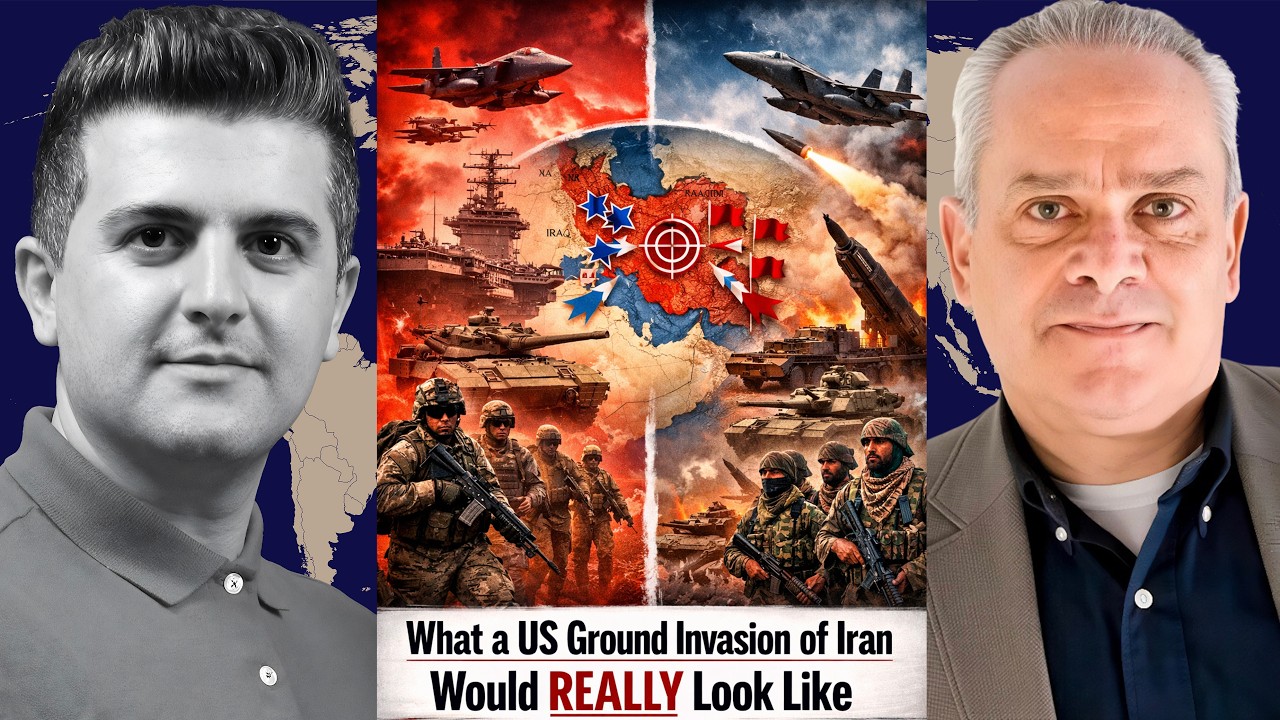
Col. Jacques Baud: What a US Ground Invasion of Iran Would REALLY Look Like
"Colonel Jacques Baud dissects the strategic futility of a US ground invasion of Iran, arguing that current troop levels are insufficient and such an action would backfire, exposing US allies and potentially leading to Iran's nuclearization."

🚨 TOTAL F*CKING CHECKMATE 😂😂😂
"The host argues that Trump's 'ceasefire' with Iran was a calculated '5D chess' move to orchestrate a global energy market reshuffle, while simultaneously lambasting 'woke' domestic policies and the 'freefall' of anti-Trump conservative figures."