Trump’s Lawless Global Power Grab BACKFIRES as HE THREATENS Western ALLIANCE
YouTube · ly9rz1tQZk8
Quick Read
Summary
Takeaways
- ❖The Trump administration's actions in Venezuela, including the abduction of Maduro, are characterized as 'lawless' and a global concern.
- ❖The US Supreme Court's grant of presidential immunity for 'official actions' contrasts sharply with the UK House of Lords' stance against immunity for international crimes like torture.
- ❖Stephen Miller's 'iron laws of the world' doctrine (strength, force, power) is seen as a return to 19th-century 'gunboat diplomacy' and echoes Hitlerian rhetoric.
- ❖The Monroe Doctrine, originally an anti-imperialist defense, is being distorted into an offensive justification for American imperialism in the Western Hemisphere.
- ❖European leaders, including Denmark's Prime Minister, warn that any US attempt to seize Greenland would lead to the end of NATO.
- ❖The UK and other European allies are experiencing profound anxiety and questioning the US's reliability and value system, with some even debating if China poses a lesser threat.
- ❖The upcoming trial of Maduro faces significant legal challenges, including arguments over immunity, illegal abduction, and the potential exposure of classified intelligence.
Insights
1Trump's 'Lawless' Foreign Policy and Global Implications
The Trump administration's actions, particularly in Venezuela, are described as a continuation of domestic 'lawlessness' onto the international stage. The guest, Philipe Sans, highlights that this approach, including the abduction of Maduro, signals a disregard for international law and sovereignty, creating a worldwide concern for the global order.
Sean Vent states, 'the key is the lawlessness, right? I mean, the attempt to overthrow the government... that this regime has no respect whatsoever for any law, domestic or foreign or international.' ()
2Repudiation of the Atlantic Charter and Rules-Based Order
The hosts and guest assert that the Trump administration's 'might makes right' philosophy, as articulated by Stephen Miller, directly repudiates the Atlantic Charter of 1941. This charter, signed by Roosevelt and Churchill, established the post-WWII rules-based international system founded on no use of force, respect for rights, and economic liberalization. Its perceived 'shredding' marks an end to 75 years of global order.
Philipe Sans states, 'It seems that President Trump has now confirmed and the recent national security strategy made it very very clear that piece of paper has been shredded.' ()
3Greenland as a NATO Flashpoint
The Trump administration's interest in acquiring Greenland is viewed as a serious threat to the NATO alliance. European leaders, including the Danish Prime Minister, have explicitly stated that any US military action or attempt to seize Greenland would signify the end of NATO. This scenario has caused significant anxiety among European allies, forcing them to question the US's commitment to collective defense and its own value system.
Philipe Sans reports, 'the British Prime Minister Kristama did not condemn in terms what had happened in Venezuela, but made it very clear he stands four square behind the Danish prime minister who said yesterday that if anything happens with Greenland, it is the end of the North Atlantic Treaty Organization.' ()
4Challenges and Implications of the Maduro Trial
The trial of Nicolas Maduro in a US court is predicted to be a complex legal and political spectacle. Key challenges include Maduro's likely claim of head-of-state immunity and arguments that his abduction was illegal, potentially invalidating US jurisdiction. The US courts' historical tendency to 'turn a blind eye' to illegal rendition contrasts with European practices. Furthermore, the prosecution's reliance on classified intelligence could raise issues regarding evidence disclosure and witness protection, making the trial's outcome and broader implications for Venezuela's governance highly uncertain.
Philipe Sans outlines, 'He's going to claim he's got immunity. He's going to say, 'I am the serving president of Venezuela... or I was abducted as serving president and therefore the abduction is manifestally illegal.' So, that issue is going to come up.' ()
Bottom Line
The US's 'might makes right' approach could inadvertently legitimize similar actions against its own leaders by other nations.
If the US justifies abducting a foreign leader based on an indictment, it sets a precedent that other countries could use to justify abducting or indicting US officials, including a former president, for alleged international crimes.
This creates an urgent need for international legal scholars and diplomats to reinforce and clarify international norms regarding sovereignty and immunity to prevent a global 'recipe for complete disaster' where any nation can unilaterally seize leaders.
The current US foreign policy is driving a re-evaluation of alliances and global trust, potentially pushing traditional allies towards non-Western powers.
The anxiety among European allies, particularly the UK, over US actions like the Greenland claim, is leading to unprecedented debates about whether China might be a more reliable partner than the United States in upholding a rules-based system. This fundamentally shifts geopolitical alignments.
For non-Western powers, this presents an opportunity to position themselves as champions of international law and multilateralism, potentially gaining influence and forging new alliances with disaffected Western nations.
Key Concepts
Gunboat Diplomacy
A foreign policy pursued by a nation in which it threatens to use force or demonstrates its military power to achieve its objectives, often without regard for international law or sovereignty. The hosts and guest argue Stephen Miller's 'iron laws of the world' doctrine aligns with this concept.
Lessons
- Monitor international legal developments, particularly the Maduro trial, to understand evolving interpretations of state sovereignty, immunity, and jurisdiction in an era of geopolitical flux.
- Engage with allied nations and bipartisan US leadership to reinforce the importance of the rules-based international order and prevent further erosion of trust and alliances.
- Analyze the motivations behind US foreign policy actions, distinguishing between stated law enforcement objectives and potential geopolitical or resource control ambitions, as these distinctions have significant international legal and political ramifications.
Notable Moments
The hosts and guest discuss the US Supreme Court granting Trump 'extraordinary presidential immunity as a de facto dictator for so-called official actions,' contrasting it with the UK's House of Lords' stance on immunity for international crimes.
This highlights a fundamental divergence in legal interpretations of executive immunity between key Western democracies, with profound implications for accountability in international law and the perception of US adherence to global norms.
Philipe Sans describes a 'sense of anxiety' in London, stating that Europeans are confronting the 'actual possibility that the United States could by force take control of a part of the territory that is within the NATO alliance.'
This conveys the profound shock and concern among long-standing US allies, indicating a severe erosion of trust and a re-evaluation of the US's role as a reliable partner and upholder of democratic values.
Quotes
"We live in a world in the real world that is governed by strength, that is governed by force, that is governed by power. These are the iron laws of the world since the beginning of time."
"This is a complete repudiation not only of American foreign policy but of American principles going back 250 years to our founding... it's eerily eerily reminiscent of what we were hearing coming out of Nazi Germany in the in the late 1930s."
"We now confront for the first time that I can ever remember, never happened before, a debate amongst reasonable people in the United Kingdom... asking the question in the future which country poses a greater threat to our value system? Is it China or is it the United States?"
Q&A
Recent Questions
Related Episodes

Col. Jacques Baud: The World Is Entering a Lawless Era
"Colonel Jacques Baud details his personal experience with arbitrary EU sanctions and argues that the world has shifted from a law-based international order to a dangerous, rules-based system dictated by powerful actors, exemplified by US actions in Venezuela and the EU's 'teenager decision-making'."

Patrick Henningsen: Hezbollah JUST Fired Back at Israel - Iran Vows to “Crush” All Attacks
"Patrick Henningsen argues that the US and Israel initiated an illegal war against Iran, driven by Trump's incompetence and Israeli influence, leading to an inevitable escalation with severe global economic repercussions."
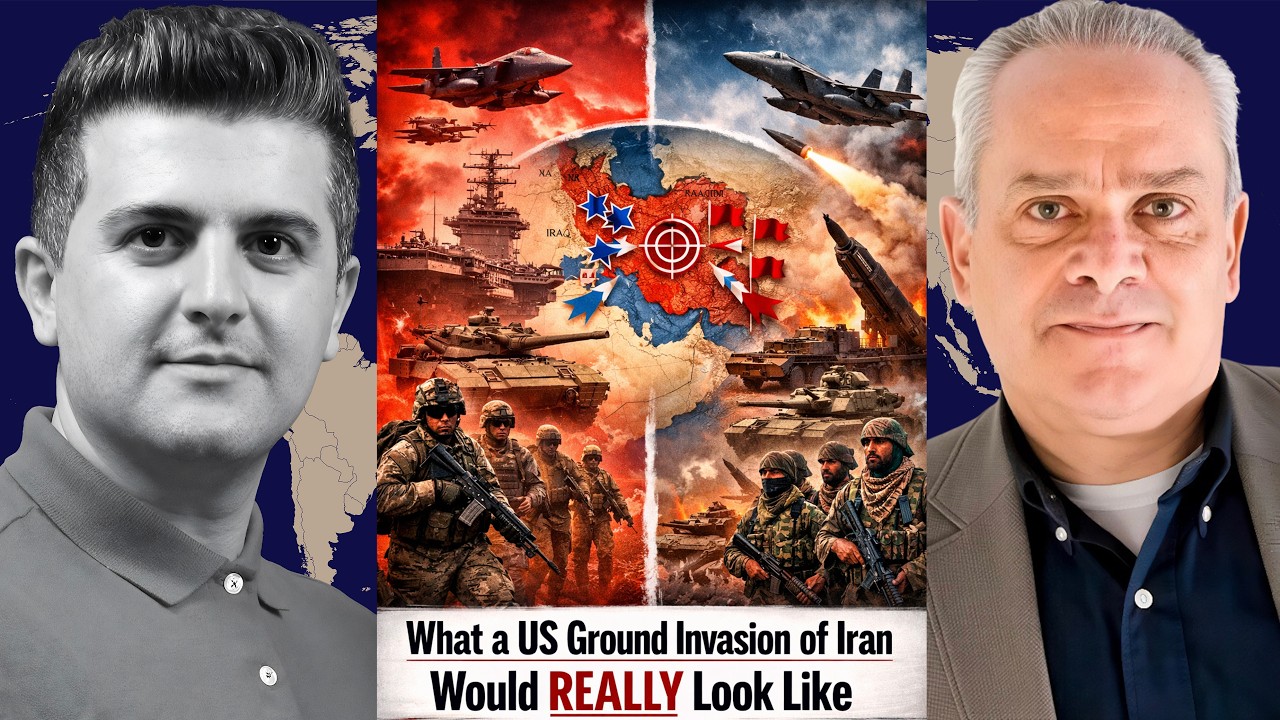
Col. Jacques Baud: What a US Ground Invasion of Iran Would REALLY Look Like
"Colonel Jacques Baud dissects the strategic futility of a US ground invasion of Iran, arguing that current troop levels are insufficient and such an action would backfire, exposing US allies and potentially leading to Iran's nuclearization."

BREAKING: Iran Threatens To END Talks; U.S. Vows Retaliation; Hezbollah Collapsing? | TBN Israel
"Iran is leveraging Hezbollah and the Strait of Hormuz to manipulate US negotiations, while Israel asserts its right to dismantle Hezbollah's eroding but still dangerous infrastructure in Lebanon, independent of international talks."