Trump Is Getting a TERRIBLE Deal (w/ Ben Rhodes) | The Bulwark Podcast
YouTube · p3CxAplWW-s
Quick Read
Summary
Takeaways
- ❖Trump's 'war' on Iran, initiated after abandoning the JCPOA, killed thousands, cost billions, and ironically advanced Iran's nuclear program.
- ❖The JCPOA imposed strict, internationally-backed limitations on Iran's nuclear program, including shipping out 98% of enriched uranium and destroying plutonium reactor cores.
- ❖Trump's current proposed deal, if finalized, would likely see Iran ship out its uranium but maintain its nuclear program and ballistic missile capabilities, while receiving substantial unfrozen assets.
- ❖Unlike the JCPOA, Trump's deal lacks international legitimacy, UN Security Council backing, and comprehensive monitoring, making it less stable.
- ❖The war strengthened the Iranian regime by demonstrating its deterrent capability (e.g., shutting down the Strait of Hormuz with drones) and providing an influx of cash.
- ❖Right-wing hawks who fiercely opposed the JCPOA are expected to rationalize Trump's inferior deal, highlighting political hypocrisy.
- ❖Trump's policies alienated European allies, who bore the economic brunt of the Iran conflict and now view the US as an unreliable partner.
- ❖Obama's Cuba normalization policy aimed to empower Cubans and foster economic change, while Trump's reversal led to severe humanitarian suffering and entrenched the Communist Party.
- ❖The debate over American identity, exemplified by JD Vance's 'blood and soil' rhetoric, challenges the foundational creedal principles of the nation.
- ❖The US needs a 'detox and cleanse' at home to restore its moral authority and effectively promote freedom globally, rather than relying on military intervention.
Insights
1Trump's Iran Deal: A Costly Re-negotiation of His Own Failure
Donald Trump's proposed Iran deal is not a victory but a re-negotiation of a crisis he created by unilaterally withdrawing from the JCPOA in 2018. This withdrawal led to Iran advancing its nuclear program, accumulating more enriched uranium, and utilizing more advanced centrifuges—all things the JCPOA had prevented. The current deal, if it materializes, would achieve less than the original JCPOA at the cost of a destructive war, thousands of lives, and hundreds of billions of dollars.
Ben Rhodes details how the JCPOA required Iran to ship out 98% of enriched uranium, destroy its plutonium reactor core, and accept strict IAEA monitoring (-). He contrasts this with Trump's withdrawal, which caused Iran to restart these activities (-). The current deal is expected to involve Iran shipping out its stockpile and limiting enrichment for a period but lacks the comprehensive, internationally-backed framework of the JCPOA (-).
2Unintended Consequences: War Strengthened Iranian Regime and Alienated Allies
The 'war' on Iran, initiated by Trump's policies, paradoxically strengthened the Iranian regime and its capabilities while decimating US international relationships. Iran demonstrated its ability to disrupt the global economy by closing the Strait of Hormuz with drones, gaining significant deterrence and leverage. Furthermore, the US's unilateral actions and subsequent insults alienated European allies, who bore the economic brunt of the conflict (e.g., gas shortages) and now view the US as an unreliable partner.
Rhodes explains that the regime will reinvest unfrozen assets into military capabilities, including ballistic missiles and drones, which proved highly effective in shutting down the Gulf (-). He notes that European citizens signed petitions to terminate trade agreements with Israel, and leaders like Italy's Georgia Maloney canceled defense agreements, indicating widespread alienation (-).
3American Identity Debate: Creed vs. Bloodline
The podcast highlights a fundamental debate about American identity, exemplified by JD Vance's 'blood and soil' rhetoric. Vance argues that American identity is not purely based on creedal principles like the Declaration of Independence but on ancestry and a 'particular place' or 'people.' This perspective is framed as a radical, un-American notion that rejects the country's historical evolution and inclusive ideals, prioritizing bloodline over shared values and the ongoing 'experiment' of expanding rights.
JD Vance's speech at the Claremont Institute is quoted, where he states that identifying America solely with principles like the Declaration of Independence is 'overinclusive' () and that people whose ancestors fought in the Civil War have 'a hell of a lot more claim over America' (). Rhodes counters that America is not a 'particular place' or 'people' and that Vance's stance is a 'most retrograde version' of the argument (-).
Bottom Line
The 'madman theory' of foreign policy, where a leader acts unpredictably to gain leverage, has a limited shelf life. World leaders eventually recognize when such a leader consistently backs down, eroding the fear factor and enabling them to defy the US.
This suggests that short-term unpredictable behavior can yield initial compliance, but long-term consistency and reliability are crucial for maintaining international influence and respect. Leaders who frequently 'back down' eventually lose their leverage.
For future US administrations, rebuilding trust and demonstrating consistent, principled foreign policy could be a powerful tool to regain international standing and cooperation, as the 'fear factor' approach has proven unsustainable.
The US's 'war on terror' infrastructure, built over two decades, has become a tool that can be easily repurposed by authoritarian leaders, both domestically and abroad, leading to unintended consequences that undermine democratic values.
The existence of extensive surveillance, detention, and military intervention capabilities, even if created with good intentions, can be exploited. This implies that the 'tools' of state power are not neutral and their very existence can shape policy outcomes in undesirable ways.
A 'detox and cleanse' of this infrastructure, both domestically (e.g., DHS) and abroad (e.g., military bases), could free up resources and reduce the temptation for intervention, allowing the US to focus on internal strengthening and moral leadership, which may be more effective for global freedom.
Key Concepts
War on Terror Framework
The idea that US foreign policy, particularly in the Middle East, has been unduly shaped by a post-9/11 'war on terror' mentality, leading to expansive military infrastructure and interventions that often yield unintended, negative consequences, such as strengthening adversaries or destabilizing regions.
Madman Theory
A foreign policy strategy where a leader attempts to make their adversaries believe they are irrational and volatile, thereby making them more cautious in dealing with the leader. The podcast suggests this theory initially worked for Trump but eventually failed as world leaders observed him backing down.
Creedal Nation vs. Blood and Soil Nationalism
A fundamental debate about American identity: whether the nation is defined by its founding principles (e.g., Declaration of Independence, equality, liberty) that anyone can subscribe to (creedal nation) or by ancestry, ethnicity, and a particular way of life (blood and soil nationalism).
Lessons
- Critically evaluate foreign policy decisions by comparing their outcomes to previous agreements, considering both immediate gains and long-term strategic costs.
- Recognize that military interventions, even if seemingly successful in the short term, can inadvertently strengthen adversaries and destabilize regions, leading to prolonged blowback.
- Challenge rhetoric that defines national identity based on ancestry or 'blood and soil,' and advocate for an inclusive, creedal understanding of national belonging.
- Support political leaders who prioritize dismantling 'war on terror' infrastructure and focus on domestic issues like corruption, as internal strength can project more moral authority globally than military might.
- Be aware of the political hypocrisy where certain groups may rationalize the same policies they previously condemned, depending on who is in power.
Quotes
"Donald Trump launched a war thinking that there would be quick and easy regime change. None of that happened. He killed thousands of people with this war. He spent hundreds of billions of dollars. He probably wiped out, you know, trillions of dollars in price increases."
"The geniuses... in not just the Trump administration but at the FDDD and these other hawkish places got what they wanted which is a much faster acceleration of the Iran nuclear program than would have been the case under the JCPOA."
"We've strengthened the back like if you're unh if you don't like the mullas like we've strengthened them throughout this process."
"Was it worth what has been done to Israel's position in this country and around the world? Was it worth the blowback? because I can guess that people in Gaza and Lebanon and Iran are not going to forget what happened and are going to be seeking revenge for a very long time. You know, was was any of this was it was this all worth it? I would argue it wasn't."
"If you told Ronald Reagan that you that the Republican party would be led by some smarmy guy like JD Vance [expletive] on immigrants when he's giving Ronald Reagan's one of his most beautiful speeches... his last speech was about if if we had to build walls around this country, we'd have doors in them so the people could come through."
Q&A
Recent Questions
Related Episodes

Patrick Henningsen: Hezbollah JUST Fired Back at Israel - Iran Vows to “Crush” All Attacks
"Patrick Henningsen argues that the US and Israel initiated an illegal war against Iran, driven by Trump's incompetence and Israeli influence, leading to an inevitable escalation with severe global economic repercussions."

Will Venezuela Be Trump's Vietnam?
"An expert breaks down three perilous pathways for Venezuela under potential US intervention, from a 'Panamanian model' to a 'Libyan-style civil war,' and the broader geopolitical fallout for Latin America."
BREAKING: Protests ERUPT In Iran Over IRGC Surrendering To Trump - Infighting Clashes In Tehran
"Iran is experiencing severe internal infighting and protests as hardline IRGC elements clash with government figures over a perceived 'surrender' to the US, while mainstream Western media misrepresents the situation."
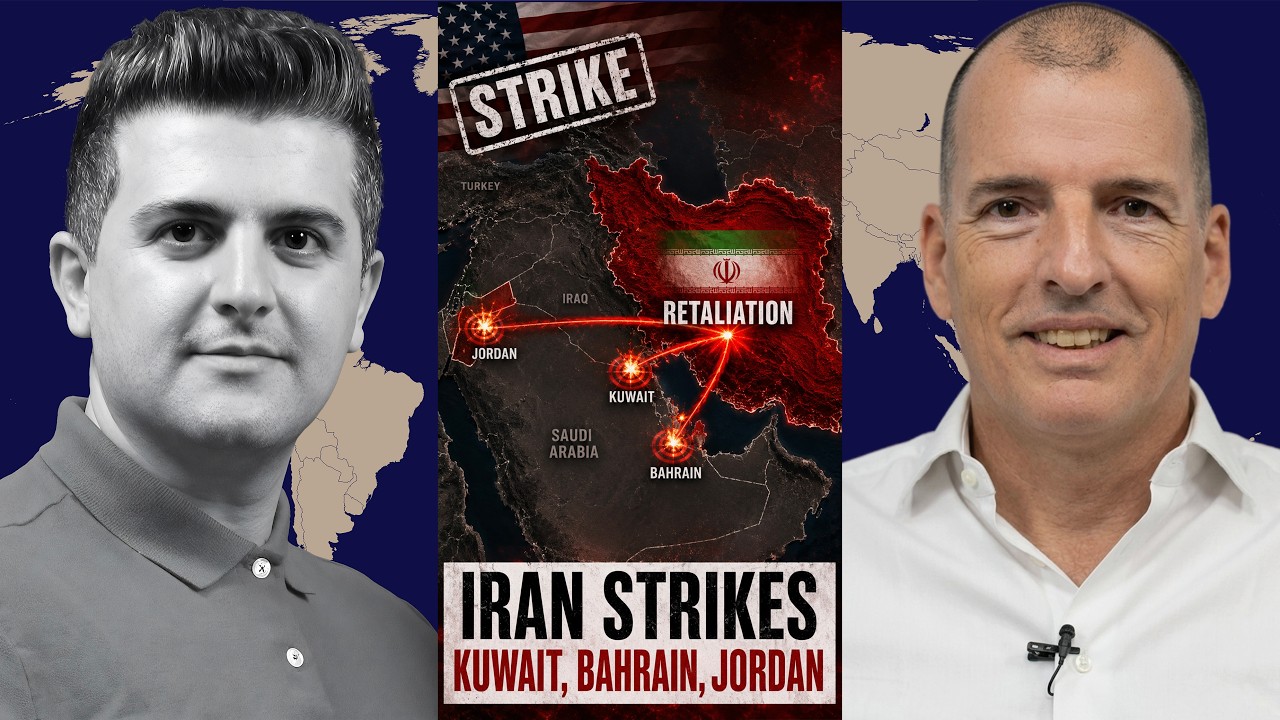
Alex Krainer: US STRIKES Iran – Iran RETALIATES Against Kuwait, Bahrain & Jordan!
"Amidst escalating US-Iran conflict and Iranian retaliation against regional US allies, this episode argues that US foreign policy is deeply controlled by an 'Anglo-Zionist conspiracy' led by the Rothschild banking dynasty, prioritizing Israeli interests over American ones."